Ronnie Sox
Everybody Had Four Speeds. Nobody Shifted One Quite Like Ronnie Sox.
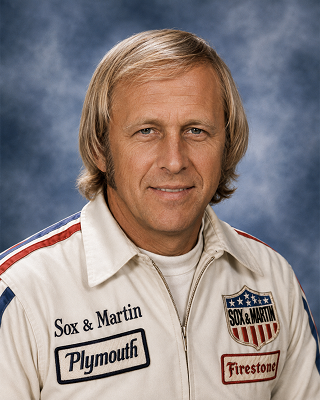
There was no button to push. No air shifter, no computer deciding when the next gear should arrive and no transmission designed to make a mediocre shift look respectable.
Four-speed factory drag racing required the driver to leave the starting line, keep the engine where it wanted to run, work the clutch and put the lever into the next gear without asking the tires, driveline or tachometer for permission.
Everybody near the front could do it.
Ronnie Sox could do it better.
Sox became so good at manually shifted factory cars that his gear changes became part of the legend. The red, white and blue Sox & Martin Plymouths had Hemi horsepower, excellent preparation and one of the best-run teams in drag racing.
They also had Ronnie Sox behind the four-speed. For a few remarkable years, that was an engineering advantage nobody could bolt onto another car.
Buddy Martin Found the Driver by Losing to Him
Ronnie Sox was born in 1938 and grew up in Burlington, North Carolina, where his family operated a Sinclair service station. Cars were not something he discovered later in life. They were already sitting around the family business waiting to be taken apart, adjusted and driven harder than their manufacturers had intended.
By the late 1950s Sox was racing seriously around the Carolinas, and one of the people who kept running into him was Buddy Martin.
Martin had good equipment. Sox kept beating him.
There are several ways to respond when another racer repeatedly proves faster. Buy more parts. Complain about the rules. Find a different track.
Martin chose the more useful answer.
He hired Sox to drive his car, and that decision created Sox & Martin, one of the most recognizable partnerships in American drag racing.
The Partnership Started With Chevrolet
The early Sox & Martin machinery was Chevrolet. In 1963 they campaigned a lightweight Z-11 Impala with Chevrolet’s 427-cubic-inch big-block and quickly established that the new partnership had been a sensible arrangement.
Then General Motors announced its official withdrawal from organized racing support. Detroit’s manufacturers frequently discovered during the 1960s that they were absolutely not racing right up until the moment somebody in another manufacturer’s car started winning.
For 1964 Sox & Martin moved to Mercury and a factory-backed A/FX Comet. The combination was formidable: Sox won Stock Eliminator at the Winternationals, and the team piled up victories on the match-race circuit.
The car was good. The fellow shifting it was better than most.
Then Plymouth Handed Them a Hemi
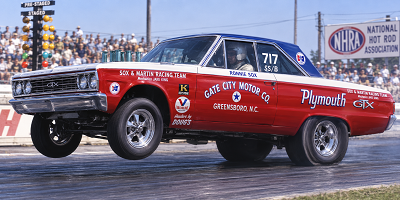
For 1965 Sox & Martin moved again, this time to Plymouth.
That was the combination people remember.
Their altered-wheelbase Plymouth joined the strange collection of factory experimental cars that were becoming shorter in front, longer in back and increasingly uninterested in the original location of the axles. The movement helped create what racers soon started calling Funny Cars.
Sox drove one of them very well, which surprised nobody who had watched him work a clutch. But when drag racing began splitting between increasingly radical Funny Cars and more recognizable factory-based machines, Sox & Martin ultimately chose the latter path.
They liked doors, carburetors and cars that still looked enough like something in a dealership window for a manufacturer to point at the racetrack and sell another one Monday morning.
That decision put them directly on the road toward Pro Stock.
The Red, White and Blue Cars Became a Business
Sox & Martin did more than win races. They looked like a professional race team before professional presentation became compulsory.
The Plymouths wore crisp red, white and blue paint. The equipment was well prepared. The transporters and support operation looked organized. Ronnie Sox and Buddy Martin could appear at a Plymouth dealership, conduct a performance clinic and explain why the machinery worked.
That was useful to Chrysler. Factory drag racing existed partly because Detroit wanted young customers standing around dealerships thinking about horsepower, and Sox & Martin supplied a racing operation that could win on Saturday and sell the story during the week.
They were racers, match-race attractions and traveling representatives for the muscle-car wars.
They were also extremely difficult to beat.
Super Stock Was Running Out of Room for Them
By the late 1960s Sox & Martin were racing the 426 Hemi in heads-up competition whenever the rules allowed it. The problem was that NHRA’s Super Stock structure still relied heavily on classifications and handicap starts.
Sox, Martin, Bill Jenkins, Dick Landy, Don Nicholson and other leading factory racers had already demonstrated what spectators wanted to see.
Two recognizable factory hot rods. Leave together. First one to the finish wins.
No arithmetic required.
The racers pushed for a national heads-up category built around that idea. For 1970, NHRA gave it to them.
Pro Stock.
Pro Stock Started With Sox on the Pole
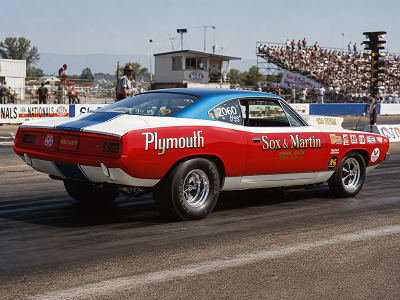
More than forty cars entered the first NHRA Pro Stock race at the 1970 Winternationals. Sox put the new Sox & Martin Barracuda at the top of the qualifying sheet.
Then Bill “Grumpy” Jenkins beat him in the final.
The same thing happened at the Gatornationals. Two races into the new category, Jenkins had both trophies and Sox had both runner-up checks.
That situation did not last.
Sox won the Springnationals, then took the World Finals and secured the 1970 Pro Stock world championship. He also won the season-ending Supernationals.
The new category needed only a few races to establish its first great rivalry. Grumpy had the Chevrolet. Sox had the Hemi. The spectators had stopped worrying about handicap starts.
Then 1971 Became Ridiculous
If 1970 established Sox as the man to beat, 1971 removed most of the doubt. He opened the NHRA season by winning the Winternationals, Gatornationals and Springnationals — the first three races on the schedule.
He eventually won six of the eight national events held that year.
Six of eight ought to settle a championship rather efficiently.
It did not.
NHRA’s championship procedure still placed enormous importance on the World Finals. Sox lost in the semifinals there, and Mike Fons took the title despite Sox having spent most of the year treating the national-event schedule like a Sox & Martin appearance tour.
The trophy system could say what it wanted. Everybody who had been in the other lane knew which car had dominated 1971.
The Four-Speed Was Part of the Horsepower
Ronnie Sox’s reputation cannot be explained by the Hemi alone. Plenty of racers had Hemis.
What separated Sox was what happened between gears.
A manual transmission creates a brief problem several times during every pass. The engine is accelerating hard, the driveline is loaded and the driver has to remove one gear and engage another without losing more time than necessary or upsetting the car.
Miss the gear and the race is probably over. Shift too slowly and the other lane gets several feet for free.
Sox developed the coordination to work the clutch and lever with remarkable speed and consistency. His shifts were not merely quick; they were repeatable enough that the rest of the car could be tuned around them.
That is the important part. A driver who does the same thing every run gives the engine builder and chassis tuner useful information. A driver who changes the shift every pass moves the problem around.
Sox was not just operating the transmission.
He was part of the combination.
Then the Transmission Took Some of the Advantage Away
Pro Stock never stays still for long. By 1972 NHRA changed the weight rules to reduce the advantage enjoyed by the Hemi cars, and Bill Jenkins responded with his lightweight small-block Vega and changed the competitive equation immediately.
Then another change arrived. The multi-speed planetary transmissions that became common in Pro Stock reduced the amount of traditional clutch-and-H-pattern shifting required from the driver.
The new equipment was quicker and more consistent. It also made one of Ronnie Sox’s greatest advantages less valuable.
That is not an argument against technological progress. Racers are supposed to use the quicker answer. It is simply one reason Sox belongs so firmly to a particular era.
When the transmission demanded exceptional hand-and-foot coordination, drag racing had one driver everybody measured against.
Sox & Martin Eventually Ran Out of Factory War
Changes in rules, manufacturer involvement and economics weakened the factory-backed racing environment that had made Sox & Martin famous, and the team’s major racing operation shut down in the mid-1970s.
Sox did not stop driving. He returned to competition at various times, including a runner-up finish at the 1979 NHRA Gatornationals and a strong period in IHRA Pro Stock. In 1981 he won the IHRA Pro Stock world championship.
Later came additional appearances in Pro Stock, Pro Modified and nostalgia racing. Sox and Martin even reunited for later projects, including a brief run when NHRA introduced Pro Stock Truck.
None of those later efforts recreated 1970 and 1971.
Very little in drag racing could.
The Bottom Line
Ronnie Sox died on April 22, 2006, at age 67 after battling prostate cancer. NHRA had already ranked him No. 15 among the greatest drivers of its first fifty years, and he and Buddy Martin were inducted together into the Motorsports Hall of Fame of America in 2007.
The statistics are substantial: six NHRA national-event wins in Super Stock before Pro Stock arrived, nine more in Pro Stock during 1970 and 1971, a 1970 NHRA Pro Stock championship and six wins in eight races during the extraordinary 1971 season.
But Ronnie Sox’s reputation has always rested on something harder to put into a results table.
There was a period when the transmission still asked the driver a serious question three times during every run: get the clutch right, find the next gear and do it fast enough that the Hemi never stops pulling.
Everybody in Pro Stock had four gears. Ronnie Sox made the shifts look like horsepower.
Sox spent enough time around factory drag racing, rulebook games and Detroit’s increasingly creative ideas about “stock” to earn more than one appearance in Racing Shenanigans.
➤ See the Altered Wheelbase story in Racing Shenanigans
↑ Back to the Top, Before Ronnie Grabs the Next Gear