
Tony Schumacher
When Top Fuel Left Only One Run That Would Work, He Had a Habit of Making It.
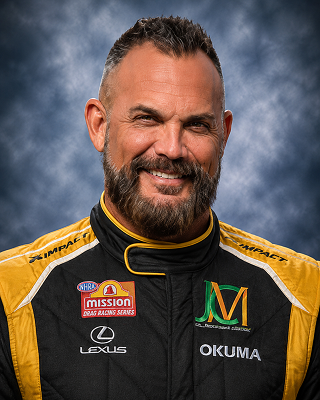
Tony Schumacher won more NHRA Top Fuel races than anybody else. He won eight championships, including six in a row, and he treated Indianapolis like a place where the trophy already knew his mailing address.
Those are the statistics. They are also the easy part.
The harder part is explaining why one particular Schumacher pass still gets referred to simply as The Run, and why that one pass tells you more about him than a stack of record books does.
Top Fuel has seen plenty of fast people. Schumacher’s specialty was something a little nastier. Give him a situation where the math had become insulting, the pressure had become unreasonable and only one specific run would save the season, and he kept finding a way to make that run anyway.
As of 2026, the totals stood at 88 NHRA Top Fuel victories, eight championships, 88 No. 1 qualifying positions and 10 U.S. Nationals victories.
Tony Schumacher built the largest record in Top Fuel history. The remarkable part is how often he did it with the sport already telling him the margin for error had been canceled.
The Last Name Already Came With Nitro on It
Tony Schumacher was born in Chicago in 1969. His father, Don Schumacher, had already been one of the major Funny Car stars of the early 1970s before stepping out of the car and building a successful business.
That gave Tony access. It did not give him a Top Fuel championship.
He worked through the Sportsman ranks, spent time in a Top Alcohol Funny Car and learned the ordinary lesson every second-generation racer eventually learns: the family name may get you introduced, but once the car leaves the starting line the timing system becomes wonderfully indifferent.
His First Indy Trip Was Supposed to Be Educational
Schumacher qualified for his first NHRA U.S. Nationals in 1996 driving for the Peek brothers. He got into the field on the bump spot, which generally means a driver is expected to appreciate the scenery and maybe survive a round if the other fellow gets careless.
Instead, Schumacher kept advancing.
His first-round opponent was supposed to be Blaine Johnson, who had been killed in a qualifying accident the previous day. Schumacher made a respectful solo run, then won enough rounds to reach the final of the biggest drag race in the country before losing to Cory McClenathan.
That looked like an arrival. It was also the beginning of a fairly annoying pattern: Schumacher reached eight final rounds before he finally won one.
The fellow could get close. Top Fuel then spent a while teaching him the difference between close and finished.
The First Win Brought a Championship With It
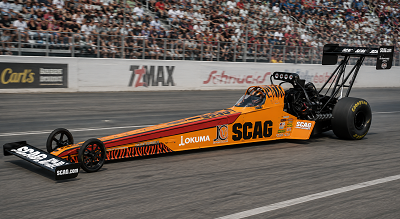
By 1999, Don Schumacher had helped put together a serious Top Fuel operation and tuner Dan Olson was handling the combination. Early that year at Phoenix, Tony ran 330.23 mph, becoming the first driver to exceed 330 mph in quarter-mile Top Fuel competition.
So speed was not the question. Winning still was.
After all those runner-up finishes, Schumacher finally broke through at Texas Motorplex in October 1999, defeating Scott Kalitta in the final.
Win number one.
It was his only national-event victory that season. He still accumulated enough points to win the 1999 NHRA Top Fuel championship.
One win and one world title is a strange ratio. Schumacher spent the next couple of decades correcting it rather aggressively.
The Army Car Became the Uniform
The U.S. Army became Schumacher’s sponsor in 2000, beginning one of the most recognizable long-term partnerships drag racing has ever had. The black-and-gold dragster became instantly identifiable, and the nickname The Sarge fit well enough that nobody had to force it.
That same first Army season also produced his first U.S. Nationals victory. There would be nine more, because moderation never seemed to interest him much at Indianapolis.
Through the early 2000s Schumacher kept winning races, but the championships did not fall every season. Larry Dixon, Kenny Bernstein and the rest of the grown-ups had not left the class unattended.
Then Alan Johnson joined the team.
Alan Johnson Turned a Strong Team Into a Problem
Johnson arrived during 2003 with the kind of tuning reputation that makes rival teams start asking uncomfortable questions about what the next few years are going to look like.
The answer came quickly. In 2004, Schumacher won 10 of 23 events, becoming the first Top Fuel driver to reach double-digit victories in a season.
The championship was not especially mysterious. He won again in 2005.
Then in 2006, the season stopped being a march and became a math problem ugly enough to deserve a separate heading.
In 2006, Winning the Race Was Still Not Enough
Doug Kalitta entered the final race of the 2006 season at Pomona in position to win the Top Fuel championship. Schumacher still had a chance, but by the time the final round arrived the requirements had become almost comically precise.
He had to win the race, and that alone would not do it. He also had to set the NHRA national elapsed-time record because the record carried twenty bonus points.
The existing record was 4.437 seconds. A victory without the record still left the championship with Kalitta.
Win the final and run the national record, or Doug Kalitta was champion.
That is not a strategy. That is extortion with time slips.
The Run
Schumacher staged against Melanie Troxel in the final round of the final race of the season. The Army dragster left, stayed planted and kept charging.
The scoreboard lit up: 4.428 seconds.
Schumacher had won the race, broken the national record by nine thousandths and collected the twenty bonus points required to win the 2006 Top Fuel championship.
It was the first time all season he had led the points.
There are dramatic championship finishes. Then there is needing the quickest legal pass in Top Fuel history at exactly the moment anything less gets you beaten.
Nobody needed to improve the title afterward.
The Run.
Then He Went Right Back to Winning Titles
A pass like that can become the whole story if the rest of the career is not careful. Schumacher was careful.
He came back in 2007 and won the championship again. Then, just to keep the point from becoming subtle, the 2008 Army team produced one of the most one-sided seasons the class had ever seen.
Schumacher won 15 of 24 events, reached 18 final rounds, won seven consecutive races and stacked up 31 straight round wins at one point. His season elimination record was 76-9.
At Charlotte, he earned career victory number 53 and passed Joe Amato to become the winningest Top Fuel driver in NHRA history. Then he won his fifth consecutive championship and sixth overall.
There are seasons when a racer beats the field. In 2008, Schumacher made the field look like something the promoter was required to provide for contrast.
Then Alan Johnson Went to Work for the Other Guy
After 2008, Alan Johnson left Don Schumacher Racing and went to the new Al-Anabi operation, where his Top Fuel driver was Larry Dixon. The tuner who had helped Schumacher build a dynasty was now standing beside the dragster most likely to break it.
Mike Green took over the Army car. If Schumacher wanted to prove all those championships were not simply a one-tuner miracle, 2009 supplied a fairly direct exam.
Two Points
Schumacher and Dixon reached the 2009 finale at Pomona fighting for the championship. Dixon had moved ahead during qualifying, so Schumacher needed a big run.
He produced a 3.772, grabbed the No. 1 qualifying position and collected enough bonus points to enter eliminations leading Dixon by two.
Both drivers then lost in the semifinals. The qualifying points remained.
Tony Schumacher: 2,571.
Larry Dixon: 2,569.
Two points.
Schumacher had won his sixth consecutive Top Fuel championship and seventh overall, this time with Mike Green tuning and Alan Johnson working from the other side.
So 2006 had not been some one-time miracle. When the equation turned ugly, Schumacher was still the fellow you least wanted lined up in the other lane.
Indianapolis Eventually Became His Other Address
The rookie who reached the U.S. Nationals final in his first appearance eventually won the race 10 times: 2000, 2002, 2003, 2004, 2006, 2007, 2008, 2009, 2012 and 2016.
In 2012, his ninth victory broke Don Garlits’ long-standing Top Fuel Indy record. In 2016 he came back and added number ten because nine looked unfinished.
Some racers are good at Indianapolis. Schumacher spent years treating the place like a recurring appointment.
The Eighth Championship Took Another Chase
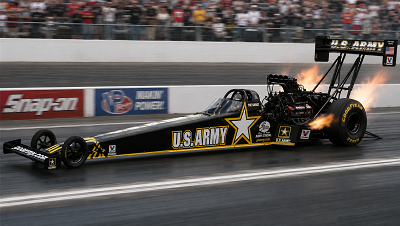
After 2009, Schumacher remained a contender but stopped ending every season with the trophy by simple force of habit. He came painfully close in 2012, finishing only seven points behind Antron Brown.
In 2014, he entered the Countdown fourth in points. Then he and Mike Green started winning when the points were at their most expensive.
Victories at Charlotte, Dallas and Reading pushed him to the front, and he never gave the lead back. The result was championship number eight.
No Top Fuel driver had won that many. None still has.
The Army Years Ended. He Wasn’t Done Yet
Schumacher continued in the Army car through 2018, finishing second in the championship in the partnership’s final season. When the sponsorship ended, so did full-time competition for a while.
He returned and won again at Seattle in 2022 after several years without a national-event victory. Two more wins followed in 2024, pushing the career total to 88.
He returned with Rick Ware Racing for selected races in 2025 and a full-time Top Fuel program in 2026.
The record book was already historic. The driver had not signed off on it being finished.
The Bottom Line
Tony Schumacher did not invent Top Fuel. He did not create the rear-engine dragster, discover nitromethane or pioneer the class the way the earlier giants had.
What he did was different. He took the modern professional Top Fuel operation and showed how relentlessly successful one driver could be inside it.
He won with Dan Olson. He dominated with Alan Johnson. He kept winning titles with Mike Green. He survived the end of the Army era and came back to add more wins after long stretches away.
Eight championships. Six in a row. Eighty-eight victories. Ten U.S. Nationals.
And when a championship once came down to a single pass that had to be both a race win and a national record, he ran 4.428 seconds.
Tony Schumacher’s record book is enormous. The simplest way to explain him is still the best one: when Top Fuel left only one run that would work, he had an irritating habit of making exactly that run.
↑ Back to the Top, Before Tony Decides the Arithmetic Still Looks Beatable