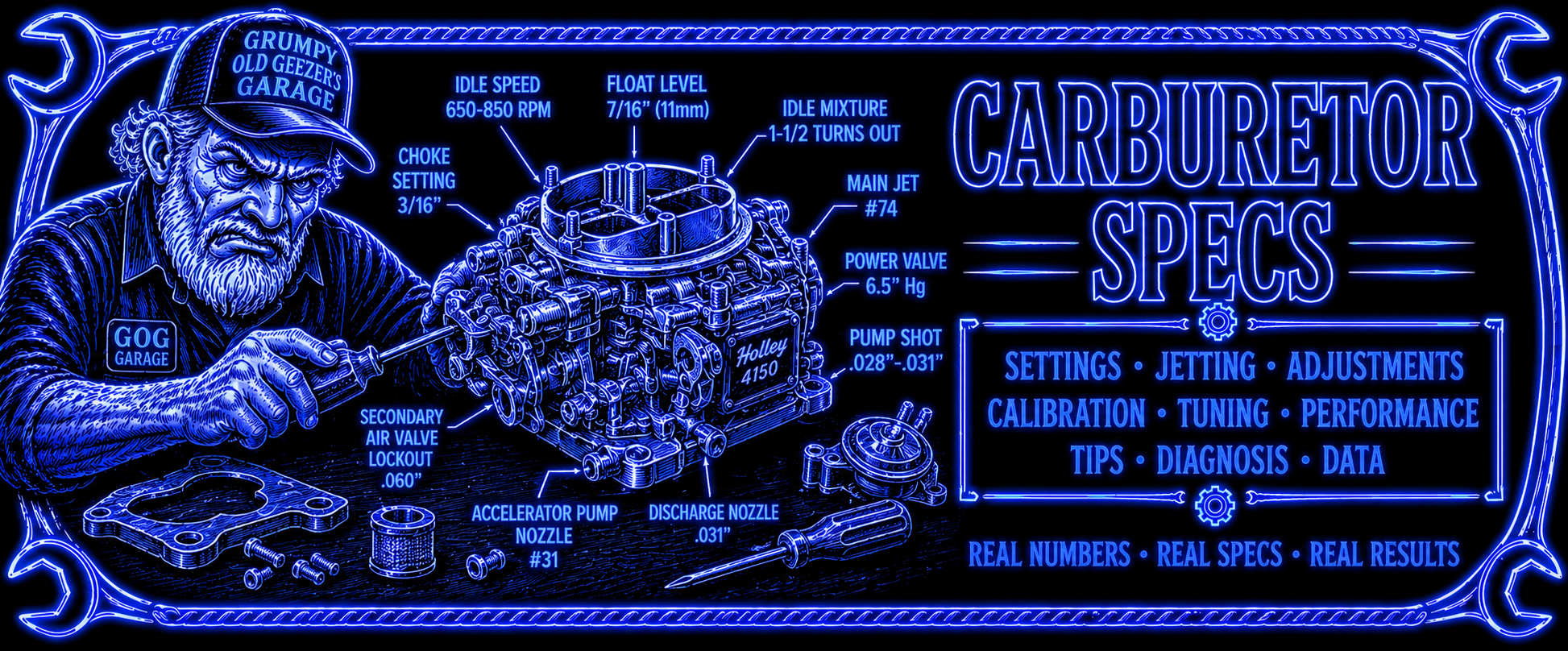
Autolite 1100 Carburetor Specs
On This Page:
Basics: Intro | Overview | What Makes This Carb Different? | General Specs
Details: Variants | Key Points
Warnings: Common Problems | Common Misconceptions | Compatibility Notes | Bottom Line
Related: Related Links

Intro
The Autolite 1100 is a single-barrel downdraft carburetor used heavily on Ford inline-six engines during the 1960s, especially 170 and 200 cubic-inch six-cylinder applications.
This was not a performance carburetor. It was built for economy cars, Falcons, Mustangs, Comets, small Ford sixes, and ordinary street use where clean starting, steady idle, fuel economy, and simple service mattered more than impressing anybody at a stoplight.
The 1100 earned its place because it was simple, compact, and matched to the engines Ford actually installed it on. It used one throttle bore, a fuel bowl, idle and main metering circuits, an accelerator pump, automatic choke hardware on most factory passenger-car applications, and several venturi and distributor-control variations.
The trouble starts when people treat every Autolite 1100 like the same carburetor. Early spark-control-valve versions were tied to Ford Load-O-Matic distributor behavior. Later non-SCV versions changed the vacuum-advance strategy. Venturi size changed by engine and year. Dashpot hardware appeared on some later units. That is a lot of ways for a simple carburetor to be made wrong by someone who thought “one barrel” meant “one size fits everything.”
Covers: Autolite 1100 single-barrel downdraft carburetors used on Ford inline-six applications, including early spark-control-valve versions, later non-SCV versions, and dashpot-equipped late-1960s versions.

Overview
The Autolite 1100 is a small one-barrel carburetor built around practical street use on Ford six-cylinder engines. It was never meant to turn a Falcon or six-cylinder Mustang into a tire-fryer. It was meant to start, idle, cruise, and keep a modest inline six fed without turning the engine bay into a weekly carburetor seminar.
The basic layout is straightforward. The upper body contains the fuel bowl, float, fuel inlet, main and idle fuel systems, power fuel system, bowl vent system, and fuel-metering hardware. The lower body handles the throttle bore, throttle plate, linkage, accelerator-pump action, and base connection to the intake.
The 1100’s main metering system uses airflow through the venturi to pull fuel through the main jet, main well, main well tube, high-speed bleed, and discharge nozzle. At idle and low speed, the idle system carries the load until airflow is strong enough to bring the main system in. The accelerator pump adds a shot of fuel when the throttle opens so the engine does not fall flat while the airflow catches up.
The part that gets people in trouble is not the basic one-barrel layout. It is the control hardware around it. Early 1100s could use a spark control valve that worked with Ford’s Load-O-Matic distributor system. Later versions eliminated that valve and expected a different distributor strategy. Some 1967-1969 versions used a second diaphragm as an anti-stall dashpot. Those details matter.
The 1100 is a good simple carburetor when it is clean, matched to the distributor, sized correctly, and adjusted properly. It becomes a miserable little box when it has the wrong venturi, wrong vacuum signal, wrong distributor, plugged passages, a bad accelerator pump, a warped top, or fuel pressure trying to drown it.
↑ Back to the Top, Before the Kickdown Rod Gets Bent

What Makes It Different
Compared with larger Autolite and Motorcraft carburetors, the 1100 is simple one-barrel hardware. It does not have a second throttle bore, annular discharge boosters like the 2100 and 4100 families, or the airflow capacity of later two- and four-barrel Ford carburetors.
Compared with the Autolite 1101, the 1100 is the smaller, more common economy six-cylinder carburetor. The 1101 belongs in the larger single-barrel conversation. The 1100 belongs on the smaller Ford sixes where signal quality, fuel economy, and simple drivability mattered more than trying to feed an engine that wanted more carburetor.
Compared with generic replacement one-barrels, the 1100’s distributor-vacuum behavior is where careless swaps get ugly. Early spark-control-valve 1100s were designed around Ford’s Load-O-Matic vacuum-advance system. Later non-SCV versions were not the same arrangement. Mix the wrong carburetor and distributor and the engine may run badly while the owner stands there blaming the idle screw like it owes him money.
Compared with performance carburetors, the 1100 is not trying to be exciting. That is not a defect. It is a small carburetor for small Ford six-cylinder engines. The problem is usually not that the 1100 failed to become a race part. The problem is that someone expected it to be one, or replaced it with something just as mismatched and shinier.
The 1100’s strength is ordinary low-speed street behavior when matched correctly. Its weakness is that its simple appearance tricks people into ignoring venturi size, spark-control-valve status, choke setup, dashpot hardware, and distributor compatibility. That is how a simple carburetor ends up looking complicated.
↑ Back to the Top, Before the Kickdown Rod Gets Bent

General Specs
| Type | 1-barrel downdraft carburetor | Bore Layout | Single bore |
| Venturi / CFM | 1.00 / 1.10 / 1.20 venturi | Mounting Pattern | Ford inline-six single-barrel flange |
| Primary Metering | Single main jet, main well tube, idle circuit, power fuel system, and accelerator pump | Secondary Metering | None |
| Secondary Type | None | Fuel Pressure | 4-5 PSI |
| Booster Style | Single-barrel booster venturi | Fuel Bowl | Integral fuel bowl |
| Fuel Feed | Single feed | Choke Types | Automatic choke on common Ford passenger-car applications |
| Main Material | Zinc alloy main body | Typical Uses | Ford 144, 170, and 200 inline-six economy and passenger-car applications |
The important 1100 split is venturi size and distributor-control hardware. A 1.00, 1.10, and 1.20 venturi 1100 may all be Autolite 1100s, but they do not feed the same engine the same way. A spark-control-valve carburetor also needs the correct distributor system. That is not optional trivia. That is how the timing works.
↑ Back to the Top, Before the Kickdown Rod Gets Bent

Variants
The useful Autolite 1100 split is not paint color, rebuild tag, or whatever somebody wrote on a parts-store box. The important splits are venturi size, spark-control-valve hardware, and late dashpot equipment.
Early SCV / Load-O-Matic-Compatible 1100
| Series | Autolite 1100 SCV | Venturi / CFM | 1.00 / 1.10 / 1.20 venturi |
| Secondary Type | None | Metering | Single main jet, idle circuit, main well tube, power fuel system, and accelerator pump |
| Booster Style | Single-barrel booster venturi | Fuel Bowl | Integral fuel bowl |
| Fuel Feed | Single feed | Choke Types | Automatic choke on common Ford passenger-car applications |
| Typical Applications | Early Ford inline-six applications using Load-O-Matic distributor control | Operating Character | One-barrel street operation with spark-control-valve vacuum behavior |
Version Notes: The early SCV 1100 works with Ford’s Load-O-Matic distributor system. Plugging the spark control valve, swapping the wrong distributor, or treating that little valve like a decorative wart is how people create timing problems and then blame the carburetor.
Late Non-SCV 1100
| Series | Autolite 1100 non-SCV | Venturi / CFM | 1.10 venturi |
| Secondary Type | None | Metering | Single main jet, idle circuit, main well tube, power fuel system, and accelerator pump |
| Booster Style | Single-barrel booster venturi | Fuel Bowl | Integral fuel bowl |
| Fuel Feed | Single feed | Choke Types | Automatic choke |
| Typical Applications | Late-1960s Ford inline-six applications after SCV removal | Operating Character | One-barrel street operation without Load-O-Matic spark-control-valve behavior |
Version Notes: Later non-SCV 1100s changed the distributor-vacuum relationship. These are not the same as early Load-O-Matic carburetors with the valve missing. If the carb and distributor do not agree about timing control, the engine gets to be the referee, and it usually complains.
Dashpot / Anti-Stall 1100 Versions
| Series | Autolite 1100 dashpot-equipped | Venturi / CFM | 1.10 / 1.20 venturi |
| Secondary Type | None | Metering | Single main jet, idle circuit, main well tube, power fuel system, and accelerator pump |
| Booster Style | Single-barrel booster venturi | Fuel Bowl | Integral fuel bowl |
| Fuel Feed | Single feed | Choke Types | Automatic choke |
| Typical Applications | Late-1960s Ford inline-six applications using anti-stall dashpot hardware | Operating Character | One-barrel operation with added throttle-control damping during deceleration |
Version Notes: Some later 1100s used a second diaphragm as an anti-stall dashpot. That second diaphragm is not a second accelerator pump. It holds the throttle open slightly during deceleration. Mistake that part and the carburetor will do exactly what you told it to do, not what you meant.
↑ Back to the Top, Before the Kickdown Rod Gets Bent

Key Points
- The Autolite 1100 is a one-barrel downdraft carburetor used heavily on Ford inline-six engines.
- The main useful splits are venturi size, spark-control-valve hardware, and dashpot hardware.
- Common venturi sizes include 1.00, 1.10, and 1.20.
- Early SCV versions were tied to Ford Load-O-Matic distributor behavior.
- Later non-SCV versions changed the distributor-vacuum strategy.
- Some 1967-1969 versions used a second diaphragm as an anti-stall dashpot.
- The 1100 is simple, but carburetor and distributor compatibility matter more than people want to admit.
- Wrong venturi size, wrong vacuum signal, plugged passages, and bad accelerator-pump operation can make a stock six-cylinder engine miserable.
- A good 1100 works fine on a stock Ford six. A mismatched one-barrel is still mismatched, even if it only has one barrel to be wrong with.
↑ Back to the Top, Before the Kickdown Rod Gets Bent

Common Problems
- SCV and distributor mismatch – Early spark-control-valve 1100s need the correct Load-O-Matic distributor setup. Mixing the wrong carburetor and distributor is how timing problems get dressed up as carburetor trouble.
- Plugged or bypassed spark control valve – The SCV is not a power valve and not a random fitting. Plug it, remove it, or misunderstand it and the distributor advance signal goes sideways.
- Wrong venturi size – A 1.00, 1.10, and 1.20 venturi 1100 do not feed the same engine the same way. Small Ford sixes care about signal and sizing. Bigger is not automatically smarter.
- Vent valve adjustment problems – The bowl vent system has linkage and adjustment requirements. If the vent rod or valve is wrong, fuel-bowl behavior can get ugly fast.
- Fuel leaking at the vent rod area – Flooding, bad float control, poor needle-and-seat sealing, or excess fuel pressure can send fuel out where it has no business being. That is not the carburetor “marking its territory.”
- Float level or float failure – Wrong float setting, a fuel-logged float, or a float that does not move freely can cause flooding, rich running, hard starts, and fuel leaking around the bowl area.
- Needle-and-seat sealing problems – Dirt, varnish, worn parts, bad seals, or debris from sloppy fuel-line work can keep the needle from seating and make the carburetor flood.
- Excess fuel pressure – The 1100 does not need a modern replacement pump trying to drown it. Too much pressure can overpower the needle and seat, flood the bowl, cause fuel leakage around the vent area, and make the carburetor look guilty when the pump is the bully.
- Accelerator-pump diaphragm or linkage problems – A weak diaphragm, stuck check ball, wrong pump cup, or misassembled linkage can kill the pump shot and make the engine fall on its face when the throttle opens.
- Main well or discharge restriction – Dirt in the main well, discharge nozzle, or check-ball area can leave fuel in the bowl while the engine still acts starved. The fuel has to reach the venturi. Sitting nearby does not count.
- Idle passage restriction – Varnish and old fuel can plug the small idle circuits. When that happens, mixture screws become decoration and the owner starts inventing theories.
- Automatic choke misadjustment – The choke system has to open at the right rate. Too rich, too lean, stuck linkage, or a lazy pull-off can make cold starts and warm-up manners miserable.
- Dashpot confusion – Late two-diaphragm versions used the added diaphragm as an anti-stall dashpot. Treating it like another accelerator pump is a good way to prove the carburetor knows more than the rebuilder.
- Warped air horn or bowl cover – Overtightened screws and old castings can distort the top section and create sealing problems. More screwdriver does not make a flat surface.
- Incorrect gasket or kit parts – Similar-looking 1100 parts and gaskets can still be wrong for the venturi size, SCV setup, dashpot arrangement, or fuel-bowl vent system.
- Cheap replacement-carb mismatch – A new replacement that bolts on may still have the wrong venturi, wrong vacuum signal, wrong choke linkage, or wrong distributor compatibility. Fresh plating does not make it correct.
Back to the Top, Before the Kickdown Rod Gets Bent

Common Misconceptions
- “All Autolite 1100s are the same.” No. Venturi size, spark-control-valve hardware, dashpot hardware, linkage, and calibration all matter.
- “The spark control valve is just emissions junk.” No. On early Load-O-Matic systems, it is part of the distributor-advance strategy.
- “You can plug the SCV and tune around it.” Not correctly. If the distributor system expects that signal, plugging it creates a timing problem, not a performance upgrade.
- “A bigger one-barrel always helps a Ford six.” Not if the engine loses signal, drivability, or distributor compatibility. Bigger can still be wrong.
- “A later non-SCV 1100 is the same as an early SCV carb with the valve missing.” No. The vacuum-advance strategy changed. Missing parts and different design are not the same thing.
- “The second diaphragm means two accelerator pumps.” No. On later versions, the second diaphragm is an anti-stall dashpot.
- “If fuel is in the bowl, the carburetor must be feeding the engine.” No. Pump circuit, main discharge, idle passages, check balls, and nozzles still have to move fuel where it belongs.
- “The 1100 is junk because it is small.” No. It is small because the engines were small. On a stock Ford six, correct beats impressive.
- “Any replacement 1100 will work.” No. Venturi size, SCV status, choke setup, dashpot hardware, linkage, and distributor compatibility still matter.
↑ Back to the Top, Before the Kickdown Rod Gets Bent

Compatibility Notes
Autolite 1100 compatibility starts with the engine, venturi size, and distributor system. A carburetor that bolts onto the log intake is not automatically the right carburetor.
Spark-control-valve versions must be matched to the correct Load-O-Matic distributor setup. Later non-SCV carburetors expect a different advance strategy. Mix those systems blindly and the engine may stumble, hesitate, run flat, or make the owner chase fuel problems that are really timing problems.
Venturi size matters. A 1.00, 1.10, and 1.20 venturi carburetor may share the 1100 family name, but they do not belong on every engine. Match the carburetor to the engine and original-style application before blaming the casting.
Dashpot-equipped versions need the correct linkage and diaphragm arrangement. The anti-stall dashpot is part of throttle behavior on those applications, not a spare pump hanging around for decoration.
Fuel pressure and fuel-level control matter. Many leak complaints are really float, needle-and-seat, fuel-pressure, gasket, or vent-system problems. A one-barrel carburetor can still flood like a drunk if the fuel system shoves too much at it.
Replacement carburetors should be checked for venturi size, SCV status, choke hardware, dashpot hardware, fuel inlet layout, throttle linkage, and vacuum-port behavior. “Fits Ford six” is not enough. That is a sales phrase, not a diagnosis.
↑ Back to the Top, Before the Kickdown Rod Gets Bent

Bottom Line
The Autolite 1100 is a simple, useful one-barrel carburetor for Ford inline-six engines. It was built for street manners, economy, cold starts, and ordinary driving.
The catch is that the 1100 has to be matched correctly. Venturi size, spark-control-valve hardware, Load-O-Matic compatibility, dashpot equipment, choke setup, and fuel-level control all matter.
A good 1100 on the right Ford six can work just fine. A mismatched 1100 with the wrong distributor signal, wrong venturi, bad pump shot, plugged passages, or flooding float system will make a simple engine act like it needs an exorcist.
The 1100 is not a race carburetor, not a universal replacement, and not junk just because it is small. It is a small carburetor for small Ford sixes. Respect that, or it will remind you that one barrel is still enough room to make mistakes.
↑ Back to the Top, Before the Kickdown Rod Gets Bent

Related Links
Common Factory Pairings
Engines
- Ford Mileage Maker / OHV inline-six — 223
- Ford Mileage Maker / OHV inline-six — 262
- Ford big six — 240
- Ford big six — 300
- Ford small six — 144
- Ford small six — 170
- Ford small six — 200
- Ford small six — 250