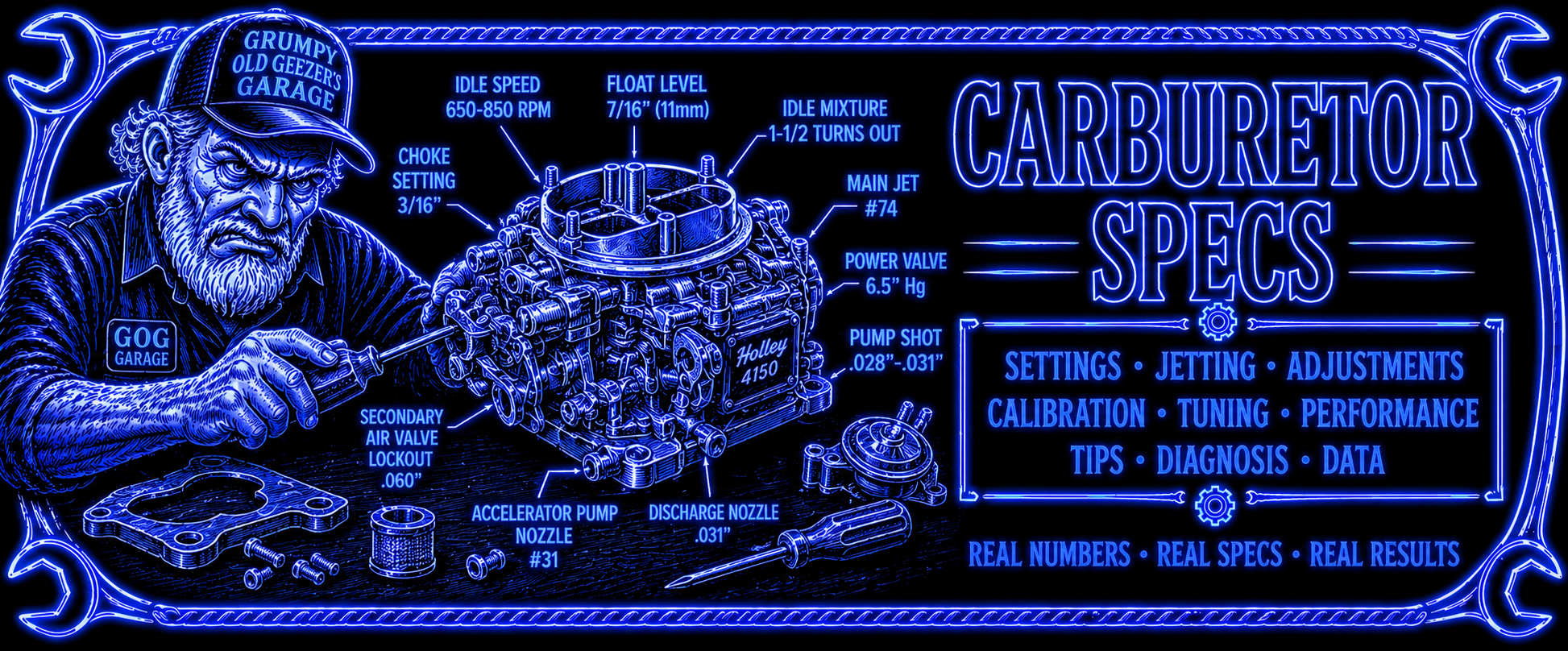
Autolite Variable Venturi Carburetor Specs
On This Page:
Basics: Intro | Overview | What Makes This Carb Different? | General Specs
Details: Variants | Key Points
Warnings: Common Problems | Common Misconceptions | Compatibility Notes | Bottom Line
Related: Related Links

Intro
The Motorcraft Variable Venturi carburetor was Ford’s late-carburetor-era attempt to make a carburetor act smarter than a fixed-venturi two-barrel without going fully into fuel injection.
Instead of using a fixed venturi size, the Variable Venturi design used movable venturi valves that changed position with engine demand and manifold vacuum. The idea was simple enough on paper: keep air velocity and fuel signal strong at low demand, then open the effective venturi area as airflow demand increased.
Ford used the Variable Venturi family during the fuel-economy and emissions era, mainly as the 2700 and 7200 two-barrel VV carburetors. These units appeared on Ford, Lincoln, and Mercury applications, especially late-1970s and 1980s emissions-controlled engines.
This was not a hot-rod carburetor, and it was not meant to be one. It was an engine-management compromise from the years when carburetors were being asked to meet fuel-injection expectations with springs, diaphragms, vacuum signals, solenoids, and a straight face.
Covers: Motorcraft 2700 and 7200 Variable Venturi two-barrel carburetors.

Overview
The Motorcraft Variable Venturi carburetor is best understood as a fuel-economy and emissions-control carburetor, not a traditional fixed-size two-barrel. The basic job was to maintain better air velocity and fuel signal across changing engine demand by varying the effective venturi opening.
The movable venturi valves are the heart of the system. They move in and out based on vacuum and airflow demand, changing how air moves through the carburetor. That allowed the carburetor to act small during light-load operation and open farther when the engine demanded more air.
That sounds clever because it was clever. It also means the carburetor depends heavily on clean passages, free-moving venturi valves, correct diaphragms, accurate vacuum control, intact feedback equipment where used, and proper adjustment. This is not the carburetor to rebuild with a screwdriver, a prayer, and a coffee can full of leftover Ford parts.
The 2700 and 7200 are the main Variable Venturi family names. Both belong to the same VV idea, but application, emissions equipment, feedback control, choke hardware, linkage, and calibration can vary. Identification should start with the carburetor ID number stamped into the top of the unit, not with a guess based on the air cleaner sticker.
The Variable Venturi’s strength was the idea: better part-throttle fuel control from a carburetor during an era that badly needed it. Its weakness was reality: age, dirt, worn diaphragms, sticking venturi valves, vacuum leaks, feedback failures, and technicians who treated it like a normal two-barrel with a bad attitude.
↑ Back to the Top, Before the Kickdown Rod Gets Bent

What makes it different
Compared with the Motorcraft 2150, the Variable Venturi is not just another fixed two-barrel. The 2150 uses fixed venturis with variable air-bleed and emissions-era control hardware. The Variable Venturi changes the effective venturi area itself.
Compared with the Autolite 2100 and Motorcraft 2150, the VV family is more dependent on movable airflow hardware and vacuum-control behavior. A 2100 can be forgiving. A VV carburetor is the sort of part that notices when one diaphragm is lazy and makes everyone else hear about it.
Compared with a feedback Quadrajet or feedback Varajet, the VV still uses a Ford-specific variable-venturi airflow strategy. Feedback electronics may be involved on later versions, but the movable venturi valve system is what makes the carburetor different.
Compared with throttle-body fuel injection, the Variable Venturi was still a carburetor. It tried to solve mixture-control problems mechanically and electro-vacuum style, before Ford and everyone else finally admitted that electronic fuel injection was going to win the argument.
The VV carburetor’s biggest difference is that it cannot be diagnosed like a simple fixed-venturi carburetor. If the venturi valves drag, the vacuum control system leaks, the feedback system goes dumb, or the idle mixture circuit gets disturbed, it will not politely run badly in one obvious way. It will make you earn the answer.
↑ Back to the Top, Before the Kickdown Rod Gets Bent

General Specs
| Type | Variable Venturi 2-barrel downdraft carburetor | Bore Layout | Two-barrel variable-venturi layout |
| Venturi / CFM | Movable venturi-valve airflow control | Mounting Pattern | Ford / Motorcraft two-barrel application-specific flange |
| Primary Metering | Variable venturi valves, idle circuit, main fuel circuit, accelerator pump, enrichment system, and feedback hardware where equipped | Secondary Metering | None |
| Secondary Type | None | Fuel Pressure | 4-5 psi |
| Booster Style | Variable-venturi fuel-metering layout | Fuel Bowl | Integral fuel bowl |
| Fuel Feed | Single feed | Choke Types | Electric, choke-control diaphragm, or application-specific automatic |
| Main Material | Aluminum and zinc alloy castings | Typical Uses | Ford, Lincoln, Mercury, 2.8L V6, 302 / 5.0L V8, truck, wagon, and emissions-era applications |
The useful Variable Venturi split is 2700 versus 7200, plus feedback and application equipment. These carburetors should be identified by the stamped carburetor ID number before ordering parts or making adjustments.
↑ Back to the Top, Before the Kickdown Rod Gets Bent

Variants
The useful Motorcraft Variable Venturi split is 2700 and 7200. Application labels like Crown Victoria, Mustang, wagon, truck, California, federal, 302, or V6 matter at the calibration and linkage level, but they are not clean family-level variants. The carburetor ID number tells the better story.
Motorcraft 2700 Variable Venturi
| Series | Motorcraft 2700 VV | Venturi / CFM | Movable venturi-valve airflow control |
| Secondary Type | None | Metering | Variable-venturi fuel metering with idle, main, accelerator-pump, enrichment, and vacuum-control systems |
| Booster Style | Variable-venturi fuel-metering layout | Fuel Bowl | Integral fuel bowl |
| Fuel Feed | Single feed | Choke Types | Electric, choke-control diaphragm, or application-specific automatic |
| Typical Applications | Late-1970s / early-1980s Ford, Lincoln, Mercury, V6, V8, and emissions-era applications | Operating Character | Variable-venturi fuel control with vacuum-operated airflow management |
Version Notes: The 2700 is the earlier / smaller VV branch most often found in late-1970s and early-1980s emissions-era Ford applications. It depends on clean venturi-valve movement, correct diaphragms, vacuum control, choke hardware, and idle adjustment. Treat it like a plain fixed two-barrel and it will return the favor by running like one that fell down the stairs.
Motorcraft 7200 Variable Venturi
| Series | Motorcraft 7200 VV | Venturi / CFM | Movable venturi-valve airflow control |
| Secondary Type | None | Metering | Variable-venturi fuel metering with idle, main, accelerator-pump, enrichment, feedback, and vacuum-control systems |
| Booster Style | Variable-venturi fuel-metering layout | Fuel Bowl | Integral fuel bowl |
| Fuel Feed | Single feed | Choke Types | Electric, choke-control diaphragm, or application-specific automatic |
| Typical Applications | Early-to-late 1980s Ford, Lincoln, Mercury, 302 / 5.0L, truck, wagon, and feedback-era applications | Operating Character | Variable-venturi operation with later feedback and emissions-control hardware |
Version Notes: The 7200 is the later VV branch commonly tied to 1980s Ford feedback-era applications. Wiring, feedback controls, diaphragms, venturi valves, choke hardware, and idle strategy all matter. Unplugging pieces and calling it “old-school” does not make the carburetor simpler. It just makes the diagnosis uglier.
↑ Back to the Top, Before the Kickdown Rod Gets Bent

Key Points
- The Motorcraft Variable Venturi family includes 2700 and 7200 two-barrel carburetors.
- The core design uses movable venturi valves to change effective airflow area with engine demand.
- The VV system was built for emissions-era fuel economy and drivability, not performance bragging rights.
- Identification should start with the stamped carburetor ID number on top of the unit.
- The venturi valves must move freely and respond correctly to vacuum control.
- The vacuum control system, choke circuit, idle mixture circuit, enrichment system, and accelerator-pump circuit all matter.
- Later feedback versions need the electronic control hardware intact and working.
- The VV carburetor is not a 2100, not a 2150, and not a normal fixed-venturi two-barrel.
- A good VV can run, but a sticky, leaky, half-bypassed one can make fuel injection look like divine intervention.
↑ Back to the Top, Before the Kickdown Rod Gets Bent

Common Problems
- Dragging variable venturi valves – The venturi valves must move freely. Dirt, varnish, wear, damage, or bad adjustment can make the valves drag and turn the whole variable-venturi idea into a mechanical argument.
- Vacuum control system problems – The VV depends on vacuum control to manage airflow behavior. Leaks, bad hoses, wrong routing, or failed controls can make the carburetor act like it forgot what engine load means.
- Feedback system failure – Later VV units need feedback wiring, controls, and mixture correction working correctly. Dead electronics do not turn a 7200 into a simple 2100. They turn it into a confused 7200.
- Idle mixture circuit problems – The idle mixture circuit and feedback system must work together where equipped. Wrong adjustments, damaged screws, plugged passages, or failed feedback control can cause rough idle, loading, stalling, or lean complaints.
- High idle / high-cam speed positioner sticking – A sticking high-cam speed positioner can hold idle too high after warm-up. That is not “just needs idle adjustment.” That is hardware not coming back home.
- Loading at idle / black smoke – Rich idle, black smoke, fuel smell, and sulfur odor can point to mixture control, feedback, float, venturi valve, or idle-system problems. Guessing leaner with a screwdriver is not diagnosis.
- Choke-control diaphragm failure – A bad choke-control diaphragm can create poor cold starts, rich warm-up, stalling, or choke behavior that makes the carburetor look more mysterious than it is.
- External vent system problems – The VV uses venting that must be present and routed correctly. Plugged, missing, or misrouted vent hardware can disturb fuel-bowl behavior and idle quality.
- Internal vent and accelerator-pump circuit problems – Internal venting and pump-shot behavior matter. Dirt, wrong gaskets, damaged seals, or misassembled parts can cause stumble, hesitation, or strange transition behavior.
- Enrichment system problems – The 2700 and 7200 enrichment systems have to respond correctly under load. If enrichment is late, early, stuck, or dead, the engine gets either stumble or rich misery.
- Wrong diaphragm or seal parts – The VV uses diaphragms, O-rings, and seals that must match the carburetor ID. Almost-right rubber parts are still wrong parts.
- Incorrect rebuild kit – Rebuild kits must match the stamped carburetor ID and application. A kit marked 2700 / 7200 may still leave you with wrong gaskets, seals, springs, or adjustment assumptions.
- Vacuum-hose deletion – Removing hoses from a VV carburetor because the diagram looks ugly is how a complicated system becomes a broken complicated system.
- Replacement-carb mismatch – A replacement VV may bolt on and still have the wrong ID, feedback hardware, choke setup, linkage, vacuum routing, or calibration. Fresh rebuild paint does not make it the right carburetor.
Back to the Top, Before the Kickdown Rod Gets Bent

Common Misconceptions
- “The Variable Venturi is just a weird 2150.” No. The VV uses movable venturi valves. That is the whole point.
- “The 2700 and 7200 are the same.” No. They belong to the same VV family, but application, feedback hardware, choke setup, and calibration can differ.
- “If it has two barrels, it can be diagnosed like a 2100.” No. A fixed-venturi two-barrel and a variable-venturi carburetor are not the same animal.
- “Feedback wiring is optional.” Not on feedback versions. If the carburetor was designed around electronic control, unplugging it is not old-school tuning.
- “Sticking venturi valves just need more idle adjustment.” No. If the movable venturi hardware is dragging, the fuel and airflow behavior are wrong before the idle screw gets a vote.
- “Vacuum hoses are emissions junk.” On a VV carburetor, vacuum control is part of how the carburetor works. Delete the hoses and the engine gets to grade your work.
- “A rebuild kit fixes everything.” No. Worn venturi-valve hardware, failed feedback parts, wrong diaphragms, bad vacuum controls, and incorrect adjustments survive new gaskets just fine.
- “A normal two-barrel swap is automatically better.” Not if the vehicle needs emissions legality, feedback hardware, linkage, choke function, or original calibration. Easier is not automatically correct.
↑ Back to the Top, Before the Kickdown Rod Gets Bent

Compatibility Notes
Motorcraft Variable Venturi compatibility starts with the stamped carburetor ID number. The 2700 and 7200 family names are not enough to identify the correct unit, kit, linkage, feedback hardware, choke setup, or calibration.
A VV carburetor that physically bolts on is not automatically correct. Vacuum routing, feedback wiring, choke-control hardware, linkage, throttle position, idle strategy, and emissions controls all have to match the vehicle.
Feedback versions need the matching vehicle control system. If the vehicle expects feedback control, the carburetor cannot simply pretend the wiring never existed. That is not simplification. That is creating a failure with fewer visible parts.
Swapping to a fixed-venturi 2100, 2150, or aftermarket two-barrel may solve some headaches in non-emissions situations, but it can create legal, linkage, choke, calibration, air-cleaner, and drivability problems. A different carburetor is not automatically a better plan.
Ford, Lincoln, Mercury, truck, wagon, Mustang, 2.8L V6, 302 / 5.0L, automatic-transmission, and feedback-era applications may use different calibrations and controls. Same family does not mean same job.
Replacement VV carburetors should be matched by ID number, casting, feedback hardware, choke hardware, linkage, vacuum-control layout, and original vehicle use. “Fits 2700 / 7200” is a beginning, not a verdict.
↑ Back to the Top, Before the Kickdown Rod Gets Bent

Bottom Line
The Motorcraft Variable Venturi carburetor was Ford’s attempt to make a carburetor behave with better fuel economy, emissions control, and part-throttle manners by changing the effective venturi area as the engine demanded air.
The clean family split is 2700 and 7200. Both depend on movable venturi valves, vacuum control, correct diaphragms, proper choke hardware, and correct calibration.
A complete, clean, correctly adjusted VV can run. A sticky, leaky, hacked, half-unplugged, or misrouted one can make a simple fixed-venturi carburetor look like a vacation.
The VV is not junk just because it is odd. It is also not forgiving just because someone wants it to be simple. Treat it like the specific variable-venturi system it is, or it will make fuel injection look like mercy.
↑ Back to the Top, Before the Kickdown Rod Gets Bent

Related Links
Common Factory Pairings
Engines
- Ford Windsor small-block
- Ford Lima / Pinto four-cylinder
- 122 2.0
- 140 2.3