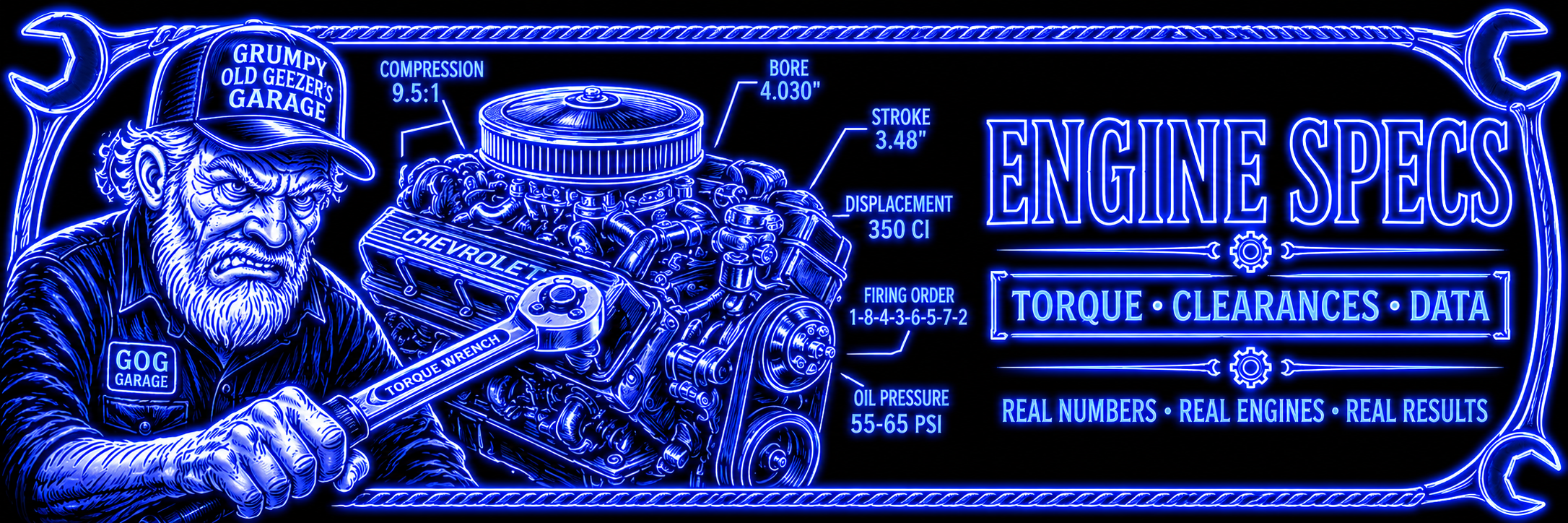
Chevy Engine Specs

Intro
Chevy engine specs need to be sorted by family before the numbers mean much. A Chevy 350, 400, or 427 can point to very different engines depending on the era, family, and application.
Use this page to get into the right Chevrolet engine family first. Then use the family page and individual displacement pages to confirm the actual engine, production range, bore, stroke, firing order, variants, and compatibility notes.
The family comes before the displacement. That rule keeps a 400 small-block from getting confused with a 400 big-block story that does not exist, keeps a 427 Mark IV from getting treated like every other 427-shaped rumor, and keeps a 409 from getting shoved into the wrong big-block bucket.
↑ Back to the Top, Before the Family Tree Gets Another Branch

Big Blocks

W-Series Big-Block – 1958- 1965
The W-series was Chevrolet’s early big-block line before the Mark IV became the main muscle-era big-block. It matters most for late-1950s and early-1960s full-size Chevrolet performance, especially the 409 reputation.
Engines covered: 348, 409
Mark IV Big-Block – 1965-1974+
The Mark IV became Chevrolet’s best-known classic big-block platform. It covered serious passenger-car, Corvette, Chevelle, Camaro, truck, and performance use with more displacement and more muscle-era recognition than the W-series.
Engines covered: 396, 402, 427, 454
Small Blocks
Gen I Small-Block – 1955 – 2003
The Gen I small-block is Chevrolet’s core V8 family and the backbone of most classic Chevy performance coverage. It includes the common street engines, the high-performance variants, and the small-block displacements most readers will be trying to identify.
Engines covered: 262, 265, 267, 283, 302, 305, 307, 327, 350, 400
Parting Shot
Start with the Chevy engine family, then move to the displacement page. The family tells you which parts rules, identification clues, and compatibility limits belong to the engine in front of you.
A Chevy displacement number by itself is only a clue. The family page is where the number gets context, and the individual engine page is where the details start proving or killing the story.