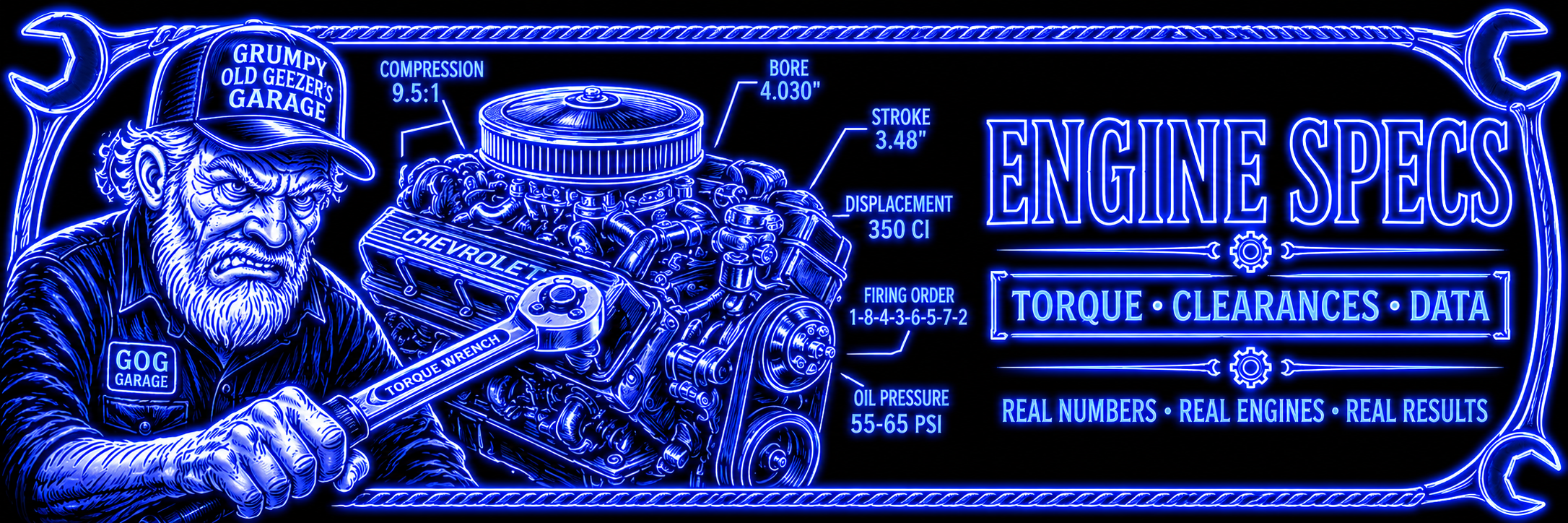
Chevrolet Mark IV Big Block V8 Family Specs and Identification
On This Page:
Start Here: Intro | Engines in This Family | Overview
Family Details: General Family Specs | Identification | Shared Design Patterns
Use and Fit: Choosing Within this Family | Compatibility Notes
Problems and Myths: Common Family Problems | Common Family Misconceptions
Final Word: Bottom Line
Related: Related Links

Intro
The Chevrolet Mark IV is the big-block Chevy most people mean when somebody says “big block” without further instructions. The 396, 402, 427, and 454 all came from this family, and between them they powered muscle cars, Corvettes, full-size Chevrolets, pickups, heavy trucks, boats, motorhomes, race cars, street machines, and enough questionable engine-swap stories to keep swap meets operating indefinitely.
Introduced during the 1965 model year, the Mark IV replaced the 348/409 W-Series as Chevrolet’s mainstream production big block. The W-engines had earned plenty of respect, but Chevrolet needed a foundation with more room for airflow, displacement, rpm, and future development. The Mark IV supplied it. It could be built mild enough to haul a family around in a big Chevrolet or nasty enough to make racers, insurance companies, and rear tires reconsider their career choices.
The 396 started the production story and quickly became one of the engines that defined Chevrolet muscle. The 427 enlarged the bore while keeping the 396’s relatively short stroke and became the family’s sharp-edged performance legend. For 1970 Chevrolet enlarged the 396 into the 402, then muddied the water by continuing to call some of them 396s and others 400s. The same year brought the 454, using the 427’s large bore with a longer stroke and giving the family its big-cube torque hammer.
Those four displacements belong to the same family, but they were never four sizes of the same engine personality. The 396 could be anything from a civilized street big block to a serious solid-lifter performance engine. The 402 carried that basic short-stroke character into the early 1970s while Chevrolet changed both the badges and the rules. The 427 built its reputation on bore, airflow, rpm capability, Corvette hardware, racing, and some genuinely exotic factory combinations. The 454 leaned harder into displacement and torque, then stayed useful for decades after the muscle-car crowd had stopped getting the best toys.
That range is one reason the Mark IV became such a hot-rodding institution. Chevrolet built enough versions, and the aftermarket built enough parts, that a Mark IV can still be assembled for almost any job. Oval-port heads and a sensible hydraulic cam can make a broad, easy street engine. Rectangular ports, compression, camshaft, and serious induction can move the same basic architecture toward high-rpm horsepower. Cubic inches can make a heavy car feel considerably less guilty about its weight. There is no single correct Mark IV combination because Chevrolet never gave the family a single job.
The weaknesses are just as real. A Mark IV is large, heavy, thirsty, and perfectly capable of producing more heat than a lazy cooling-system upgrade can handle. Big ports do not fix low compression. Giant camshafts do not cure bad gearing. Cubic inches do not make mismatched parts suddenly understand each other. A badly planned big block can consume money and premium fuel while making less useful power than a smaller engine somebody bothered to think about first.
Its reputation also creates its own trouble. “396,” “427,” and especially “454” have been magic numbers long enough that ordinary engines have spent decades acquiring famous histories they were not born with. Truck engines become Corvette engines somewhere between the seller’s garage and the classified ad. Every rectangular-port head develops an LS6 story. Every old 427 apparently knew somebody in the COPO department. The famous versions are genuinely important. That is exactly why the evidence has to be better than the story.
The Mark IV lasted because it was useful after it stopped being fashionable. Passenger-car horsepower faded under lower compression, emissions requirements, fuel changes, and the general misery of the 1970s, but trucks, marine applications, commercial equipment, replacement engines, racers, and street builders kept the architecture working. Chevrolet eventually moved on to later generations of the big block, but the Mark IV had already spent roughly a quarter-century proving that a good engine family does not become obsolete just because the showroom brochures get boring.
That is why the Mark IV still matters. It gave Chevrolet one of the defining performance engines of the muscle era, produced some of the company’s most collectible factory hardware, worked for a living long after the glory years ended, and became one of the deepest-supported American V8s ever built. The legend is deserved. Just remember that the legend belongs to the family. The exact engine sitting in front of you still has to earn its own reputation.
↑ Back to the Top, Before the Casting Numbers Start Lying

Engines in This Family
This is the Mark IV big-block lineup covered here. Same basic architecture, four different personalities, and enough shared iron to make identification dangerous when somebody starts believing valve covers. Start with the engine page that matches the hardware, then let the numbers, dates, and rotating assembly prove the rest.

The engine that introduced production Mark IV muscle. Real street manners, serious high-performance versions, and enough name recognition that ordinary 396s have been promoted in conversation for sixty years. A good 396 does not need to pretend it is a 427.
The enlarged 396 that Chevrolet sometimes kept calling a 396 and sometimes called a 400, proving that marketing departments should never be allowed near a micrometer. Strong early-1970s street engine, genuine Mark IV hardware, and a permanent identification headache.
The big-bore, shorter-stroke performance legend of the family. Corvette, full-size, racing, COPO, L88, ZL1, and ordinary 427 history all live under the same displacement number, which is exactly why a valuable 427 story needs more evidence than a rectangular-port head and a confident seller.
The long-stroke torque hammer. It served everything from LS6 muscle to pickups, boats, motorhomes, and heavy street machinery. Plenty of displacement, plenty of useful torque, and enough truck and marine cores in circulation to make application history worth checking before the price starts wearing racing shoes.

Overview
The Mark IV did not begin with a 396 sitting under a shiny hood in 1965. Chevrolet Engineering had been looking for a way past the breathing limits of the 348/409 W-Series while Detroit’s horsepower war was getting too serious for polite engineering meetings. The W-engine had made real power and real history, but its unusual combustion-chamber arrangement and head geometry were running out of convenient places to find more airflow. Eventually even good machinery reaches the point where another larger carburetor is not an engineering department.
The first public glimpse of Chevrolet’s answer came in 1963 with the experimental 427-cubic-inch Mark II, quickly nicknamed the Mystery Motor after appearing in NASCAR competition at Daytona. The important part was not the mystery and not even the 427 cubic inches. The real news was upstairs. Chevrolet moved the combustion chambers into the cylinder heads and arranged the valves at different angles instead of lining them up neatly like soldiers waiting for inspection.
Those canted valves gave the intake and exhaust ports more room to work and let the valves open away from the cylinder walls instead of trying to breathe beside them. That reduced shrouding and allowed larger valves and better port approaches. The cylinder head was no longer the place where airflow went to ask permission. Chevrolet had finally given the big block some room to inhale.
There was a Mark III development step between the Mystery Motor and the production Mark IV, and Chevrolet even investigated wider bore spacing that would have allowed more cylinder room yet. Then somebody presumably showed engineering the tooling bill. Wider bore spacing meant changing a mountain of production equipment. Chevrolet wisely kept the established 4.840-inch spacing and developed the canted-valve idea around machinery the company already owned. Sometimes brilliant engineering is knowing which brilliant idea will bankrupt the factory.
The resulting Mark IV was its own architecture. It was not a larger small block wearing heavier shoes and it was not a W-engine with the rough edges filed off. Chevrolet used a deep-skirt cast-iron block, an in-block camshaft, pushrod valvetrain, rear-mounted distributor, and large cylinder heads built around the canted-valve layout. The result could support ordinary passenger-car torque, high-rpm race airflow, and displacement growth without needing a new engine family every time somebody asked for another fifty horsepower.
Production started with the 396 for 1965. It used a 4.094-inch bore and 3.760-inch stroke, and Chevrolet immediately demonstrated how much personality the same displacement could have. Mild hydraulic-lifter versions moved large passenger cars around without drama. High-compression, solid-lifter versions went looking for trouble in Chevelles, Corvettes, Camaros, Novas, and anywhere else Chevrolet could fit the hardware without attracting too much attention from the insurance company.
The 396 established the basic Mark IV trick: one architecture could be civil, nasty, or anything in between depending on heads, compression, camshaft, induction, exhaust, and application. That flexibility is why a bare displacement number never tells the whole story. A grocery-getter 396 and a serious solid-lifter performance version may share bore and stroke while having completely different ideas about what constitutes a reasonable Saturday night.
For 1966 Chevrolet kept the same 3.760-inch stroke and enlarged the bore to 4.250 inches, creating the 427. That was a particularly useful way to add cubic inches because the larger bore did more than increase displacement. It also gave the valves more room and let the Mark IV heads use their airflow potential more effectively.
The 427 then wandered into nearly every corner of Chevrolet performance history. Ordinary street versions shared the displacement with L71 and L72 combinations, the serious L88, the aluminum-block ZL1, racing engines, full-size machinery, Corvettes, COPO hardware, and enough later folklore to make every unidentified 427 sound as though it spent weekends at Daytona. The same displacement also appeared in heavy-truck service, including tall-deck blocks built for a life involving considerably more gravel than glory.
That is the first rule of Mark IV mythology: the number does not tell you whether the engine wanted a drag strip or a dump body. Chevrolet used the architecture wherever cubic inches and airflow were useful. Sellers later discovered that some applications sound better in advertisements than others.
For 1970 Chevrolet enlarged the 396 bore to 4.125 inches while keeping the 3.760-inch stroke. That made roughly 402 cubic inches. Then Chevrolet kept calling some of them 396s and used 400 terminology elsewhere. The engine did nothing wrong. The people making the badges simply decided arithmetic had become optional.
Mechanically, the 402 remained very close to the 396 in character. Same stroke, slightly larger bore, a few more cubic inches, and the same basic short-stroke Mark IV personality. It is a useful engine in its own right and does not need to be called a 396 any more than it needs to apologize for Chevrolet’s naming department.
The other 1970 development was the 454. Chevrolet kept the 427’s 4.250-inch bore and stretched the crankshaft stroke to 4.000 inches. That extra quarter-inch of travel added displacement and crank leverage, shifting the family toward easier low- and midrange torque. The 427 and 454 therefore share a bore but not quite the same attitude. The 427 gets more of its reputation from bore, airflow, and rpm. The 454 leans on cubic inches and leverage like a man who knows the wrench is long enough.
Cylinder-head choice widened those differences even more. Oval-port heads generally served street, passenger-car, truck, and broad-torque combinations where port velocity and useful midrange mattered. Large rectangular-port heads supplied much more high-rpm airflow for serious performance packages.
Neither port shape is automatically superior. Rectangular ports look impressive and belong on combinations that can use them. Bolt them onto a low-compression street engine with a mild cam and ordinary gearing just because racing engines had them, and the reward may be less useful torque and a considerably more impressive receipt. Bigger ports are airflow capacity, not horsepower coupons.
Combustion chambers changed too. Early closed-chamber heads worked with the high-compression pistons and fuel available during the muscle era. Open-chamber designs became increasingly common as Chevrolet changed compression ratios, piston designs, emissions requirements, and fuel expectations. Iron heads handled most production work. Aluminum appeared on selected serious combinations. Chevrolet even cast the ZL1 block in aluminum, just in case a cast-iron 427 had not already given collectors enough things to argue about.
The Mark IV was never merely a muscle-car engine. It went into full-size Chevrolets, Corvettes, intermediates, Camaros, Novas, pickups, medium- and heavy-duty trucks, boats, motorhomes, commercial chassis, industrial equipment, replacement engines, and race cars. Chevrolet built tall-deck 366 and 427 versions specifically for sustained heavy work while standard-deck engines became fixtures in hot rods and performance cars.
Half a century of swapping means today’s restored-looking Chevelle may contain an engine that began life several feet higher off the pavement in something hauling twelve tons of gravel. That does not automatically make it a bad engine. It makes the casting numbers considerably more useful than the orange paint.
The 1970s did not kill the Mark IV. They changed the assignment. Compression ratios dropped as fuel changed. Emissions systems multiplied. Camshaft timing became more conservative. Exhaust systems became quieter and more restrictive. The move from SAE gross to SAE net horsepower ratings made the brochure numbers fall even harder because Detroit changed both the engines and the way it measured them.
Some horsepower genuinely disappeared. Some disappeared on paper. Either way, the factory’s wildest street combinations faded quickly. A 1970 454 and a later smog-era 454 can carry the same displacement while making their power in very different ways and with very different amounts of enthusiasm.
The 454 carried most of the remaining passenger-car big-block story, but the family found an even longer second career away from the showroom performance wars. Trucks, marine service, motorhomes, commercial equipment, replacement engines, racing, and the aftermarket kept the architecture alive because torque, strength, displacement, and an enormous parts supply remained useful even after horsepower stopped decorating every advertisement.
That survival says more about the Mark IV than any famous option code. Chevrolet designed the engine in the middle of a horsepower war, then discovered it remained useful when horsepower was no longer the main reason for building one. Good architecture does not care whether the next owner is towing a trailer or trying to embarrass the car in the other lane.
By the end of the 1980s the traditional Mark IV had finally reached the end of its factory development road. Chevrolet introduced the revised Gen V big block for 1991 and later the Gen VI. Those engines kept the basic Chevrolet big-block bloodline and familiar 4.840-inch bore spacing, but enough details changed that treating them as Mark IVs with newer casting dates is an excellent way to order the wrong parts.
Cooling passages, oiling arrangements, rear-main-seal design, timing components, block provisions, valvetrain details, head-gasket compatibility, and other features evolved. Some later parts can be adapted to earlier blocks and vice versa, but “it bolts on” remains one of the most expensive sentences in the Chevrolet language.
Taken as an engineering story, the Mark IV worked because Chevrolet gave one architecture enough room to serve wildly different jobs. The same basic bones could support a mild oval-port hydraulic engine, a screaming rectangular-port solid-lifter 427, a long-stroke 454 torque engine, or a tall-deck commercial block expected to spend its life dragging weight uphill.
That range was not an accident. It is why the Mark IV lasted.
Chevrolet used racing to find a better way to make a big engine breathe, refused to throw away perfectly useful manufacturing infrastructure, turned the canted-valve idea into a production engine, stretched the package from 396 muscle to 454 grunt, and kept the whole thing useful for roughly a quarter-century.
Not bad for an engine family that exists because the 409 finally ran out of convenient places to hide more airflow.
↑ Back to the Top, Before the Casting Numbers Start Lying

General Family Specs
| Engine Family | Chevrolet Mark IV Big Block V8 | Production / Use Era | 1965–1990 traditional Mark IV era |
| Configuration | 90-degree V8 | Valve Layout | OHV / pushrod, 2 valves per cylinder |
| Cam Location | In-block camshaft | Bore Spacing | 4.840 in |
| Firing Order | 1-8-4-3-6-5-7-2 | Distributor Rotation | Clockwise |
| Distributor Location | Rear-mounted | Common Block Material | Cast iron |
| Common Head Material | Cast iron | Oiling System | Wet sump |
| Typical Bellhousing Pattern | Chevrolet V8 bellhousing pattern | Major Factory Displacements Covered Here | 396, 402, 427, 454 |
This table is the Mark IV baseline. It tells you the family architecture, not the exact engine sitting on the stand. The 396, 402, 427, and 454 share the big-block Chevy foundation, but displacement, application, year, and build history still decide the important details.
Use these specs to confirm the broad family before digging deeper. After that, the real answers come from casting numbers, stamped codes, date codes, head numbers, rotating assembly, and the parts actually bolted to the engine. The table gets you oriented. It doesn’t finish the inspection.
↑ Back to the Top, Before the Casting Numbers Start Lying

Identification
A Mark IV big-block Chevy is usually easy to recognize. It is physically wider and heavier than a small block, with a rear-mounted distributor, broad intake manifold, large cylinder heads, and the familiar rectangular big-block valve covers. It also lacks the deeply scalloped valve-cover shape of the earlier 348/409 W-Series. Once you have seen a few, confusing a Mark IV with a small block requires either very poor lighting or considerable commitment to being wrong.
That identifies the family. It does not tell you whether the iron is a 396, 402, 427, or 454. Those four share enough external architecture that paint, valve covers, carburetors, air cleaners, decals, chrome, exhaust manifolds, and seller confidence are not acceptable substitutes for measuring equipment.
Make Sure It Is the Right Kind of Mark IV
Before chasing displacement, make sure the block belongs to the standard-deck passenger-car side of the family. Chevrolet also built 366 and 427 medium-duty truck engines on the Mark IV architecture. Those use a roughly 10.2-inch deck instead of the standard passenger-car block’s roughly 9.8-inch deck.
That extra deck height changes intake-manifold geometry and raises the heads farther apart. Heavy-truck accessories, large thermostat housings, unusual intake arrangements, governor hardware, and commercial-looking front dress should therefore slow the identification process down. A tall-deck 427 is genuine Chevrolet big-block iron. It is also not automatically the Corvette 427 the seller’s imagination has already spent.
Start With the Block Casting Number
The block casting number is raised into the iron, normally at the rear of the block around the bellhousing flange and most commonly toward the driver side. On an installed engine this may require a flashlight, mirror, degreaser, toothbrush, and a temporary expansion of the vocabulary.
Clean the number before decoding it. One greasy digit can turn one block into another on paper while the engine itself remains stubbornly unchanged.
The casting number tells you what Chevrolet designed that block casting to support. Sometimes that gets very close to the answer. Sometimes Chevrolet used one casting for more than one displacement, which means the number narrows the neighborhood and leaves you standing at the wrong house if you stop there.
A few important examples make the problem obvious:
- 3855961, 3855962, 3902406, 3916323, 3935440, and 3955272 are associated with muscle-era 396 production.
- 3969854 lives in the 396/402 confusion zone and became a familiar 402 casting. The badge on the car does not settle what the bore measures.
- 3963512 was used for both 427 and 454 applications. That casting identifies neither displacement by itself.
- 3999289 is a later 454 casting and provides a much stronger displacement clue, although application and internal configuration still deserve checking.
A casting number is evidence, not a confession. If Chevrolet used the same piece of iron for more than one engine, the block is telling you to keep looking.
Find the Casting Date
The casting date is the next piece. On early Mark IV blocks it may appear low on the passenger side near the freeze-plug and starter area. Later castings commonly place it around the rear bellhousing ledge near the casting number. Chevrolet moved dates around often enough that not finding one in the first place you look does not mean the block forgot its birthday.
Typical Chevrolet casting dates use a letter for the month, numbers for the day, and a year digit. A through L normally represent January through December. When the year is represented by a single digit, the casting family and application have to establish the decade. A “9” with no context is not an identification system.
The chronology has to work. The block was cast before the engine was machined and assembled. If the assembly stamp says the engine existed before the foundry poured the iron, either somebody misread a code or somebody has been improving history.
Read the Engine Assembly Stamp
The most useful factory identification is usually the stamped assembly code on the machined pad at the front passenger side of the block near the cylinder head and timing-cover area. Brackets, alternators, paint, rust, dirt, and fifty years of oil mist can hide it surprisingly well.
A production Chevrolet engine stamp normally identifies the assembly plant, assembly date, and application suffix. The plant and date tell you where and when Chevrolet assembled the engine. The suffix is the part that often identifies displacement, original application, transmission, horsepower level, induction, or related equipment.
Decode the suffix for the correct year. Chevrolet reused codes. The same pair or group of letters can mean something entirely different a few years later. Reading the suffix without the casting number and date is how ordinary big blocks graduate into rare Corvette engines between the garage and the classified ad.
Inspect the pad itself too. Machine shops deck blocks. Decking can weaken or remove the original stamp. A blank pad on an old rebuilt engine is not automatic evidence of fraud. A suspiciously crisp stamp on a freshly machined pad is not automatic evidence of Chevrolet either.
The more expensive the claim, the less optimism belongs in the inspection.
VIN and Vehicle Assembly Markings
Later muscle-era engines may also carry a partial vehicle VIN stamped into the block. From 1968 forward these markings became especially useful when determining whether a particular engine actually belonged to a particular car. Depending on model year and assembly plant, the stamp may be on the front pad or elsewhere on the block. Some 1969 Chevrolet V8 applications used the rough casting near the oil-filter area.
A matching partial VIN is strong evidence tying the block to the original vehicle. It does not tell you what crankshaft somebody installed during a rebuild twenty years later. Pedigree and present mechanical configuration are related questions, not the same question.
A CE-style service-replacement stamping changes the investigation. Genuine Chevrolet replacement engines and blocks do not always carry the original vehicle-specific production identification. Replacement does not mean counterfeit. It means casting numbers, dates, hardware, and measurements have to do more of the work.
Heads, Intake, Exhaust, and Other Hardware
Cylinder heads are useful evidence because casting numbers and dates can establish the head family, production era, chamber style, and whether you are looking at ordinary oval-port hardware, serious rectangular-port pieces, or something added by a previous owner.
They identify the heads extremely well.
They identify the short block considerably less well.
A 454 can wear earlier performance heads. A 396 can wear later heads. A truck block can acquire aluminum intake and rectangular-port hardware on its way into a street car. Chevrolet big-block heads are held on with bolts, and hot rodders learned how those bolts work shortly after the engines became available.
The intake manifold, carburetor, exhaust manifolds, distributor, water pump, accessory brackets, pulleys, smog equipment, and ignition system can all support an era or application when their numbers and dates agree. When five original-looking components tell the same story, pay attention. When the block is 1969, the heads are 1972, the intake is aftermarket, and the valve covers arrived by UPS last Thursday, believe the iron before the accessories.
None of those bolt-on pieces proves displacement. Intakes swap before lunch. Carburetors swap before breakfast. Valve covers swap while somebody is waiting for the coffee.
Separating the 396, 402, 427, and 454
The 396 and 402 are the hardest pair to separate by appearance because they share the same 3.760-inch stroke and differ mainly in bore. The 396 uses a 4.094-inch bore. The 402 uses 4.125 inches.
Chevrolet made that simple mechanical distinction unnecessarily entertaining by continuing to use the 396 name after actual displacement increased to roughly 402 cubic inches and using 400 terminology in other applications. Therefore a factory-looking 396 badge can be completely legitimate while sitting over 402 cubic inches. Detroit marketing has been ruining clean identification logic for generations.
On an untouched engine, casting number, date, and suffix code usually settle the 396-versus-402 question. Once decking, replacement blocks, rebuilds, or swapped rotating parts enter the picture, the evidence weakens. There is no secret external ridge that appears when the bore grows .031 inch.
The 427 uses the same 3.760-inch stroke as the 396 and 402 but opens the bore to 4.250 inches. Correct castings, dates, and suffixes can identify an original engine without opening it. Shared castings or missing stamps cannot.
Because 427 stories can add serious money, rectangular-port heads, aluminum intakes, chrome valve covers, and somebody remembering the engine “came out of a Corvette” should be treated as supporting theater until the numbers agree.
The 454 shares the 427’s 4.250-inch bore but increases stroke to 4.000 inches. That makes the rotating assembly the important difference.
Factory production 454s also provide a useful assembled-engine clue through external balance. Traditional 396, 402, and 427 combinations are internally balanced. Common production 454s use an externally balanced harmonic damper and flywheel or flexplate.
That hardware is a strong clue, not divine revelation. Aftermarket rotating assemblies can be internally balanced. Dampers and flexplates get swapped. Stroker combinations exist. Somebody can install the wrong balance parts too, although the engine will usually begin sending a vibration complaint before long.
What Evidence Deserves Trust?
- Paint, decals, valve covers, air cleaner: decoration. Useful mainly for learning somebody’s favorite color.
- Carburetor, intake, exhaust manifolds, accessories: useful application and era clues when numbers and dates agree, but easily changed.
- Head casting numbers and dates: strong identification of the heads; supporting evidence for the short block.
- Block casting number: strong family and era evidence and sometimes strong displacement evidence, but shared castings exist.
- Block casting date plus original assembly suffix: much stronger and often enough to identify a factory engine correctly.
- Partial VIN matching the car: strong evidence tying that block to the vehicle when new.
- Balance hardware: useful supporting evidence, especially for a production 454.
- All of the above agreeing: about as good as assembled-engine identification gets.
- Measured bore and stroke: the engine finally loses the right to argue.
That last one matters more as engines get older. A casting number tells you what Chevrolet intended when the block left the foundry. It cannot tell you what a machine shop did in 1978, which crank somebody installed in 1994, or how many previous owners regarded matching parts as an unnecessary luxury.
If casting number, date, suffix, VIN, heads, and balance hardware all agree, there is usually no reason to disassemble a healthy engine merely to satisfy curiosity. If the evidence disagrees, the stamp is missing, the block was a service replacement, or the casting served more than one displacement, outside identification eventually runs out of road.
Then measure it.
Bore tells you which cylinder size is actually there. Stroke tells you which crankshaft geometry is moving the piston. Neither measurement has ever heard the seller’s story, which is one of the reasons they are so dependable.
Bore / Stroke Reference
| Displacement | Bore | Stroke | Displacement | Bore | Stroke | |
|---|---|---|---|---|---|---|
| 396 | 4.094 in | 3.760 in | 402 | 4.125 in | 3.760 in | |
| 427 | 4.250 in | 3.760 in | 454 | 4.250 in | 4.000 in |
↑ Back to the Top, Before the Casting Numbers Start Lying

Shared Design Patterns
The 396, 402, 427, and 454 all live on the same Mark IV foundation: canted-valve big-block architecture with enough breathing room and bottom-end capacity to support everything from ordinary street duty to serious factory performance. The family resemblance is real. What changes the personality is Chevrolet’s bore-and-stroke recipe.
The 396 starts with a 4.094-inch bore and 3.760-inch stroke. The 402 keeps that same 3.760-inch stroke and opens the bore to 4.125 inches. Mechanically, those two are the closest pair in the family: the 402 is essentially the 396 idea with a little more bore and displacement, not a separate big-block design.
The 427 keeps the same 3.760-inch stroke again but opens the bore all the way to 4.250 inches. That is the important difference. More bore gave Chevrolet more displacement and breathing room without turning the engine into a longer-stroke torque motor. That short-stroke, big-bore combination is a big part of why the 427 earned its reputation for airflow and rpm instead of merely leaning on cubic inches.
The 454 uses that same 4.250-inch bore but changes the crankshaft side of the argument with a 4.000-inch stroke. That extra stroke brings more displacement and more crank leverage, shifting the family character toward stronger low- and midrange torque. The 427 and 454 may share a bore, but they do not get there the same way and they do not behave quite the same once the throttle opens.
So the family breaks down cleanly: 396 and 402 share the smaller-bore, 3.760-inch-stroke foundation; the 427 keeps that stroke and adds bore; the 454 keeps the 427 bore and adds stroke. Same Mark IV bones. Chevrolet changed where the cubic inches came from, and that changed what each engine was naturally good at.
↑ Back to the Top, Before the Casting Numbers Start Lying

Choosing Within This Family
There is no automatic winner in the Mark IV family. The 396 and 402 make sense when period big-block character matters, the 427 leans toward airflow and rpm, and the 454 puts the emphasis on low- and midrange torque. Pick the engine that matches the job instead of buying the biggest number or the most expensive story.
- 396 — for muscle-era character and a strong street combination.
The 396 fits a correct period car, restoration, or street build where early Mark IV identity matters. It has real torque and performance potential without needing to pretend it is a 427. The tradeoff is simple: if originality and 396 character do not matter and easy torque is the only goal, a 454 may deliver more shove for the same amount of big-block trouble. - 402 — for an honest early-1970s Mark IV street engine.
The 402 sits close to the 396 in character, adds a little displacement, and can make a strong street bruiser without chasing rare-engine mythology. It makes particular sense when it belongs in the car already. Its weak point as a choice is mostly purpose: if the goal is documented 396 identity, the 402 is not one; if the goal is simply more torque with no concern for originality, the 454 has a stronger argument. - 427 — for sharper performance and rpm character.
The 427 is the family choice when big-bore breathing, stronger high-rpm character, period performance, racing flavor, or a correct 427 application is the point. A mild one can still make an excellent street engine, but serious 427 combinations ask more from compression, fuel, gearing, cooling, and the rest of the car. If ordinary street torque and easy manners matter more than the 427’s character or history, the extra cost and complexity can be hard to justify. - 454 — for torque, weight, towing, and hard street pull.
The 454 earns its keep when low- and midrange shove matter: heavy cars, cruisers, trucks, tow duty, and street builds that need torque without living at high rpm. The longer stroke brings more load and heat along with the extra pull, so cooling and drivetrain demands get louder. If the goal is lighter weight or the shorter-stroke, higher-rpm character of the 427, the 454 is solving the wrong problem.
The short version is easy enough: choose the 396 or 402 when the car and period character matter, the 427 when breathing and rpm are part of the reason for being there, and the 454 when torque is the job. A correct engine in the right car can outweigh all of that. What does not make sense is paying for reputation the job never asked for.
↑ Back to the Top, Before the Casting Numbers Start Lying

Compatibility Notes
The 396, 402, 427, and 454 share enough Mark IV architecture to make parts interchange practical, but “big-block Chevy” is not a universal fitment rule. The part still has to match the Mark IV generation, block type, heads, rotating assembly, chassis, and accessory layout.
- Stay inside the right big-block family.
Mark IV heads, intakes, pistons, and combustion-chamber layout do not interchange with the earlier 348 / 409 W-Series just because both are Chevrolet big blocks. Later Gen V and Gen VI big-block parts are not automatic Mark IV swaps either; cooling passages, head-gasket requirements, valvetrain provisions, timing covers, oiling details, and accessory fit can change the answer. - Heads, pistons, and intake have to agree.
Oval-port and rectangular-port combinations need the matching intake and a sensible head package. Open- versus closed-chamber heads also change chamber volume and piston requirements. A part may bolt on and still be wrong if the port shape, chamber, piston dome, compression, or intake does not match the rest of the engine. - The 454 changes the balance rule.
Smaller Mark IV combinations are generally internally balanced, while common-production 454s are externally balanced. The crankshaft, damper, and flywheel or flexplate have to belong to the same balance arrangement. Mixing them can turn a perfectly good rotating assembly into a vibration problem. - Tall-deck 427 truck blocks are a separate fitment problem.
Passenger-car and Corvette Mark IV blocks use the normal standard-deck package covered by this family, but tall-deck truck-style 427 blocks change the geometry. Intake fit, distributor arrangement, accessories, and hood clearance can all require different parts or additional work. - Vehicle fitment lives outside the block.
Oil pans, pickups, dipstick arrangements, mounts, exhaust, and accessory drives vary by car, truck, marine, and swap application. Crossmembers, steering, suspension, starter clearance, header clearance, short- versus long-water-pump layouts, pulley alignment, fan position, and belt routing all have to match the chassis. A part can fit the engine and still not fit the car. - The Chevrolet bellhousing pattern only gets you started.
Transmission fit still depends on the correct flywheel or flexplate, tooth count, balance, starter, clutch or converter, linkage, crossmember, and driveshaft arrangement. The 454’s external balance makes the flywheel or flexplate especially important. Bellhousing bolts lining up do not finish the interchange check.
↑ Back to the Top, Before the Casting Numbers Start Lying

Common Family Problems
The Mark IV big block does not carry one grand design defect waiting to ruin every engine. Most trouble comes from a simpler combination: heat, detonation, age, hard service, flat-tappet valvetrain wear, questionable rebuilds, old seals, and people assuming that anything heavy and orange must be indestructible.
It is a strong engine family. Strength is not the same thing as immunity from fifty years of abuse.
- Cooling-System Weakness and Heat Load
Big-block Chevys make plenty of heat, and they often live in applications that give the cooling system plenty to complain about. Heavy cars, trucks, motorhomes, boats, tight Corvette engine bays, crowded swaps, headers, and low-speed traffic all raise the workload. Weak radiators, poor fans, missing shrouds, clogged passages, tired water pumps, wrong pulley ratios, bad ignition timing, and lean mixtures can turn a healthy 396, 402, 427, or 454 into an overheating problem. The engine usually gets blamed after the cooling system has spent three summers waving both arms. - Detonation Under Load
High-compression 396 and 427 combinations are obvious candidates, but a hard-working 454 can suffer too. Modern fuel, too much ignition timing, excessive heat, carbon buildup, poor quench, wrong compression, lean mixtures, and heavy load can produce detonation that pounds pistons, rings, bearings, and head gaskets long before anything outside the engine looks dramatic. The compression ratio may still be period-correct. The fuel at the corner station did not come through the time machine with it. - Hard-Use and Heavy-Service Wear
Mark IV engines were rarely purchased for gentle retirement. Performance 396s and 427s saw high rpm, missed shifts, drag-strip launches, street abuse, overheating, and whatever the second owner failed to mention. Many 454s spent years towing trailers, hauling loads, pushing motorhomes, or running under steady marine load. Worn cylinders, tired bearings, stressed rods, damaged pistons, guide wear, cracked manifolds, repaired heads, and exhausted valvetrain parts can all hide beneath paint nice enough to fool somebody standing six feet away. - Old Rebuilds and Hidden Machine-Work Damage
Most surviving Mark IV engines are old enough to have been apart at least once. Some have been apart often enough to qualify for a punch card. Poor boring, crooked decking, worn crankshafts, incorrect clearances, questionable sleeves, repaired cracks, pulled threads, mismatched pistons, wrong compression combinations, and sloppy assembly can survive for years before becoming the next owner’s expensive surprise. Fresh paint identifies the day somebody painted it. Nothing more. - Rare Blocks and Specialty Hardware Need Even More Inspection
Aluminum 427 blocks, high-performance castings, rare heads, and specialty racing pieces deserve extra scrutiny precisely because they are valuable. Aluminum can suffer corrosion, sleeve trouble, repairs, cracks, deck damage, and missing material. Racing hardware may have been welded, machined, repaired, and stressed repeatedly. Rare does not mean untouched. Sometimes rare merely means previous owners had better reasons to keep repairing it. - Oil Leaks and Aging Seals
Valve covers, intake ends, timing covers, oil pans, rear main seals, and old gasket surfaces are common leak points. Heat cycles, crankcase pressure, distorted sheetmetal, rough sealing surfaces, cheap gaskets, overtightened fasteners, and careless assembly all contribute. A mechanically healthy Mark IV can still mark its parking spot well enough that nobody needs to ask which car was there. - Flat-Tappet Cam and Lifter Failure
Many Mark IV engines use flat-tappet camshafts, and those systems need compatible lifters, correct spring pressure, proper lubricant, suitable oil, careful break-in, and sensible valvetrain geometry. Get the combination wrong and a cam lobe can disappear while distributing metal through an engine that was expensive enough before the lesson started. Big-block reputation offers absolutely no protection from a bad break-in procedure. - Valvetrain Wear on High-Rpm Engines
Serious 396 and 427 combinations can put substantial demand on springs, rockers, pushrods, lifters, guides, and camshaft lobes. Mechanical-lifter engines add periodic lash adjustment to the job. Weak springs, worn rocker hardware, incorrect geometry, poor adjustment, or tired components may not announce themselves at idle. They wait until the tachometer climbs, when failure becomes considerably more educational. - Wrong Balance Parts
The 454 is the major family warning because common production versions use external balance while traditional 396, 402, and 427 combinations are internally balanced. The crankshaft, harmonic damper, and flywheel or flexplate have to agree with the rotating assembly. Parts can bolt together perfectly and still be wrong enough to produce vibration, bearing stress, cracked components, and a very expensive demonstration of the difference between fitment and compatibility. - Mixed Heads, Pistons, and Compression Ratios
Decades of parts swapping have created plenty of engines with heads, pistons, and chambers that Chevrolet never intended to meet one another. Open- and closed-chamber heads, different piston domes, replacement pistons, milled decks, aftermarket heads, and unknown previous machine work can produce compression ratios very different from whatever the engine originally had. Before choosing fuel or camshaft, know what is actually squeezing the mixture. “It has 781 heads” is not a compression calculation.
Most Mark IV problems are therefore not mysterious. Identify what the engine actually is, inspect what years of heat and load have done to it, verify the cooling system, check the valvetrain, understand the compression and balance arrangement, and assume every unknown rebuild deserves inspection rather than trust.
The Mark IV earned its reputation by surviving work that would have killed lesser machinery.
It did not earn a promise to survive every bad decision made after Chevrolet sold it.
↑ Back to the Top, Before the Casting Numbers Start Lying

Common Family Misconceptions
The Mark IV earned enough reputation to support several generations of bad assumptions. The basic engines are straightforward. The mythology bolted to them is where the trouble starts.
- “All big-block Chevys are basically the same.”
They are not. W-Series, Mark IV, Gen V, and Gen VI engines do not all follow the same parts and compatibility rules, and even the 396, 402, 427, and 454 are not interchangeable versions of one engine with different numbers painted on the air cleaner. Bore, stroke, balance, heads, pistons, compression, applications, and hardware can change the answer considerably. - “The badge tells you the displacement.”
Chevrolet spoiled that theory itself. Some 402-cubic-inch engines continued to be marketed and badged as 396s, so a legitimate car can say 396 while carrying 402 cubic inches. That does not make the engine fake, and it does not make displacement irrelevant. Year, application, codes, castings, dates, and hardware settle the argument better than the fender emblem. - “A famous displacement proves the famous version.”
A 396 is not automatically an L78, a 427 is not automatically an L88 or race engine, and a 454 is not automatically an LS6. A 427 under the hood also does not prove a COPO car, and a big-block Camaro, Chevelle, or Corvette is not automatically wearing its original engine. Specific high-performance and high-value claims require the correct codes, dates, block, heads, induction, compression, valvetrain, application, and documentation. Chrome, noise, and confidence remain surprisingly poor substitutes. - “Bigger displacement automatically makes the better engine.”
Better depends on the job. A 454 usually brings more low-speed torque. A 427 can offer the sharper short-stroke character and period performance identity somebody actually wants. A 396 can be exactly right for an early muscle-car restoration, and a small block may make more sense where weight, space, cost, or balance matter. Cubic inches are useful. They are not a ranking system. - “Bigger ports and more serious-looking parts always make more power.”
Rectangular-port heads can be excellent when the compression, camshaft, induction, gearing, and rpm range need them. Oval-port heads often make more sense on a street engine that lives lower in the rev range. The same rule applies to oversized carburetors, wild camshafts, and impressive-looking induction. Bigger parts do not repair a mismatched combination. - “Low-compression and emissions-era big blocks are worthless.”
The early 1970s softened many 402 and 454 combinations with lower compression, milder calibration, emissions equipment, and changing horsepower ratings. That can make them less exciting than the famous muscle-era versions without making them useless engines. A healthy low-compression Mark IV can still make strong torque and provide a useful foundation. It simply does not inherit earlier high-performance hardware by association. - “Truck and marine big blocks tell you everything you need to know.”
Neither extreme works. A truck engine is not automatically junk, and it is not secretly a muscle-car engine because the displacement matches. A marine 454 is not automatically a wonderful street-engine bargain either. Heads, compression, camshaft, rotation, accessory hardware, cooling arrangement, corrosion, balance, and service history can all differ. The application tells you where to start inspecting, not what conclusion to reach. - “Big-block torque fixes a bad combination.”
It does not. A 454 can hide poor gearing or a mild tune better than a smaller engine, but displacement cannot cure detonation, weak cooling, wrong compression, mismatched cam timing, poor fuel delivery, bad exhaust, unsuitable gearing, or a drivetrain that cannot handle the load. Cubic inches can forgive a few mistakes. They cannot repeal them.
↑ Back to the Top, Before the Casting Numbers Start Lying

Bottom Line
The Chevrolet Mark IV earned the reputation people still give it. The 396 dragged the new big block straight into the muscle-car fight, the 402 carried that machinery through Chevrolet’s naming confusion, the 427 became the sharp-edged performance legend, and the 454 brought the long-stroke torque hammer. Between them, Chevrolet built the big-block family most people still picture when somebody says “big block Chevy” and starts clearing room under the hood.
That family resemblance is real, but it is not permission to stop thinking. A 396 street engine, a genuine high-performance 427, a truck 454, a marine pullout, and forty years of mixed rebuild parts may all wear familiar Mark IV shapes while being completely different propositions. Heads, ports, chambers, compression, crankshaft, balance, application, condition, and build history still get the final vote. The valve covers can campaign all they want.
That is also why the Mark IV can be either one of the easiest old big blocks to justify or one of the easiest ways to buy an expensive story. Parts support is excellent, real power is available, and there is no shortage of good hardware. There is also no shortage of orange paint, famous numbers, swapped parts, tired cores, and sellers who discovered the word “rare” five minutes before putting up the ad.
Choose the Mark IV because the engine, car, and job belong together. Preserve the genuinely important versions, build the ordinary ones honestly, and let truck and marine cores earn their keep without pretending they were born at the drag strip. The words “big block Chevy” open the conversation. Numbers, hardware, condition, and a little old-fashioned suspicion decide whether the wallet should open with it.
↑ Back to the Top, Before the Casting Numbers Start Lying