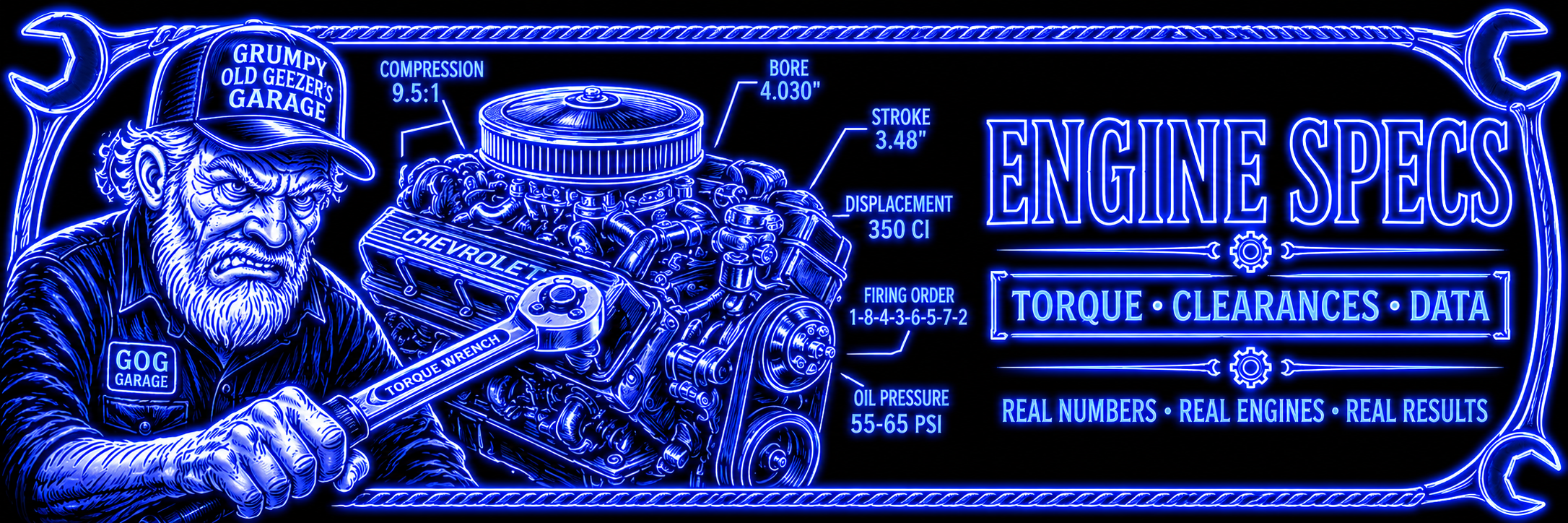
Mopar 440 Engine Specs
On This Page:
Engine Details: General Specs | Variants | Key Notes
Final Word: Bottom Line
Related: Related Links

Intro
➤ See the Family Page for specs common to all engines in this family.
The Mopar 440 RB is what happens when an engine gets famous by doing almost everything well instead of doing one exotic trick. Chrysler introduced it for 1966 with 440 cubic inches, a 4.320-inch bore, the RB family’s familiar 3.750-inch stroke, and enough torque to make a heavy car stop feeling like punishment. It was not the Hemi, did not cost Hemi money, and did not need hemispherical heads to make rear tires reconsider their career plans.
The 440 was the final big step in Chrysler’s raised-deck wedge progression. The 413 established the RB architecture. The 426 wedge opened the bore farther and went hunting for Super Stock trophies. The 440 opened it again and turned that same basic tall-deck idea into something Chrysler could use almost everywhere. Luxury cars, muscle cars, police packages, big cruisers, towing duty, marine service, motorhomes — the 440 spent far more time working than posing.
That broad usefulness is exactly why the engine became such a good street piece. A 440 does not need heroic rpm to feel strong. Big displacement and the 3.750-inch stroke give it the kind of midrange shove that works in a real car carrying real weight. Put sensible compression, decent heads, the right cam, enough carburetor, good exhaust, and proper gearing around one, and the engine generally gets on with the job instead of demanding a conference.
Then Chrysler built the performance versions and gave everybody something to argue about for the next half-century. TNT, Magnum, and Super Commando packages took the ordinary 440 formula and added the compression, camshaft, induction, exhaust, ignition calibration, and supporting hardware needed to make a genuine muscle-era bruiser. Those engines were not special because the air cleaner used larger lettering. The whole combination was different where it counted.
The Six Pack and Six Barrel versions turned the volume up again. Three two-barrel carburetors, serious supporting hardware, and some appropriately rude cars gave the 440 nearly as much showroom intimidation as the Hemi without requiring buyers to explain to their families why the engine option cost nearly as much as another used car. The package was real. So is the modern habit of bolting three carburetors onto an ordinary 440 and waiting for the pedigree to appear.
That is the 440’s biggest identification trap: there were simply too many legitimate versions. A New Yorker 440, Magnum, Super Commando, TNT, Six Pack, police engine, motorhome takeout, marine engine, late low-compression smog motor, and service replacement all say 440 somewhere in the conversation. They do not have the same compression, crankshaft, balance system, camshaft, heads, induction, exhaust, application, or value. Famous displacement is not a substitute for looking at the engine.
The late engines deserve better than the usual lazy verdict too. Emissions-era compression and calibration took plenty of bite out of factory performance, and later cast-crank combinations brought different balance requirements, but that does not make every late 440 junk. A sound block is still 440 cubic inches of useful RB iron. Just do not expect 1969 Magnum behavior to appear because somebody removed the smog equipment and painted the valve covers.
For most traditional Mopar street builds, the 440 remains one of the easiest big-block choices to defend. It has displacement, torque, broad parts support, decades of proven combinations, and enough factory history that nobody has to invent a reason for using one. That does not mean every correct 383, 413, or 426 car should be gutted for a 440 swap. More cubes can improve the stopwatch while making the car less interesting.
The 440 earned its reputation because it was common enough to use, strong enough to abuse, flexible enough to serve half the Chrysler catalog, and nasty enough in the right trim to make the Hemi share some of the attention. Buy the actual engine, not whatever version the orange paint is pretending to be. A plain good 440 has more than enough résumé without stealing anybody else’s.
↑ Back to the Top, Before the Casting Numbers Start Lying

Overview
Chrysler introduced the 440 for 1966 by using the same trick that had already worked twice in the RB family: leave the 3.750-inch stroke alone and open the bore farther. The 413 used a 4.1875-inch bore. The 426 wedge went to 4.250. The 440 reached 4.320 inches. Chrysler had found a useful crank throw years earlier and wisely resisted the urge to redesign it merely so engineers could have another dimension to explain.
The rest of the basic architecture remained pure RB: roughly 10.725-inch deck height, 4.800-inch bore spacing, 6.768-inch connecting rods, five main bearings, camshaft in the block, pushrods, wedge chambers, and shaft-mounted rocker arms. It was taller than the B-series 383 and 400, wider across the intake valley, and built around the longer 3.750-inch stroke that gave the RB engines their big-car torque personality.
That 4.320-by-3.750-inch combination produced exactly what Chrysler needed in the mid-1960s: a large-production engine with more displacement than the 413 and 426 wedge, but without the expense and complexity of the 426 Hemi. The Hemi could have the exotic cylinder heads and racing halo. The 440 could make mountains of torque, fit more applications, cost less to build, and actually sell in numbers large enough to matter.
Standard passenger-car 440s went into big Chryslers, Imperials, Dodges, Plymouths, wagons, and other heavy machinery where smooth authority was the assignment. Those engines were not failed muscle motors. They were supposed to pull tall gearing, move several thousand pounds without complaint, and produce effortless passing power with enough manners that the owner did not have to explain the idle to passengers.
That broad production role is one reason the 440 remains such a useful street engine today. The basic combination naturally favors torque in the rpm range where heavy street cars actually spend their lives. A sensible 440 does not need to scream to convince anybody it has displacement. Give it throttle and let Newton handle the demonstration.
The high-performance four-barrel versions sharpened the same architecture rather than replacing it. Chrysler called its version TNT, Dodge used Magnum, and Plymouth used Super Commando. Different names kept the marketing departments employed. Compression, camshaft, induction, exhaust, distributor calibration, and supporting hardware are what made the engines perform.
That distinction is important because the bare block itself did not receive supernatural powers when somebody stamped HP on the engine pad. Ordinary and high-performance engines could begin with the same basic casting family. The performance identity came from how Chrysler assembled the engine. HP is useful evidence. It is not a metallurgical blessing.
In the muscle cars, the formula worked beautifully. Chargers, GTXs, Road Runners, Coronets, and other performance Mopars already had enough weight to appreciate displacement, and the 440 supplied torque without requiring the driver to live at the top of the tachometer. The result was the kind of street performance that feels impressive before anybody has enough road to finish describing the carburetor.
Then came the Six Pack and Six Barrel combinations. Dodge called it Six Pack. Plymouth called it Six Barrel. Three two-barrel carburetors gave the 440 one of the most recognizable induction systems of the era and created a factory package with enough performance credibility that original examples now attract serious money and equally serious storytelling.
The 1969 A12 Road Runner and Super Bee packages are part of that story, combining the triple-carb 440 with heavy-duty drivetrain hardware and the sort of stripped-down performance thinking that did not waste engineering effort pretending everybody wanted luxury with his quarter-mile times. They were purposeful cars, which is why genuine ones deserve more than an air cleaner and an enthusiastic memory as proof.
A factory Six Pack or Six Barrel claim therefore needs the engine and the vehicle to agree. Induction, carburetors, linkage, air cleaner, engine stampings, dates, drivetrain, vehicle codes, tags, documentation, and history all help establish what Chrysler built. Three carburetors prove somebody owns three carburetors. Fortunately, Chrysler left more evidence than that.
Police and heavy-duty 440s added another personality. These engines could receive equipment suited to hard service, cooling, charging, exhaust, and sustained use. That can make them interesting foundations, but “police engine” does not mean the thing spent its career idling gently behind the library. Heat, long idle time, hard acceleration, and fleet maintenance can leave a very different kind of wear than weekend cruising.
Motorhome, truck, marine, and service applications kept the 440 alive well beyond its muscle-car glory years. That long working career is useful because it left plenty of cores. It is also dangerous because those engines may arrive with low compression, application-specific manifolds, different oil pans, unusual cooling systems, odd accessory drives, governor equipment, or other hardware that has no intention of cooperating with the passenger car waiting in the garage.
Marine engines deserve extra suspicion before somebody celebrates finding cheap 440 iron. Cooling hardware, manifolds, front dress, crank and flywheel arrangements, and possible rotation differences all need checking. An engine can be perfectly complete for the boat it came from and astonishingly incomplete five minutes after the buyer decides it belongs in a Charger.
The long production life also changed the rotating assembly. Early 440s commonly used forged crankshafts and internally balanced combinations. Later production introduced cast-crank versions requiring external balance through the correct damper and rear balance hardware. Mix an externally balanced crank with neutral pieces because “all 440 stuff fits,” and the engine will begin explaining the mistake long before the bearings appreciate it.
The famous Six Pack heavy-rod forged-crank combinations complicate the balance conversation further because they used their own balance corrections. A weighted-looking damper does not automatically prove a cast crank, and a forged crank does not automatically mean every neutral-balance piece belongs behind it. The crank, rods, damper, converter or flywheel, and flexplate have to be treated as one rotating system rather than a yard-sale collection.
The 440’s cylinder heads create another easy way to get distracted. Mopar B and RB wedge heads interchange broadly enough that desirable castings have spent decades migrating between engines. A set of good heads can improve a 440 enormously. They cannot testify about what the block was born under. Heads identify heads. That rule has saved more money than staring at orange paint ever will.
Compared with the 383, the 440 is taller, longer-stroked, and much more interested in low- and midrange torque. The 383’s 3.375-inch stroke gives it a somewhat quicker, freer-revving character, while the 440’s 3.750-inch stroke and extra displacement make heavy-car acceleration feel less dependent on enthusiasm from the tachometer.
Compared with the low-deck 400, the 440 brings more factory displacement but a taller, wider package. The 400’s huge bore and low-deck architecture later made it a favorite modern stroker foundation. The 440 remains the simpler answer when the goal is already having 440 cubic inches before the machine shop starts inventing more.
Compared with the 426 Hemi, the 440 is the sensible brother everybody secretly borrowed tools from. The Hemi has better exotic-head mythology, racing pedigree, collector value, and enough visual drama to empty a parking lot when the hood opens. The 440 is simpler, more common, easier to package, and perfectly capable of producing brutal street performance without turning every replacement part into a financial decision.
That makes the 440 one of the strongest general-purpose Mopar big-block choices when originality does not dictate another engine. A mild build with useful compression, decent heads, a cam selected for vehicle weight and gearing, enough carburetor, proper ignition, free exhaust, and adequate cooling can make an excellent cruiser or muscle-car engine. Nothing clever is required. The cubic inches already did some of the homework.
Unfortunately, plenty of builders treat those cubic inches as permission to quit thinking. Too much cam, too little compression, oversized carburetion, poor exhaust, lazy gearing, wrong converter, and bad ignition can make a 440 surprisingly unimpressive. Large displacement forgives plenty. It does not perform miracles for combinations assembled by catalog page number.
Late low-compression 440s need the same clear-eyed approach. Their factory performance may be a long way from the high-compression muscle-era engines, but a healthy later core can still be useful if the build restores compression and matches the rest of the combination properly. Removing emissions equipment does not restore compression ratio. That usually requires parts with pistons attached.
Condition can overrule every version discussion anyway. These engines have hauled trailers, powered boats, idled in police cars, dragged motorhomes across mountains, raced, overheated, been bored repeatedly, and survived rebuilds from several generations of machine shops. Cracks, worn bores, damaged decks, tired main saddles, thread repairs, corrosion, and ancient machine work do not disappear when somebody identifies an HP stamp.
For restoration work, preserve genuine performance engines when the evidence supports them. A real Magnum, Super Commando, TNT, Six Pack, or Six Barrel combination has value because of the complete factory package. Replacing rare correct hardware with generic speed parts in pursuit of another twenty horsepower may improve a dyno sheet while making the engine less interesting everywhere else.
For an ordinary street project, a plain sound 440 can be the better starting point anyway. There is no collector guilt, no rare induction system to protect, and no reason not to choose modern pistons, camshaft, heads, ignition, or exhaust around the actual mission. Ordinary iron is wonderfully liberating when nobody is paying extra for the factory mistakes to remain intact.
The 440’s reputation ultimately comes from versatility rather than exclusivity. Chrysler built faster, rarer, stranger, and more glamorous engines. Very few combined this much displacement, torque, durability, production volume, and performance potential in one package. The 440 could chauffeur an executive, chase a speeder, pull a house, push a boat, or make a Road Runner considerably more interested in the next stoplight.
That is why the smart way to judge one is still the least glamorous way. Identify the year and application. Read the pad and casting. Determine forged versus cast crank. Verify the balance hardware. Check the heads, induction, exhaust, and documentation if somebody is selling a performance pedigree. Then measure the block before planning the build. A 440 has enough muscle to survive without mythology. The expensive mistakes usually begin when somebody decides the number alone has already answered the questions.
↑ Back to the Top, Before the Casting Numbers Start Lying

General Specs
| Displacement | 440 cu in / 7.2L | Bore / Stroke | 4.320 in × 3.750 in |
| Production / Use Era | 1966–1978 Mopar RB-series passenger-car, performance, and truck big-block era | Bore Spacing | 4.800 in |
| Engine Family | Chrysler / Mopar RB-series raised-deck big-block wedge V8 | Deck Height | 10.725 in |
| Block Material | Cast iron | Rod Length | 6.768 in |
| Cylinder Head Material | Cast iron | Main Journal | 2.750 in |
| Fuel / Induction | Gasoline; carbureted, 2-barrel, 4-barrel, or Six Barrel / Six Pack by version | Rod Journal | 2.375 in |
| Cam Location | In-block camshaft | Main Bearings | 5 |
| Valve Layout | OHV / pushrod, 2 valves per cylinder | Firing Order | 1-8-4-3-6-5-7-2 |
| Common Main Caps | 2-bolt | Distributor Rotation | Counterclockwise |
| Rear Main Seal | 2-piece | Weight | ~670–720 lb complete iron RB big-block, depending on accessories/configuration |
| Balance | Internal balance on forged-crank versions; external balance on cast-crank versions | Dimensions | ~30H / ~29W / ~32L |
↑ Back to the Top, Before the Casting Numbers Start Lying

Variants
The 440 stayed in production long enough for Chrysler to change considerably more than the air-cleaner lettering. Early engines commonly carried forged cranks and useful compression. The real HP versions added camshaft, exhaust, induction, and calibration. Six Pack and Six Barrel engines added their famous triple-carburetor system and, in some combinations, heavier rotating hardware with its own balance requirements. Later 440s lost compression and eventually gained cast cranks with external balance. Same 4.320-inch bore and 3.750-inch stroke throughout. What surrounded that displacement changed enough that “it’s a 440” is only the beginning of the inspection.
Early Standard 440 — Forged-Crank Passenger-Car Version
What it was: The original 440 arrived for 1966 as Chrysler’s largest regular-production RB wedge. It went into big Chryslers, Imperials, Dodges, Plymouths, and wagons where effortless torque mattered more than a performance badge.
What changed: Early 440s commonly used forged crankshafts with internally balanced rotating assemblies, conventional passenger-car heads, mild hydraulic cam timing, and ordinary 4-barrel or other application-appropriate induction.
What that did: The 440’s displacement and 3.750-inch stroke supplied plenty of low- and midrange pull without needing heroic rpm. A normal 440 could make a two-ton Chrysler move smartly while idling smoothly enough that the passengers never had to know anything interesting was happening under the hood.
Where used: Mid- and late-1960s Chrysler, Imperial, Dodge, Plymouth, wagon, and other regular passenger-car applications.
A standard 440 is not an HP engine waiting for the right decal. Chrysler built plenty of excellent ordinary 440s, and they do not need to borrow somebody else’s camshaft to justify existing.
440 TNT / Magnum / Super Commando — High-Performance Four-Barrel
What it was: This is the factory four-barrel performance 440. Chrysler called it TNT, Dodge called it Magnum, and Plymouth called it Super Commando. Marketing departments changed the nouns. The useful differences were made out of metal.
What changed: HP versions combined performance-oriented 4-barrel carburetion with hotter cam timing, stronger compression in the muscle-era engines, freer exhaust, performance distributor calibration, and the supporting hardware appropriate to the application.
What that did: The 440 already had torque. The HP package let it breathe and keep pulling farther through the rpm range instead of signing off like a luxury-car engine once the tachometer became interesting. That combination made the 440 such an effective muscle-car engine: plenty of displacement downstairs and enough airflow upstairs to make the whole car rude.
Where used: Chrysler TNT, Dodge Magnum, and Plymouth Super Commando performance applications in muscle-era B-, C-, and E-body cars.
Identification caution: Four barrels and orange paint prove almost nothing. Pad stamping, casting date, intake, carburetor, heads, camshaft, compression, exhaust manifolds, distributor, vehicle application, tags, broadcast sheet, and documentation need to support an HP claim. Parts are more reliable witnesses than sellers.
440 Six Pack / Six Barrel — Triple Two-Barrel Performance
What it was: Dodge called it Six Pack. Plymouth called it Six Barrel. Either way, Chrysler put three two-barrel carburetors on a 440 and created one of the most recognizable induction packages of the muscle era.
What changed: The factory package used a dedicated intake manifold, three two-barrel carburetors, progressive linkage, matching air-cleaner hardware, performance camshaft and exhaust, and heavy-duty supporting pieces. Some Six Pack combinations also used the famous heavier connecting rods with a forged crankshaft and their own balance correction rather than the ordinary neutral-balance forged-crank setup.
What that did: The outer carburetors stayed out of the way during mild driving and joined the center carburetor when the throttle opened far enough to make fuel economy somebody else’s problem. The result supplied enormous airflow without giving away the broad torque that made the 440 useful in the first place.
Where used: Dodge Six Pack and Plymouth Six Barrel performance applications, including the 1969 A12 Super Bee and Road Runner packages and later factory triple-carburetor 440 cars.
Identification caution: Three carburetors establish that the engine currently owns three carburetors. They do not establish factory Six Pack or Six Barrel identity. Engine stamping, intake, carburetors, linkage, air cleaner, rotating assembly, balance hardware, exhaust, vehicle codes, drivetrain, tags, broadcast sheet, and history all need to agree.
Later Low-Compression / Cast-Crank 440
What it was: The 440 survived the muscle era and kept working while compression ratios, emissions requirements, fuel quality, and factory priorities headed in another direction.
What changed: Later engines moved toward lower compression and milder emissions-era calibration. Chrysler eventually introduced cast-crank 440 combinations that required external balance through the correct damper and rear balance hardware rather than the earlier forged-crank neutral-balance arrangement.
What that did: Factory output fell, but the basic block still contained 440 cubic inches. Removing emissions equipment does not put the compression back, and installing an early air cleaner does not convert a late engine into a 1969 Magnum. Pistons remain stubbornly unimpressed by decals.
Where used: Later passenger cars and other 1970s 440 applications as the engine moved away from its high-compression muscle-era configuration.
Identification caution: Determine forged versus cast crank and verify the matching damper, converter or flywheel, and flexplate before mixing rotating parts. A 440 assembled with the wrong balance hardware will explain the mistake far more convincingly than this page can.
Police / Heavy-Duty 440
What it was: Police and fleet 440s were built for sustained hard service rather than showroom bragging.
What changed: Depending on application, these packages could include heavier cooling, charging equipment, specific exhaust and distributor calibration, different pulleys, oil pans, carburetion, and other fleet-duty supporting hardware.
What that did: Better supporting equipment helped the engine survive long idle periods, heat, repeated hard acceleration, and sustained high-speed work. Unfortunately, it also means many surviving examples received exactly the abuse all that hardware was installed to tolerate.
Where used: Police, pursuit, fleet, and other heavy-duty Chrysler Corporation applications.
Identification caution: A big radiator does not make a police engine. Cooling hardware, charging system, exhaust, distributor, pulleys, oil pan, application tags, vehicle documentation, and history need to support the claim.
Motorhome, Truck, Marine, and Service 440s
What it was: The 440 kept earning wages after the muscle-car posters had faded. Motorhomes, trucks, marine applications, industrial equipment, and service replacements extended the engine’s working life well into the 1970s.
What changed: These engines can carry low compression, application-specific manifolds, oil pans, cooling systems, accessory drives, governors, flywheel or crank hardware, and other pieces selected for pulling houses, turning propellers, or running machinery rather than fitting neatly into a Road Runner.
What that did: Some make excellent rebuildable cores. Others spent years hot, loaded, slow, corroding, or being serviced only after the noise changed. A motorhome 440 can be cheap because nobody wants the motorhome. That does not mean the cylinders got the same retirement plan.
Identification caution: Marine engines deserve particular attention for cooling arrangements, manifolds, crank and flywheel details, front dress, and possible rotation differences. A complete boat engine can become remarkably incomplete the moment somebody decides it belongs in a Charger.
So the useful 440 hardware map is broader than the badge suggests: early forged-crank passenger engines, real HP four-barrels, Six Pack / Six Barrel combinations, later low-compression and cast-crank versions, heavy-duty fleet engines, and work-duty applications. The 440 became famous because Chrysler could make it do nearly anything. Sixty years later, that versatility is exactly why the engine on the stand needs to prove which one it is.
↑ Back to the Top, Before the Casting Numbers Start Lying

Key Notes
The Mopar 440 RB is the raised-deck big block everybody thinks he understands, which is exactly why it gets people in trouble. It’s famous, common enough to build, strong enough to respect, and popular enough that every seller with orange paint starts practicing his “HP engine” voice. A 440 can be a great engine. A 440 can also be a regular big-car core wearing somebody else’s muscle-car attitude.
The basic fingerprint is 4.320-inch bore and 3.750-inch stroke in Chrysler’s RB architecture. That separates it from low-deck B engines like the 361, 383, and 400, and from the smaller-bore 413 and 426 wedge RB engines. The 440 is the biggest regular-production RB wedge, not a universal “big-block Mopar” blob where every intake, piston, pan, bracket, and balance part magically agrees.
The 440’s biggest advantage is displacement with support. It starts with real cubic inches, has strong parts availability, and can make serious street torque without exotic hardware. That’s why it became the default Mopar big-block answer for so many builds. But default doesn’t mean automatic. The engine still needs the right compression, camshaft, heads, induction, exhaust, ignition, cooling, converter or clutch, and rear gear.
Factory 440s came in a wide spread, and that spread is where the trouble starts. A standard luxury-car 440, TNT, Magnum, Super Commando, Six Barrel, Six Pack, police engine, motorhome pullout, marine piece, service replacement, and later low-compression smog-era engine don’t carry the same hardware or value. Carburetion, heads, cam, compression, exhaust manifolds, HP stampings, application, dates, and documentation need to agree before the price starts puffing its chest.
Six Barrel and Six Pack claims need hard proof. A real triple-carb 440 package had specific induction, linkage, air-cleaner hardware, calibration, application context, and documentation. Three carburetors sitting on an intake don’t automatically create a factory Six Pack engine. Sometimes they create history. Sometimes they create a tuning problem with an ego.
HP stamping claims need the same discipline. A factory HP 440 can be worth more in the right car, but the letters alone don’t finish the story. The pad stamping, casting date, assembly date, vehicle application, heads, manifolds, intake, carburetor, distributor, transmission pairing, and documentation all need to agree. A stamped pad without context is not a permission slip for muscle-car pricing.
The 440 needs separation from the 383 and 400 because people love comparing them badly. The 383 is the shorter-stroke low-deck practical hero. The 400 is the big-bore low-deck stroker darling. The 440 is the long-stroke raised-deck torque default. Those are different build lanes. Bigger is useful. It isn’t always smarter.
The 440 also needs separation from the 426 Hemi and 426 wedge. The Hemi lives in a different hardware, value, and proof universe. The 426 wedge shares RB family logic but carries its own early performance and Max Wedge baggage. A 440 can be powerful and desirable without pretending to be either. If the sales pitch starts borrowing Hemi or Max Wedge glory, the Geezer starts looking for what the engine actually is.
Cast-crank and forged-crank differences matter. Early and performance-era 440s are often discussed like all of them share one rotating story, but later cast-crank engines and externally balanced combinations need the correct damper, converter, flexplate, flywheel, and balance parts. Mix balance pieces by guesswork and the big wedge will shake like it’s trying to confess something.
Truck, motorhome, marine, and industrial-service 440s deserve inspection before celebration. Some are good foundations. Some lived hot, loaded, under-maintained lives with odd accessories, different manifolds, special pans, heavy-duty cooling, governor equipment, or application-specific front dress. A cheap takeout can be a bargain, or it can be a greasy lesson in why “ran when parked” should be printed on warning labels.
Interchange helps because the RB family has real support, but it won’t save lazy parts mixing. Heads, intakes, cams, timing parts, oil pans, accessories, exhaust, ignition pieces, converters, balance parts, and transmission combinations need to match the year, application, and build. A 440 has enough support to make building easier than the oddballs. It also has enough versions to punish people who stop reading after “RB.”
A used 440 needs identification before bragging starts. Check block casting, pad stamping, bore size, crank, heads, intake, carburetion, exhaust pieces, date codes, vehicle application, HP markings, crank type, balance hardware, and previous machine work. These engines have been swapped, stroked, overbored, raced, worked hard, de-smogged, cloned, painted, and rebuilt badly for decades. Orange paint and big valve covers don’t make the story true.
Block condition still matters. The 440 is popular enough that people assume any core is worth dragging home, but cracks, excessive overbore, damaged decks, worn main saddles, tired heads, bad threads, and ancient machine work can still turn a desirable block into a bill pile. Measure it, inspect it, and stop acting like displacement makes rust and abuse apologize.
Build judgment depends on purpose. A mild 440 can be a great street engine with compression, decent heads, proper cam, good ignition, strong exhaust, enough converter or gear, and a cooling system that isn’t trying to retire. A serious 440 can make plenty of power. But if the plan is all cam, no compression, bad exhaust, lazy gearing, and a carb big enough to drown the combination, the 440 will still run like a parts catalog had a seizure.
The Mopar 440 RB deserves its reputation because it’s one of Chrysler’s best big-block street engines. It has cubes, torque, strength, support, and real muscle-era history. It doesn’t need fake Six Pack claims, Hemi envy, or mystery HP stamps to matter. Verify the RB identity, version, application, dates, heads, induction, exhaust, crank type, balance package, block condition, and documentation before spending money. A 440 can be the right hammer, but the block, parts, and proof still have to survive the swing.
↑ Back to the Top, Before the Casting Numbers Start Lying

Bottom Line
The Mopar 440 RB is the practical king of Chrysler big-block torque. It was common enough to power everything from luxury cars and police packages to muscle cars, marine applications, motorhomes, and heavy-duty work, yet strong enough to earn a reputation that never needed Hemi valve covers to get attention. That broad usefulness is exactly why the 440 is so good — and exactly why the number alone proves almost nothing about the version sitting in front of you.
The serious factory performance versions deserve the noise. TNT, Magnum, Super Commando, HP, Six Pack, and Six Barrel engines can be highly desirable when the hardware and documentation support the claim. A regular passenger-car 440 deserves respect too. It can make an excellent cruiser, street engine, or restoration piece without pretending triple carburetors appeared sometime during the previous owner’s memory lapse.
For most street builds, the 440 makes one of the strongest arguments in the Mopar big-block world. It already brings displacement and torque, parts familiarity is broad, and a healthy standard engine can be built into something strong without chasing exotic hardware. That does not make it the automatic answer for every car. A correct 383, 413, 426 wedge, or Hemi car can lose more identity than it gains from a 440 swap, and a low-deck 400 stroker may make more sense when the project is starting from scratch.
The cheap-core trap deserves its own warning. Late motorhome, work-duty, marine, and low-compression engines can be useful foundations, but they can also arrive heat-soaked, worn out, oddly equipped, or missing enough pieces to erase the bargain before machining begins. A famous displacement does not heal cracked iron, replace bad bores, straighten old machine work, or make the wrong balance parts suddenly cooperate.
So buy the actual 440, not the legend attached to the number. Preserve the genuine performance versions, respect the ordinary good ones, and judge every loose core by condition, completeness, and purpose. The 440 earned its reputation because it was big, strong, useful, and brutally effective in the right combination. Treat every one like a rare factory monster, though, and the only thing guaranteed to make big torque will be the machine-shop bill twisting the wallet.
↑ Back to the Top, Before the Casting Numbers Start Lying
Related Links
Torque Specs
Common Factory Pairings
Carburetors
- Carter AFB — 4-bbl
- Carter AVS — 4-bbl
- Carter BBD — 2-bbl
- Carter Thermo-Quad — 4-bbl
- Holley 2300 — 2-bbl
- Holley 4150 — 4-bbl
- Holley 4160 — 4-bbl
- Stromberg WW / WWC — 2-bbl
Transmissions
- A230 — 3-Speed
- A250 — 3-Speed
- A745 — 3-Speed
- A833 — 4-Speed
- Borg-Warner T18 — 4-Speed
- New Process NP435 — 4-Speed
- A727 TorqueFlite — 3-Speed Automatic