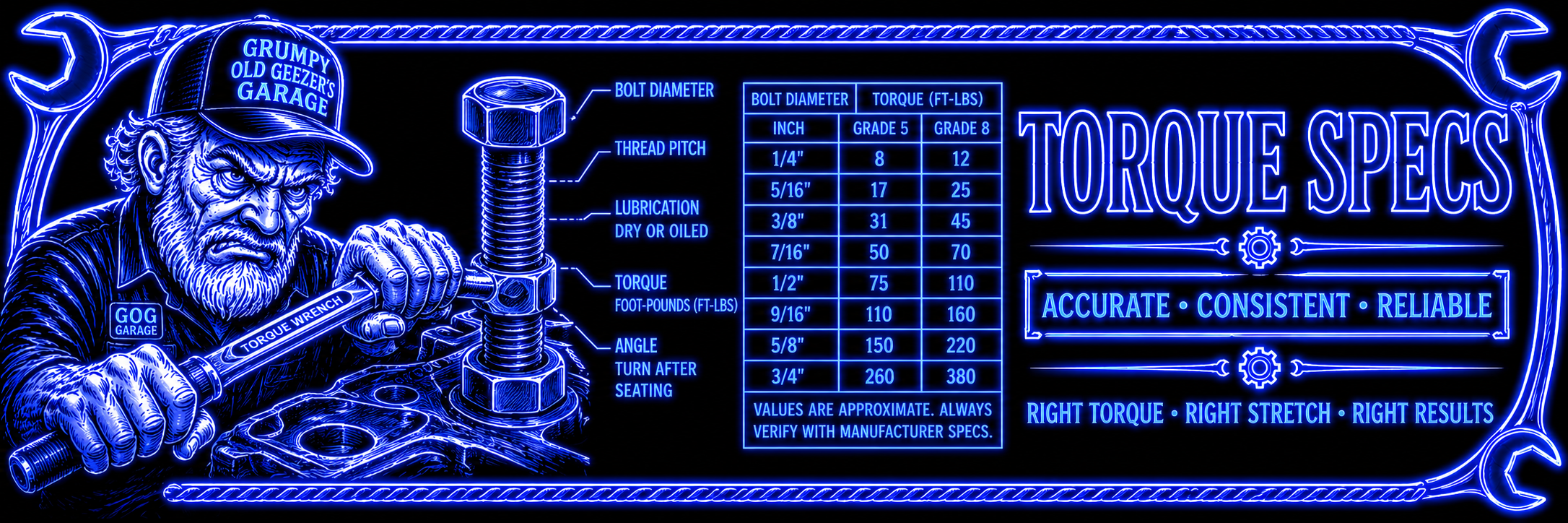
Chevy Stovebolt Inline Six Torque Specs
On This Page:
Intro | Torque Specs | Notes | Mistakes | Bottom Line | Links

Intro
The early Chevrolet Stovebolt six looks simple because it is simple. That doesn’t make it modern, and it sure doesn’t make every 194, 207, 216, and early splash-lubricated 235 interchangeable at the torque wrench.
These engines came from the era of babbitt bearings, shims, splash lubrication, plain-steel fasteners, and specifications that changed as Chevrolet developed the family. Rod-cap values move from 25-35 lb-ft on early 194 / 207-style hardware to 40-50 on later 216-style assemblies. Head-bolt values make a similar jump. Those differences belong to the engine, not to whatever number somebody remembers an old Chevrolet six ought to take.
The wrench only supplies clamping force. It can’t identify the engine, set a babbitt bearing, choose the right shim pack, repair worn threads, or tell an early fastener from a later one. On a Stovebolt, the wrench is about sixth in line for the important jobs.
↑ Back to the Top, Before “Good and Tight” Breaks Something Else

General Torque Specs
| Bottom End | Top End | ||
|---|---|---|---|
| Main Bearing Cap Nuts | 75-80 lb-ft1 | Cylinder Head Bolts | 60-70 lb-ft5 75-80 lb-ft6 |
| Connecting Rod Cap Nuts | 25-35 lb-ft2 40-50 lb-ft3 |
Rocker Shaft Bolts | 25-30 lb-ft |
| Piston Pin Clamp Bolt | 25-30 lb-ft | Spark Plugs | 20-25 lb-ft |
| Oil Pan Rail Bolts | 6-8 lb-ft4 | Oil Pan Corner Bolts | 12-15 lb-ft4 |
| Manifolds and Carburetor | Driveline Side | ||
| Manifold Clamp Bolts | 15-20 lb-ft | Flywheel Bolts | 50-60 lb-ft |
| Carburetor Mounting Nuts | 8-12 lb-ft | Pressure Plate Bolts | 25-30 lb-ft |
| Bellhousing Bolts | 45-55 lb-ft | ||
| Starter Bolts | 25-35 lb-ft | ||
| External Engine | |||
| Water Pump Bolts | 25-30 lb-ft | Fuel Pump Bolts | 15-20 lb-ft |
| Timing Gear Cover Bolts | 6-8 lb-ft4 | Distributor Clamp Bolt | 10-15 lb-ft |
1 Common early Stovebolt working value. Babbitt fit, cap condition, shims, and rebuilder guidance still matter.
2 Early 194 / 207-style rod value where the lower range applies. Bearing clearance is still checked by fit, not wished into place by torque.
3 Later 216-style rod cap value where the higher range applies. Check the actual rod hardware and bearing setup.
4 Small gasketed covers and pans distort easily. Tighten evenly and do not turn seep control into sheetmetal damage.
5 Early 1929-era practical head-bolt value where the lower range applies.
6 Common 216 / early splash-235 head-bolt value.
The split rod and head values are the part of this table worth staring at before the wrench comes out. An early 194 / 207-style rod assembly at 25-35 lb-ft isn’t asking for the same clamp load as the later 216-style hardware at 40-50. Head-bolt figures tell the same story: early engines can live in the 60-70 lb-ft range while later 216 / splash-235 applications move to 75-80.
None of that turns torque into a substitute for bearing work. A shimmed babbitt assembly is fitted for clearance first and clamped afterward. Tightening the cap harder won’t correct a bearing that was fitted wrong; it just gives the mistake more force.
The other end of the scale can bite just as hard. Oil-pan rail and timing-cover bolts are only 6-8 lb-ft, while the pan corners use 12-15. Old sheetmetal will bend long before an enthusiastic wrench hand decides it’s had enough.
Rebuilt babbitt assemblies, replacement studs, reproduction fasteners, changed rods, and other non-original hardware use the rebuilder or part maker’s instructions. An eighty-year-old engine has had plenty of time to collect other people’s decisions, so the hardware deserves more attention than the casting date.
↑ Back to the Top, Before “Good and Tight” Breaks Something Else

Important Notes
- Early 194 / 207-style engines and later 216 / early splash-235 versions belong to the same Chevrolet lineage, but the rod and head numbers make one thing plain: one generic Stovebolt chart isn’t enough.
- Babbitt-bearing clearance is established by fit and shimming. The rod-cap nut only clamps the finished adjustment together. If the clearance is wrong before tightening, there isn’t a magic mark on the torque wrench that’ll rescue it.
- Some of the earliest values are practical working figures rather than the tidy specifications later service literature hands you. That calls for better identification and inspection, not a bigger allowance for guessing.
- Old threads can change the relationship between wrench torque and actual clamp load. Rust, dirt, stretched fasteners, repaired holes, and reproduction hardware all deserve inspection before an old block is asked to hold another rebuild together.
- The oil-pan rails and corners deliberately use different figures. Treat the entire pan as though every bolt wants 12-15 lb-ft and the rails can be distorted before the leak ever gets a chance to start.
↑ Back to the Top, Before “Good and Tight” Breaks Something Else

Common Mistakes
- Using one “old Chevy six” number across the 194, 207, 216, and early splash-235 without checking which rod and head-bolt range belongs to the engine.
- Trying to correct babbitt-bearing clearance with more wrench instead of fitting and shimming the bearing correctly.
- Applying the later 75-80 lb-ft head figure to an early application that belongs in the lower range, or carrying the early number forward onto the later engine.
- Assuming an old fastener that threads in smoothly is still fit for another service cycle without checking its condition, the hole, or previous repairs.
- Giving every oil-pan bolt the corner-bolt torque and pulling the rails out of shape.
- Using modern replacement or reproduction hardware with an old factory-style number when the replacement part has its own torque or lubrication requirement.
↑ Back to the Top, Before “Good and Tight” Breaks Something Else

Bottom Line
The early Stovebolt is simple machinery from a time when a mechanic had to fit parts, not just tighten them.
Its rod and head specifications changed as the family evolved, its babbitt bearings still demand correct clearance before the caps are tightened, and its little gasketed fasteners need a whole lot less enthusiasm than the mains and head bolts.
Identify the version, fit the bearing before clamping it, respect the split specifications, and remember that a torque wrench can tighten an old Chevrolet six perfectly while the rest of the assembly is completely wrong.
↑ Back to the Top, Before “Good and Tight” Breaks Something Else

Related Links
Engine Specs
- Chevrolet Stovebolt 194 Inline-Six Engine Specs
- Chevrolet Stovebolt 207 Inline-Six Engine Specs
- Chevrolet Stovebolt 216 Inline-Six Engine Specs
- Chevrolet Early Splash-Lubricated 235 Inline-Six Engine Specs
Engine Family
- Chevrolet Stovebolt Inline-Six Engine Family
↑ Back to the Top, Before “Good and Tight” Breaks Something Else