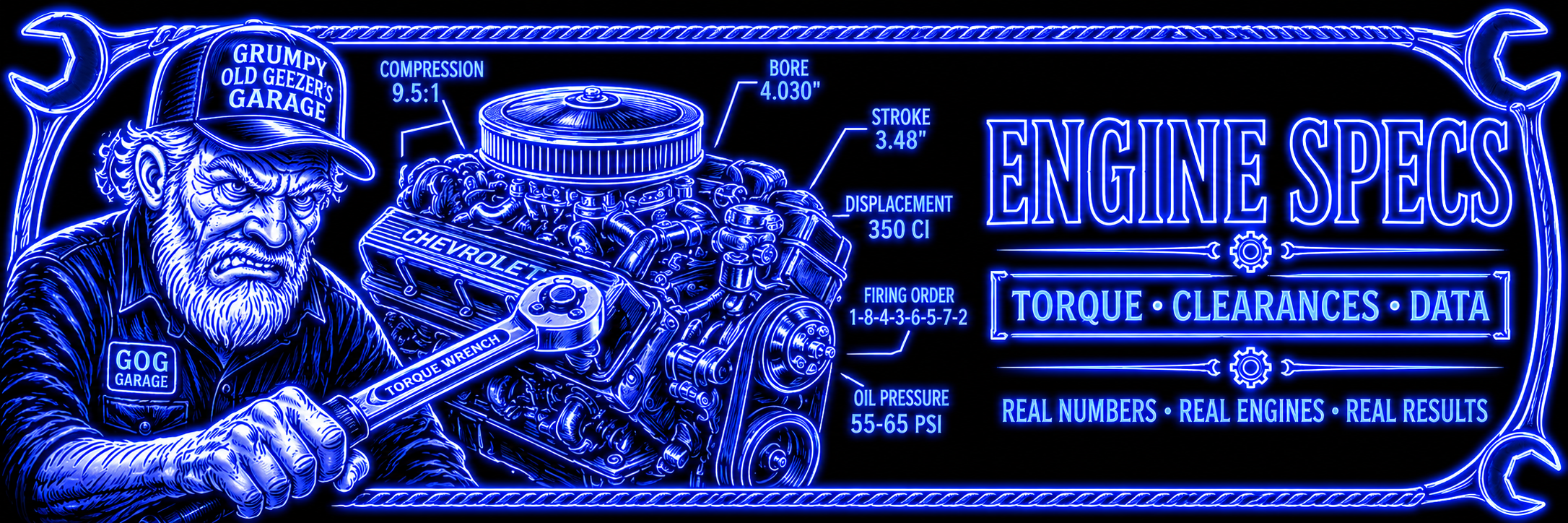
Engine Specs
Intro
You don’t identify an engine by the badge, the seller’s story, or the displacement number somebody keeps repeating. You identify it by the manufacturer, engine family, physical features, casting clues, production range, and specs that actually match the chunk of iron in front of you.
That’s what this section is for: hard engine reference, not folklore dressed up like confidence. Bore, stroke, displacement, firing order, compression, horsepower, torque, production years, family differences, and version details all matter. Guess wrong, and the parts bill usually shows up before the lesson does.
Start with the manufacturer, then work down to the engine family and version. Skip the family step and the numbers turn into trivia with consequences.
Reality Check: A “350” is not always the same 350. Same displacement does not mean same block, same heads, same crank, same firing order, same parts, or same specs.
↑ Back to the Top, Before the Family Tree Gets Another Branch

Chevrolet engine specs start with the active small-block and big-block families in this release. Use this page to reach the Gen I small-block, W-series big-block, and Mark IV big-block pages before choosing the exact displacement.
Ford engine specs cover the current release families, including Y-block, Windsor, Cleveland / Modified, FE, MEL, and 385-series engines. Start here when the family name matters more than the displacement number.
Mopar engine specs cover the current release families, including A / Poly, LA, B-series, RB-series, and Hemi engines. Sort the family first, because Mopar badges and engine names can get slippery fast.
Key Points
Engine specs are only useful when you know exactly what engine you are looking at. Guessing by badge, displacement, or what some seller wrote in a listing is how people end up with parts that almost fit.
Start With the Engine Family
Displacement is not enough. Identify the engine family first, then the specific version. A 302, 305, 318, 350, 351, 400, or 455 can mean very different things depending on the manufacturer, era, and application.
Badges Lie
Fender emblems, air cleaner decals, valve-cover stickers, and sales listings are not proof. Engines get swapped, rebuilt, dressed up, repainted, and misrepresented. Use casting numbers, block design, head layout, intake pattern, distributor location, and other physical clues before trusting the label.
Same Cubic Inches Does Not Mean Same Engine
Manufacturers reused displacement numbers across unrelated engine families. General Motors is especially good at making this confusing. A 350 small block Chevy, 350 Olds, 350 Buick, 350 Pontiac, LT1, LS-based engine, and later LT-family engine do not share the same basic identity.
Production Years Can Overlap
Old engine families did not always disappear the day a new one showed up. Trucks, vans, performance cars, fleet vehicles, and odd applications often kept older engines longer than passenger cars. Do not assume the year alone tells the whole story.
Specs Change by Application
Compression ratio, camshaft, heads, intake, carburetion, fuel injection, emissions equipment, horsepower, and torque can vary by year, vehicle, transmission, market, and emissions package. The same engine family can have strong versions, weak versions, truck versions, smog-era versions, and performance versions.
Horsepower Ratings Changed
Early engines were often rated using gross horsepower. Later engines used net horsepower. Do not compare those numbers straight across like they mean the same thing. A drop on paper does not always mean the engine suddenly became worthless. Sometimes the measuring stick changed.
Use Specs as Identification Support, Not the Whole Case
Bore, stroke, firing order, deck height, valve layout, distributor location, and block architecture can help confirm what you have. But one clue by itself is not enough. Match several details before calling it identified.
Aftermarket and Rebuilt Engines May Not Match Factory Specs
Once an engine has been rebuilt, bored, stroked, decked, cammed, swapped, or fitted with aftermarket heads, factory specs may only describe what it used to be. Good for identification. Not always good for final build assumptions.
Parting Shot
Right manufacturer. Right family. Right version.
That is the order. Skip it, and the numbers turn into trivia with a parts bill attached.
Engine specs are useful only after the engine is properly identified. Otherwise, you are not researching. You are guessing with confidence.