Herb McCandless
They Called Him Mr. 4 Speed Because Nobody Had Invented a Fifth Gear He Needed Yet
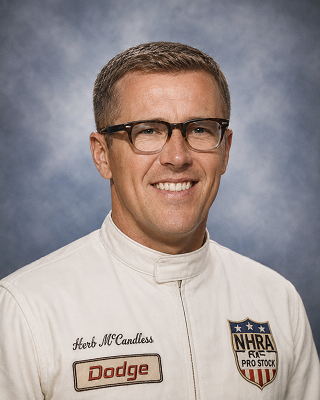
There are people who can drive a manual transmission, and there are people who can shift one quickly.
Then there was Herb McCandless.
McCandless could powershift a Chrysler four-speed so quickly and cleanly that the transmission seemed to have misplaced the part where the car stopped accelerating between gears. That earned him the nickname Mr. 4 Speed.
But reducing Herb McCandless to fast shifts misses most of the story. He could build the car, tune it, diagnose it and then climb inside and race it. Chrysler used him to test performance parts. Sox & Martin hired him when one of the strongest drag-racing operations in America needed another driver who would not embarrass the name on the door.
In 1970, during the first season of NHRA Pro Stock, McCandless drove a Sox & Martin Hemi Duster to victory at the U.S. Nationals.
Ronnie Sox may have been the most famous four-speed driver in the building. Herb McCandless was good enough that Sox & Martin put him in the other car.
It Started With a Job and a 409
McCandless grew up in Memphis, Tennessee, and started drag racing in 1959 at age 16. There was no factory contract waiting for him. He worked full time at a print shop and raced whenever the paycheck and the race car could be persuaded to cooperate.
By 1963, McCandless was running a Chevrolet powered by a 409. He bought an engine from “Dyno Don” Nicholson and had Bill “Grumpy” Jenkins sort out the carburetors.
That is a fairly respectable pair of people to have involved when a young racer is trying to make a Chevrolet faster.
McCandless built a reputation for two things that would follow him through his career: he could drive, and he understood why the car was doing what it was doing.
Chrysler Offered Him a Hemi
McCandless eventually attracted the attention of John Moore, an assistant regional manager for Chrysler-Plymouth. Moore asked whether he could drive a four-speed Hemi Belvedere.
McCandless gave the sort of answer that becomes a nickname later.
He could drive a four-speed anything.
At 21, still living at home, he arranged financing and bought a new 1965 A990 Super Stock Hemi Plymouth Belvedere. McCandless took the Plymouth west to the NHRA Winternationals and won his A/Stock four-speed class.
John Moore already knew what he wanted painted on the car: Mr. 4 Speed.
The name stayed. Chrysler had plenty of drivers who could leave the starting line. Finding one who could grab the next three gears without wasting what the Hemi had just produced was more useful.
The Hemi Dart Made Him a Hired Gun
By 1968, Chrysler had escalated the Super Stock war with the Hurst-built Hemi Dart and Barracuda. The formula was subtle only by Detroit’s standards: take one of the smallest cars in the catalog, install the 426 Race Hemi, remove anything unnecessarily heavy and sell just enough of them to satisfy the rulebook.
McCandless acquired a 1968 Hemi Dart and raced it extensively. Buddy Martin also hired him to drive a 440-powered Sox & Martin Plymouth GTX at the Winternationals.
McCandless won his class. That helped settle another question.
He quit the print-shop job and became a professional racer.
1970 Started With Another Trophy
Before Pro Stock became McCandless’s full-time assignment, he opened 1970 by winning Modified Eliminator at the Gatornationals. It was another NHRA national-event victory for a driver whose reputation was already spreading well beyond Memphis and the Chrysler Super Stock crowd.
Then NHRA created Pro Stock.
Then Pro Stock Arrived
The new category gave the factory hot rods a heads-up professional class of their own. The first fields were loaded with Ronnie Sox, Bill Jenkins, Dick Landy, Dyno Don Nicholson, Arlen Vanke, Butch Leal and enough other serious racers to make qualifying an accomplishment.
Sox & Martin was already one of the strongest operations in drag racing, and Buddy Martin needed another full-time driver.
He called Herb.
McCandless and his wife Marie moved to North Carolina. Mr. 4 Speed was now driving the second Sox & Martin Pro Stocker.
The Second Car Wasn’t Supposed to Be Second Rate
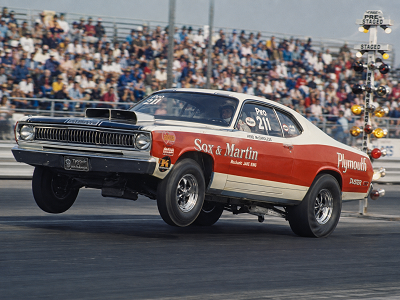
Calling McCandless the second Sox & Martin driver can give the wrong impression. The other driver happened to be Ronnie Sox.
There are worse people to be listed behind on the shop door.
McCandless was expected to win races, help develop the cars and make the entire operation stronger. Early in the program, his Duster developed a habit of breaking transmissions.
Herb did not consider that normal.
He discovered that the clutch linkage geometry was wrong. The Duster had been assembled with six-cylinder-style linkage that was not releasing the clutch correctly during his shifts.
McCandless lengthened the pedal arm by about five-eighths of an inch, and the transmission problem disappeared.
There was Mr. 4 Speed the driver. Then there was Mr. 4 Speed crawling under the car figuring out why the transmission was unhappy.
Indy 1970
The first Pro Stock U.S. Nationals drew more than 90 entries trying to get into a 32-car field. McCandless arrived with the Sox & Martin Hemi Duster and found a racetrack slick enough to require some thinking.
He borrowed a lightweight aluminum flywheel from Ford racer Bill Bagshaw, replacing the heavier piece in the Duster. The change was worth a few hundredths.
At Indy in a field that deep, a few hundredths was not pocket change.
McCandless worked through eliminations and reached the final against Arlen Vanke. Both cars ran 9.81.
Herb left first and stayed there.
Herb McCandless had won the first Pro Stock championship ever contested at the U.S. Nationals. He was 27 years old.
Afterward, television interviewer Chris Economaki caught a young McCandless almost at a loss for words.
Mr. 4 Speed had just won Indy. For once, even Herb needed a moment before shifting into the next sentence.
Sox & Martin Had Two Problems for Everybody Else
The red, white and blue Plymouths became the defining Pro Stock team of the class’s first years. Ronnie Sox was the centerpiece; his reaction time, shifting ability and consistency made him brutally difficult to beat.
McCandless gave the team another car capable of going rounds while providing testing and mechanical feedback that helped the entire operation.
In 1971, Sox won six of NHRA’s eight Pro Stock national events. McCandless reached the final of the World Finals at Amarillo, where Mike Fons beat him and captured the championship under the points system then in use.
It was an odd season. Sox won almost everything in sight and did not win the championship.
Early Pro Stock could be like that.
The 1972 Demon Was Herb’s Car
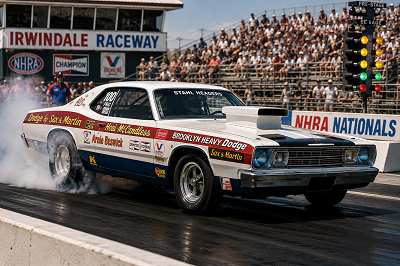
For 1972, Chrysler supplied McCandless with a new Dodge Demon body-in-white. McCandless and mechanic Gale Mortimer turned it into a Pro Stock car.
The pair attacked weight, chassis rigidity, suspension geometry and drivetrain placement while trying to keep the Hemi competitive under rules that were steadily adding weight to the combination.
At the 1972 Summernationals semifinal, McCandless produced one of the more memorable early Pro Stock photographs when the Demon launched against Bill Jenkins and headed skyward after the wheelie bars failed.
He still ran a 10.35.
There are cleaner ways to demonstrate horsepower. Few photograph as well.
McCandless continued running the Demon in NHRA, AHRA and match-race competition while Pro Stock rules changed almost as quickly as the cars.
Then Chrysler Changed the Job
By the middle of the 1970s, Detroit’s factory-racing money was no longer flowing the way it had during the muscle-car wars. Chrysler created Direct Connection, selling performance parts and technical information directly to racers and enthusiasts.
That was almost suspiciously well suited to Herb McCandless.
He had spent years figuring out which combinations worked and why. McCandless tested prototype Direct Connection components and helped refine parts before they reached customers.
Then he turned that knowledge into a business.
McCandless Performance Kept the Racing Going
Herb and Marie established McCandless Performance in North Carolina and became major Direct Connection and later Mopar Performance dealers.
McCandless built engines, sold components and supplied the part that did not come in the box: knowing what to do with them.
Racers and Mopar enthusiasts could bring him a combination that was not working and have a reasonable chance of reaching somebody who had already broken, redesigned or raced whatever part they were discussing.
He was still trying to make Chryslers go faster.
Mr. 4 Speed Never Really Retired
McCandless eventually stepped away from the parts business but remained active around Mopar racing, restoration and historical events.
His son Mike also assembled the McCandless Collection, preserving several of Herb’s important cars and a substantial collection of Chrysler racing history. Among them are the 1965 A990 Belvedere, 1968 Hemi Dart and 1972 Demon.
Most racers are fortunate if somebody preserves one important car.
Herb left enough of them to make choosing difficult.
The Bottom Line
Herb McCandless started racing at 16 while working in a print shop. Six years later he was driving a Hemi Super Stock Plymouth with Mr. 4 Speed painted on the side.
By 1970 he had won Modified Eliminator at Gainesville and was driving for Sox & Martin. At Indianapolis he rewarded them by winning the first Pro Stock U.S. Nationals.
But the nickname never told the entire story.
McCandless knew how to shift because he understood the machinery between his hand and the rear tires. He could tell when the clutch linkage was wrong, when the flywheel was too heavy, when the chassis needed something different and when a promising factory part still needed work.
Then he spent decades passing that knowledge to the next fellow trying to make a Mopar quicker.
Herb McCandless earned his reputation with a four-speed. He built his legacy by knowing what every part attached to it was doing.
↑ Back to the Top, Before Herb Finds Another Hundredth Between Second and Third