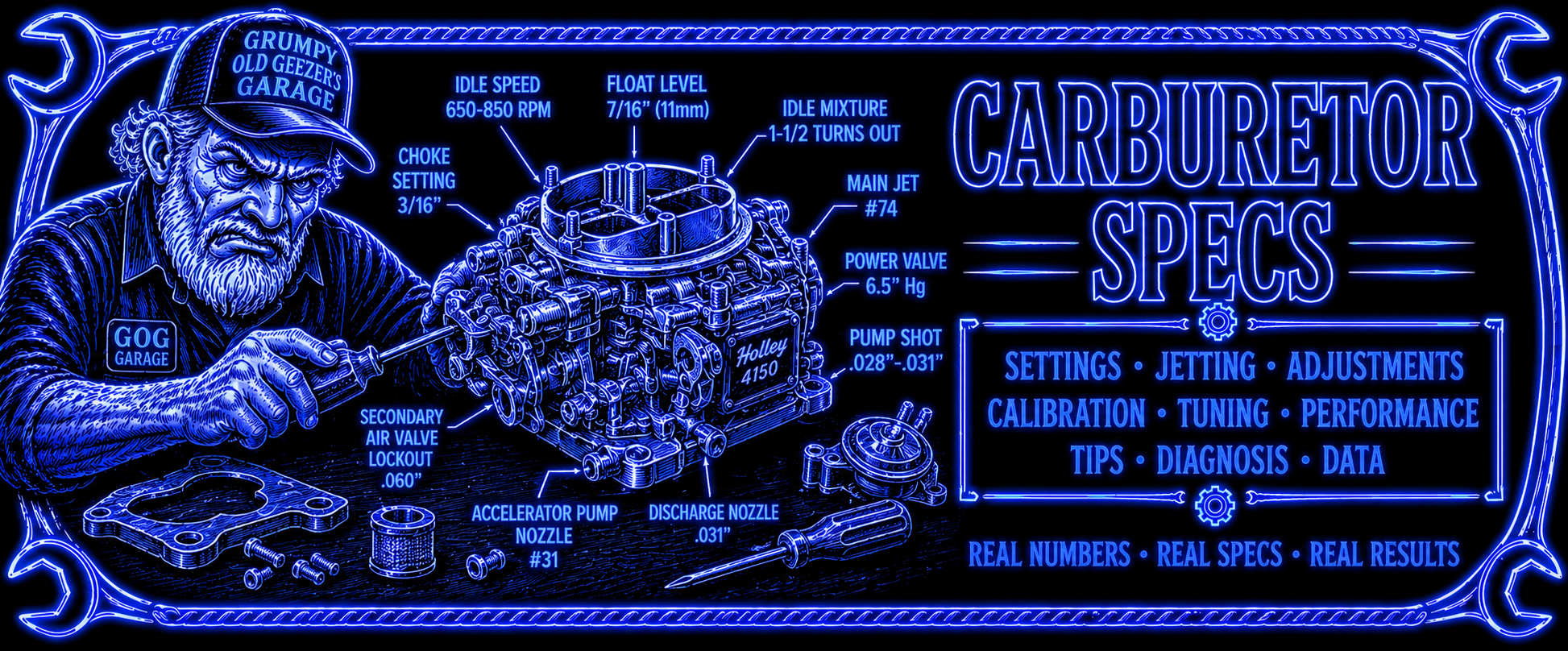
Autolite 4300 Carburetor Specs
On This Page:
Basics: Intro | Overview | What Makes This Carb Different? | General Specs
Details: Variants | Key Points
Warnings: Common Problems | Common Misconceptions | Compatibility Notes | Bottom Line
Related: Related Links

Intro
The Autolite 4300 was Ford’s late-1960s four-barrel replacement for the Autolite 4100, built during the early emissions-control years when clean operation, calibration control, and drivability were all trying to sit in the same chair.
It was used from the late 1960s into the mid-1970s on Ford, Mercury, Lincoln, Mustang, Thunderbird, big-block, small-block, and some AMC applications. It came in several major forms: the 4300A 441 CFM version, the larger 4300A 600 CFM version, and the 4300D 715 CFM spread-bore version.
The 4300 has a rough reputation, and not entirely because the internet needed another carburetor to kick around. These carbs could suffer from hesitation, flat spots, hot-start trouble, transition problems, fuel-inlet issues, and tuning sensitivity. Some of that was design. Some of it was calibration. A lot of it was decades of rebuilders treating a fussy emissions-era four-barrel like it was a 2100 with extra holes.
That does not mean every 4300 is scrap. It means the exact version matters. A 441 CFM 4300A, 600 CFM 4300A, and 715 CFM 4300D are not interchangeable just because they share a family name and a bad reputation. Venturi size, bore layout, intake pattern, secondary air-valve behavior, choke hardware, linkage, and calibration all matter.
Covers: Autolite and Motorcraft 4300 four-barrel carburetors, including 4300A 441 CFM, 4300A 600 CFM, and 4300D 715 CFM spread-bore versions.

Overview
The 4300 was Ford’s attempt to move beyond the 4100 while meeting changing emissions and drivability requirements. The idea was reasonable: keep a factory four-barrel, improve control, and make it work across a new generation of engines and regulations.
The problem was execution. The 4300 could be sensitive to float level, secondary transition, air-valve adjustment, fuel inlet sealing, idle calibration, choke setup, and year-to-year engineering changes. A good one could run acceptably. A bad one could make a stock Ford feel like it was dragging a trailer full of wet gravel.
The 4300A came first. Early 441 CFM versions used a smaller primary venturi and bore package. Later 600 CFM 4300A versions used larger primary and secondary bores for bigger engines. The 4300D was a different animal: a pronounced spread-bore 715 CFM version with large secondary bores and its own intake compatibility issues.
Secondary operation is part of the story. These carburetors use staged four-barrel operation with secondary air-valve behavior intended to smooth transition into the rear barrels. That system can work, but it has to be clean, adjusted, and matched. If the air valves, pull-offs, linkage, float level, or calibration are wrong, the 4300 will not hide it out of politeness.
The 4300’s strength is factory integration when complete and correct. Its weakness is that it lives in the uncomfortable gap between the simple 4100 and later emissions-era control systems. That gap is where drivability complaints breed like mice in an old parts car.
↑ Back to the Top, Before the Kickdown Rod Gets Bent

What makes it different
Compared with the Autolite 4100, the 4300 is the later emissions-transition replacement. The 4100 is generally simpler and better liked. The 4300 added complexity and calibration sensitivity that did not age as gracefully. Ford may have meant well. The carburetor did not always make that easy to prove.
Compared with the Motorcraft 4350, the 4300D is the earlier spread-bore step. The 4350 followed the 4300D as Ford continued chasing spread-bore airflow and emissions-era drivability. The 4300D is not just a regular 4300 with bigger secondaries. Its spread-bore pattern and intake compatibility are their own problem.
Compared with the Rochester Quadrajet, the 4300D shares the broad idea of smaller primaries and large secondary airflow, but it is not a Rochester and it does not interchange like one. Ford’s 4300D spread-bore pattern is its own little trap. Assuming all spread-bores are the same is how adapters, leaks, linkage problems, and bad language get invited.
Compared with Holley-style square-bore four-barrels, the 4300 family is much more application-sensitive. A generic square-bore swap may look tempting, especially when the 4300 is acting up, but linkage, kickdown, choke, spacer, emissions hardware, and intake pattern still have to be handled correctly.
The 4300’s biggest difference is that version identity matters more than reputation. The 441 CFM 4300A, 600 CFM 4300A, and 715 CFM 4300D are different enough that treating them as one lump of “bad Ford carburetor” is lazy. Tempting, but lazy.
↑ Back to the Top, Before the Kickdown Rod Gets Bent

General Specs
| Type | 4-barrel downdraft carburetor | Bore Layout | Square-bore 4300A / spread-bore 4300D |
| Venturi / CFM | 4300A: 441 / 600 CFM; 4300D: 715 CFM | Mounting Pattern | 4300A square-bore Ford pattern / 4300D Ford spread-bore pattern |
| Primary Metering | Fixed jets, idle circuits, power enrichment, accelerator pump, and application-specific calibration | Secondary Metering | Secondary fuel circuits controlled with staged secondary airflow |
| Secondary Type | Mechanical secondary throttle plates with air-valve-controlled airflow | Fuel Pressure | 4-4.5 PSI |
| Booster Style | 4300-family primary booster / secondary air-valve layout | Fuel Bowl | Integral fuel bowl layout |
| Fuel Feed | Single feed | Choke Types | Hot-air automatic, electric, or application-specific automatic |
| Main Material | Aluminum and zinc alloy castings | Typical Uses | Ford, Mercury, Lincoln, Mustang, Thunderbird, AMC, small-block, FE, 351C, 429, 460, and emissions-era V8 applications |
The main 4300 split is 4300A versus 4300D, then airflow size. The 4300A came in 441 and 600 CFM versions. The 4300D is the 715 CFM spread-bore version. Those are not trim levels. They are different carburetor answers.
↑ Back to the Top, Before the Kickdown Rod Gets Bent

Variants
The useful 4300 split is simple: 4300A 441 CFM, 4300A 600 CFM, and 4300D 715 CFM. Labels like Mustang, Thunderbird, Lincoln, 351C, 429, 460, federal, California, and service replacement matter at the calibration and linkage level, but they are not clean family-level variants.
4300A 441 CFM Version
| Series | 4300A | Venturi / CFM | 1.00″ primary venturi / 441 CFM |
| Secondary Type | Mechanical secondary throttle plates with air-valve-controlled airflow | Metering | Fixed jets, power enrichment, accelerator pump, and staged secondary fuel control |
| Booster Style | 4300-family primary booster / secondary air-valve layout | Fuel Bowl | Integral fuel bowl layout |
| Fuel Feed | Single feed | Choke Types | Hot-air automatic or application-specific automatic |
| Typical Applications | 1967-1969 Ford and Mercury small-block / moderate V8 applications | Operating Character | Early emissions-era four-barrel with smaller 4300A airflow |
Version Notes: The 441 CFM 4300A was the early smaller version. It was meant to replace the 4100 in many Ford applications, but it did not inherit the 4100’s easy goodwill. Smaller airflow did not save it from transition complaints, lean behavior, and the usual 4300 fussiness.
4300A 600 CFM Version
| Series | 4300A | Venturi / CFM | 1.25″ primary venturi / 600 CFM |
| Secondary Type | Mechanical secondary throttle plates with air-valve-controlled airflow | Metering | Fixed jets, power enrichment, accelerator pump, and staged secondary fuel control |
| Booster Style | 4300-family primary booster / secondary air-valve layout | Fuel Bowl | Integral fuel bowl layout |
| Fuel Feed | Single feed | Choke Types | Hot-air automatic, electric, or application-specific automatic |
| Typical Applications | 1968-1974 larger Ford / Mercury / Lincoln V8 applications, including 351C, 429, and 460 usage | Operating Character | Higher-airflow 4300A version for engines that needed more than the early 441 CFM unit |
Version Notes: The 600 CFM 4300A was the larger square-bore branch. It was Ford’s answer when the smaller 4300A was not enough carburetor for larger engines. That did not make it a 4100 with more airflow. It made it a 4300 with more airflow, which is a very different sort of warning label.
4300D 715 CFM Spread-Bore Version
| Series | 4300D | Venturi / CFM | 1.25″ primary venturi / 2.00″ secondary throttle bore / 715 CFM |
| Secondary Type | Mechanical secondary throttle plates with air-valve-controlled airflow | Metering | Spread-bore primary / secondary metering with staged secondary air-valve behavior |
| Booster Style | 4300D spread-bore primary / secondary air-valve layout | Fuel Bowl | Integral fuel bowl layout |
| Fuel Feed | Single feed | Choke Types | Hot-air automatic, electric, or application-specific automatic |
| Typical Applications | 1971-1974 351C-4V, Boss 351, Cobra Jet, and related Ford spread-bore applications | Operating Character | Large-airflow Ford spread-bore operation with sensitive secondary transition behavior |
Version Notes: The 4300D is the big one, the weird one, and the one most likely to turn an intake swap into a vocabulary lesson. It uses a pronounced Ford spread-bore layout and does not interchange cleanly with generic square-bore or Rochester spread-bore assumptions. If the intake, adapter, linkage, and air-valve behavior are wrong, the carburetor will make sure everybody knows.
↑ Back to the Top, Before the Kickdown Rod Gets Bent

Key Points
- The Autolite / Motorcraft 4300 replaced the Autolite 4100 as Ford moved into emissions-era four-barrel calibration.
- The clean family split is 4300A 441 CFM, 4300A 600 CFM, and 4300D 715 CFM.
- The 4300A is the less-pronounced square-bore / mild spread-style branch.
- The 4300D is the pronounced spread-bore version and needs the correct intake pattern.
- Secondary operation depends on staged throttle action and air-valve behavior.
- 4300s are known for hesitation, bogs, flat spots, hot-start complaints, fuel-inlet problems, and transition sensitivity.
- The 4300D was followed by the Motorcraft 4350.
- A 4300 can run acceptably when complete and correct, but it is not a forgiving carburetor.
- The carburetor’s reputation is not imaginary. Neither is the damage caused by bad rebuilding, wrong parts, and swap-meet confidence.
↑ Back to the Top, Before the Kickdown Rod Gets Bent
Common Problems
- Secondary air-valve misadjustment – The 4300 depends on controlled secondary transition. If the air valves open too quickly or too slowly, the carburetor can bog, stumble, or fall flat like it forgot why the secondaries exist.
- Secondary air-valve binding – Dirt, varnish, bent hardware, or damaged linkage can keep the air valves from moving smoothly. A sticky air valve turns a fussy carburetor into a very dedicated nuisance.
- Hesitation and flat spots – The 4300 family is known for transition complaints. Accelerator-pump action, float level, secondary air-valve behavior, and calibration all need to be right. Guessing usually just moves the stumble somewhere else.
- Hot-start flooding – Fuel expansion in the bowl can cause dribble, rich restart behavior, and hard hot starts. Lowering float level blindly can create lean problems instead. That is the 4300 teaching both sides of the lesson.
- Float level sensitivity – Float level is critical on these carbs. Too high floods. Too low leans out. Either way, the engine gets to complain while the owner blames Ford engineering.
- Fuel inlet leakage – The 4300 has a known reputation for fuel-inlet sealing trouble. A fuel leak at the inlet is not character. It is a repair bill trying to become a fire.
- Wrong jets or power valve parts – The 4300 is sensitive to calibration. Random jets, wrong power valves, and parts-store guessing can create lean surge, bogging, rich operation, or worse drivability than the original problem.
- Accelerator-pump problems – A weak pump shot, stuck pump, damaged spring, or wrong linkage setup can make the engine fall on its face during throttle opening.
- Air-bleed or passage restrictions – Small passages and air bleeds do not tolerate dirt, varnish, wrong gaskets, or lazy cleaning. The 4300 already has enough personality without plugged circuits helping it.
- Wrong air-horn or bowl gasket – Similar-looking gaskets can block or expose passages incorrectly. A clean rebuild with the wrong gasket is just a tidy failure.
- 1967 idle air adjustment confusion – Early 1967 units used a large rear idle air adjustment screw. Later units changed that area. Treating all years the same can send the adjustment process into the weeds.
- 4300A / 4300D mismatch – The 4300A and 4300D are not the same carburetor. Spread-bore pattern, throttle bores, secondary air valves, intake fit, and linkage details can all differ.
- Wrong intake or adapter – A 4300D spread-bore setup needs the correct Ford spread-bore intake or a properly matched adapter. Bolting parts together over the wrong holes is not compatibility. It is carpentry with gasoline.
- Choke pull-off / vacuum break problems – Bad pull-offs, wrong choke hardware, or lazy vacuum-break operation can cause rich cold operation, rough warm-up, bogging, and secondary transition complaints.
- Linkage mismatch – Ford, Mercury, Lincoln, Mustang, Thunderbird, AMC, automatic-transmission, and manual-transmission versions can use different throttle arms, kickdown geometry, choke linkage, and idle hardware.
- Replacement-carb mismatch – A replacement 4300 may bolt on and still have the wrong CFM, wrong throttle-bore pattern, wrong linkage, wrong choke hardware, wrong calibration, or wrong intake match. Fresh rebuild paint does not make it correct.
Back to the Top, Before the Kickdown Rod Gets Bent

Common Misconceptions
- “All 4300s are the same.” No. 4300A 441 CFM, 4300A 600 CFM, and 4300D 715 CFM versions differ in airflow, bore layout, intake fit, and behavior.
- “The 4300D is just a bigger 4300A.” No. The 4300D is a pronounced spread-bore carburetor with its own intake and secondary-air-valve issues.
- “A 4100 and 4300 swap cleanly because both are Ford four-barrels.” No. Pattern, spacer, linkage, calibration, and fitment details matter.
- “The 4300 is always junk.” Not always. But it is sensitive, reputation-stained, and less forgiving than the 4100. That is not the same as praise.
- “Changing jets fixes every 4300 stumble.” No. Transition issues can come from air-valve behavior, pump shot, float level, choke pull-off, passage restriction, or calibration mismatch.
- “All spread-bore carbs interchange.” No. Ford 4300D spread-bore, Rochester spread-bore, and generic adapters can become three different ways to make the engine hate you.
- “If the secondaries open, they are working correctly.” No. Opening is not the same as opening at the right time with the right fuel behavior.
- “A rebuild kit fixes the reputation.” No. Wrong gaskets, worn parts, fuel-inlet leaks, bad air valves, wrong float setting, and mismatched applications survive new gaskets just fine.
↑ Back to the Top, Before the Kickdown Rod Gets Bent

Compatibility Notes
4300 compatibility starts with version identity. A 4300A 441 CFM, 4300A 600 CFM, and 4300D 715 CFM do not belong in the same guessing pile.
The 4300A and 4300D use different bore layouts and intake assumptions. The 4300D spread-bore version needs the correct Ford spread-bore intake or a properly matched adapter. Rochester spread-bore thinking does not automatically apply.
A 4100 swap may be tempting when a 4300 acts up, but spacer, base pattern, PCV routing, linkage, choke hardware, and vacuum sealing still have to be handled correctly. A better carburetor installed badly becomes a different problem, not a solution.
Throttle linkage, transmission kickdown, choke hardware, hot-idle hardware, vacuum routing, fuel inlet, spacer, and air cleaner clearance can all vary by Ford, Mercury, Lincoln, Mustang, Thunderbird, AMC, manual-transmission, and automatic-transmission application.
The 4300D is especially unforgiving because of its spread-bore layout and large secondaries. If the intake, adapter, linkage, secondary air-valve behavior, and calibration are not right, the carburetor will not make polite excuses.
Replacement 4300s should be checked for CFM rating, 4300A versus 4300D body style, throttle-bore layout, choke setup, linkage, tag identity, and original calibration. “Fits Ford four-barrel” is not enough. That phrase has ruined plenty of afternoons.
↑ Back to the Top, Before the Kickdown Rod Gets Bent
Bottom Line
The Autolite / Motorcraft 4300 was Ford’s emissions-era four-barrel replacement for the 4100, and it never earned the same easy affection.
The clean split is 4300A 441 CFM, 4300A 600 CFM, and 4300D 715 CFM spread-bore. Those versions differ in airflow, bore layout, intake fit, and secondary behavior.
A correct 4300 can run acceptably. A mismatched, misadjusted, hot-soaked, leaking, or wrong-pattern 4300 can make a good engine feel like it developed an attitude problem overnight.
The 4300 is not the carburetor to treat casually. Identify the version, match the intake, fix the fuel inlet, set the float, respect the air valves, and stop pretending a fussy Ford emissions carburetor will forgive lazy work just because it has four barrels.
↑ Back to the Top, Before the Kickdown Rod Gets Bent
Related Links
Common Factory Pairings
Engines
- Ford 385-series big-block
- Ford FE big-block
- Ford 335-series
- 302 Cleveland
- 351 Boss
- 351 Cleveland
- 400
- Ford Windsor small-block
- AMC Gen-2 V8
- 290
- 343
- 390
- AMC Gen-3 V8
- 304
- 360
- 390
- 401