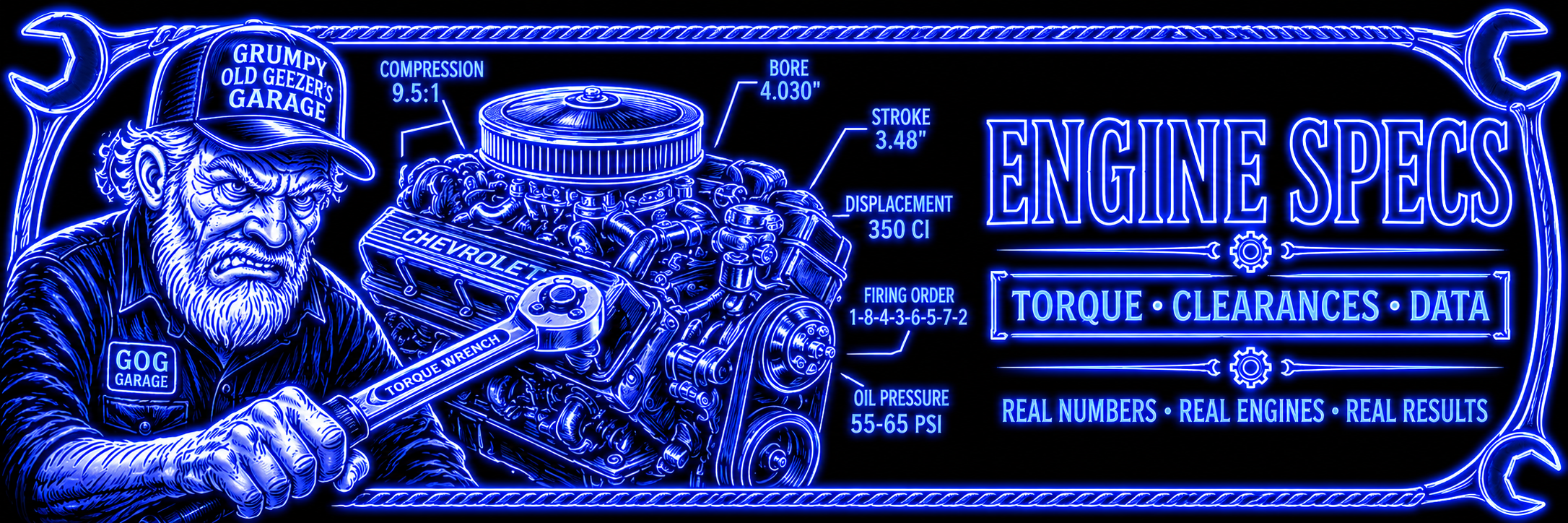
Mopar 313 Engine Specs
On This Page:
Engine Details: General Specs | Variants | Key Notes
Final Word: Bottom Line
Related: Related Links

Intro
➤ See the Family Page for specs common to all engines in this family.
The Mopar 313 Poly is the engine that reminds American parts books they were never in charge of the whole Chrysler Corporation. While the 318 became the familiar name in the United States, the 313 spent its life mainly in Canada and export markets, turning up in Canadian Dodges and Plymouths, Australian Chrysler Royals, British Bristols, and other places where Detroit’s domestic engine calendar was merely a suggestion.
Mechanically, there is nothing imaginary about it. The 313 belongs squarely in the A-series Poly family, using the same broad polyspherical-head architecture as the better-known Plymouth engines. Its 3.875-inch bore and 3.3125-inch stroke put it on the longer-stroke side of the family with the 303, 318, and 326. It is close enough to a 318 to encourage laziness and different enough to make that laziness arrive later in a box marked WRONG PART.
The reason Chrysler kept the 313 around had less to do with American horsepower fashion than with the untidy realities of selling cars around the world. Different markets had different assembly plants, model lineups, tax rules, supply chains, and production schedules. An engine that disappeared from a U.S. brochure could remain perfectly useful somewhere else. Chrysler built cars to sell cars, not to make future collectors’ charts symmetrical.
Most 313s were not performance trophies. They were sturdy medium-displacement V8s expected to pull real cars around without drama. In a Canadian Dodge or Plymouth, that meant ordinary passenger-car work. In an Australian Chrysler Royal, it meant another regional application of the same basic machinery. Bristol put the 313 into the 407 and early 408, dressed the car considerably better, and gave the engine an English accent without changing where the block came from.
That Bristol connection is interesting enough that it has naturally become dangerous. A 313 does not turn into Bristol history because somebody once shipped parts across an ocean. Just as every 303 is not a Fury engine, every 313 is not some exotic British prize waiting to finance retirement. Market, year, stamping, induction, application, and the car around it still have to do the talking.
The 313 makes the strongest case today when correctness matters. In a Canadian, Australian, British, or other export vehicle built around one, keeping the proper engine preserves a piece of Chrysler history most American enthusiasts barely know exists. As a loose engine for somebody simply hunting horsepower, however, the common 318 Poly has more familiarity and later LA engines make the entire job easier.
That does not make the 313 an orphan somebody should apologize for owning. It makes it a real export-market Mopar with its own reason for existing. Verify the country, verify the engine, and quit trying to turn it into either a misprinted 318 or a priceless Bristol relic. Chrysler already made the story interesting without anybody improving it.
↑ Back to the Top, Before the Casting Numbers Start Lying

Overview
The 313 sits on the branch of the A-series Poly family that disappears almost completely if somebody studies Mopar history using nothing but U.S. dealer brochures. Plymouth’s 277 started the A-block story, the 301 and 303 handled short early developments, and the 318 became the familiar American workhorse. Meanwhile, Chrysler continued building the 313 for Canada and export markets because automobiles outside the United States apparently refused to organize themselves for the convenience of American hobbyists.
The basic engine remained pure A-series Poly. It used a cast-iron block and heads, polyspherical combustion chambers, an in-block camshaft, pushrods, shaft-mounted rocker arms, five main bearings, and a rear-mounted distributor. Bore spacing was 4.460 inches and deck height roughly 9.603 inches. Nothing about the architecture makes it a Dodge Red Ram Poly, DeSoto Poly, Chrysler Hemi, or later LA engine no matter how often somebody waves the word “Mopar” over the parts pile.
The displacement came from a 3.875-inch bore and 3.3125-inch stroke. That stroke ties the 313 mechanically to the longer-stroke A-block group rather than the earlier 277 and 301, which use 3.125 inches. The 318 uses the same basic stroke with a larger bore of roughly 3.910 inches. In other words, “basically a 318” is close enough for conversation and nowhere near good enough for ordering pistons.
That smaller bore existed because the 313 had its own market job. Canadian production did not always mirror Detroit’s U.S. lineup, and export operations had their own requirements. Local assembly, taxation, parts sourcing, model positioning, and market rules could all keep one engine displacement alive while another country moved on. The 313 is what happens when corporate engineering meets the actual world instead of a collector’s neat little timeline.
Canadian Dodge and Plymouth applications form a large part of that story. These were not clandestine performance cars Detroit forgot to advertise south of the border. The 313 was a useful passenger-car V8 providing smooth torque and respectable power in vehicles built for Canadian buyers. That job may sound ordinary, but ordinary engines usually become ordinary because they work.
Australia added another chapter through Chrysler Royal applications. Again, the important point is not that every Australian 313 is rare treasure. It is that Chrysler used the same A-series architecture differently depending on where the car was sold. Original Australian induction, cooling, exhaust, accessories, transmission pieces, and installation hardware therefore deserve more respect than somebody armed with a U.S. 318 catalog might initially give them.
Then Bristol makes the whole thing more entertaining. The British company used Chrysler’s 313 in the 407 and early 408 era, including four-barrel versions commonly listed around 250 horsepower. That put American V8 torque into an expensive British car and gave the humble Poly a passport nobody looking at a Canadian Plymouth would have predicted.
The temptation is to let that glamorous application contaminate every 313 story afterward. Resist it. A Canadian sedan engine does not become Bristol hardware because both pistons displace 313 cubic inches. Correct carburetion, compression, accessories, stampings, dates, vehicle application, and documentation have to support the particular version being claimed. The Union Jack is not an engine-identification tool.
Performance varied accordingly. A normal two-barrel passenger-car 313 was calibrated for ordinary driving and durability. Higher-output four-barrel applications could sharpen the engine considerably. Those differences came from the surrounding combination rather than some secret 313 block that developed aristocratic tendencies after crossing the Atlantic.
The engine’s long export life also means year assumptions deserve caution. The 313 story stretches from 1957 into the later 1960s in export use, far beyond the narrow period an American enthusiast might expect from looking at domestic Plymouth history. A later export engine can therefore be perfectly legitimate even when an American application chart insists the displacement should have disappeared years earlier.
That extended production is why market identification is unusually useful here. Stamp location, prefix, casting period, original vehicle, country of assembly, and surviving hardware can tell a much better story than a U.S.-only interchange book. On many export engines even the stamped identification location can differ from domestic practice. When the number is not where the American manual says it should be, check the other side before accusing Chrysler of losing the stamping hammer.
Compared with the 303, the 313 shares the longer-stroke family pattern but uses a larger bore and had a much broader export career. The 303’s famous U.S. chapter is tied tightly to the 1956 Fury. The 313’s identity is almost the opposite: less glamorous in American memory, more geographically widespread, and far more dependent on understanding which market the engine actually served.
Compared with the 318 Poly, the 313 is close enough mechanically that the resemblance can be useful. The shared 3.3125-inch stroke and common A-block architecture provide real family overlap. But the smaller bore affects pistons, rings, compression planning, and rebuild parts, while market-specific equipment can change everything surrounding the long block. Similarity is helpful information. It is not permission to stop reading.
The later LA small-block belongs behind an even taller fence. The Poly and LA families share Chrysler small-block ancestry, but the LA’s wedge heads, intake arrangement, rocker system, exhaust, valve covers, and supporting hardware are different. An LA 318 is not the parts-donor answer to every question a 313 asks merely because both engines came from Chrysler and eventually occupied similar-sized engine bays.
For restoration purposes, the 313 is usually easy to judge. If the car was built with one, keep it when practical. Canadian and export vehicles lose a piece of their identity when the unusual original engine gets discarded merely because an American 318 is easier to explain. A car that survived sixty years with the engine most people have never seen does not necessarily need rescuing from its own history.
Completeness helps make that decision. Rocker gear, intake, carburetor, exhaust manifolds, pulleys, brackets, cooling pieces, linkage, mounts, and transmission hardware can follow the particular market and vehicle. A bare 313 may look cheap until the missing export-specific pieces begin arriving one expensive parcel at a time from places requiring customs forms.
Condition still outranks rarity. Cylinder wear, corrosion, rocker-shaft wear, damaged exhaust hardware, old machine work, missing parts, cracked castings, and years of storage can turn an uncommon engine into an uncommon repair bill. “Canadian,” “export,” and “Bristol” are historical descriptions. None of them are cylinder-wall treatments.
As a general performance foundation, the 313 therefore occupies a narrow lane. It can make a perfectly good street engine when healthy and sensibly built, but there is little reason to choose one over a more common 318 Poly unless the project itself gives the 313 a reason to be there. If easy aftermarket support and inexpensive horsepower are the priorities, the later LA family will eventually win the argument without needing a passport.
The 313’s real value is that it expands the A-series story beyond Detroit. It proves Chrysler’s engine history was shaped by Canada, Australia, Britain, export production, local markets, and practical business decisions just as much as by American horsepower advertising. The 318 became the name everybody remembers. The 313 kept working where everybody forgot to look.
↑ Back to the Top, Before the Casting Numbers Start Lying

General Specs
| Displacement | 313 cu in / 5.1L | Bore / Stroke | 3.875 in × 3.3125 in |
| Production / Use Era | 1957–1967 Canadian/export A-block Poly passenger-car era | Bore Spacing | 4.460 in |
| Engine Family | Chrysler / Plymouth A-series Poly small-block V8 | Deck Height | 9.603 in A-block baseline |
| Block Material | Cast iron | Rod Length | 6.123 in A-block baseline |
| Cylinder Head Material | Cast iron | Main Journal | 2.500 in |
| Factory Rating | Common passenger-car ratings vary by market and tune; Bristol 4-barrel versions are commonly listed around 250 hp / 340 lb-ft | Compression Ratio | Market/tune dependent; verify by exact application |
| Fuel / Induction | Gasoline; carbureted, 2-barrel or 4-barrel by version | Rod Journal | 2.125 in |
| Cam Location | In-block camshaft | Main Bearings | 5 |
| Valve Layout | OHV / pushrod, 2 valves per cylinder; polyspherical chambers with canted valves | Firing Order | 1-8-4-3-6-5-7-2 |
| Common Main Caps | 2-bolt | Distributor Rotation | Clockwise |
| Rear Main Seal | 2-piece | Weight | ~525–575 lb complete iron A-block Poly, depending on accessories/configuration |
| Balance | Internal balance | Dimensions | ~29H / ~28W / ~30L |
Verify the block, bore, stroke, crank, heads, intake, carburetor, exhaust, stampings, market, and vehicle application before ordering parts. The 313 sits close enough to the 318 Poly to invite lazy assumptions, and far enough away to punish them when the parts show up wrong.
↑ Back to the Top, Before the Casting Numbers Start Lying

Variants
The 313 is one of those engines that gets complicated because of where Chrysler sold it, not because the factory built a dozen radically different versions. Underneath, the useful mechanical split is narrow: the regular Canadian and export passenger-car engine, and the stronger four-barrel export combinations represented by Bristol use. Everything else is identification trouble wearing a passport.
Canadian / Export Passenger-Car 313
What it was: This was the ordinary working 313 used mainly in Canadian and export Chrysler Corporation applications rather than the normal U.S. Plymouth engine lineup.
What changed: The 313 used a 3.875-inch bore and 3.3125-inch stroke in the A-series Poly architecture. Regular passenger-car versions used the more conservative induction and calibration appropriate to normal street duty rather than the stronger four-barrel hardware found in higher-output export applications.
What that did: The engine delivered useful medium-displacement V8 torque without trying to become somebody’s performance legend. Canadian Dodge and Plymouth applications, Australian Chrysler Royals, and other export cars needed an engine that started, pulled, and stayed together. Most buyers were perfectly happy if the thing did all three before lunch.
Where used: Canadian Dodge and Plymouth applications, Australian Chrysler Royal, and other documented Chrysler Corporation export-market vehicles.
The important point is that market identity does not automatically create another engine variant. Canada, Australia, and other export destinations could use different surrounding installation hardware, but the supplied material does not establish enough internal or induction difference to split every country into its own engine package.
Bristol / Higher-Output Export 313 — Four-Barrel
What it was: This was the stronger export branch of the 313 story, most notably associated with Bristol 407 and early 408 use.
What changed: Higher-output applications used four-barrel carburetion and corresponding induction hardware rather than the milder passenger-car setup. The source treats these as stronger versions of the same basic 313 rather than a completely different short block.
What that did: More carburetion let the Poly breathe harder and supported a higher output level than the ordinary Canadian and export passenger-car versions. The engine did not become aristocratic because it crossed the Atlantic, but Bristol at least gave it enough carburetor to justify wearing a better suit.
Where used: Bristol 407, early Bristol 408, and other documented higher-output four-barrel export applications.
Identification caution: A four-barrel intake on a loose 313 does not establish Bristol or other special export identity. Intake, carburetor, linkage, air cleaner, exhaust, engine details, dates, vehicle history, market context, and documentation all need to agree before an ordinary 313 starts collecting exotic-car money.
The everyday trap is confusing the 313 with the 318 Poly. Both use the same 3.3125-inch stroke and share the broader A-series architecture, but the 313 carries a 3.875-inch bore while the 318 is larger. That difference affects pistons, rings, compression planning, and rebuild parts. “Basically a 318” works considerably better at a folding-chair conversation than it does at the machine shop.
So the honest factory hardware map is short: regular Canadian / export passenger-car 313 and the stronger four-barrel export combination. The rest of the 313 story is about market, application, and identification rather than imaginary engine variants. Measure the bore, check the hardware, verify where it came from, and let the passport stamps stay out of the combustion chamber.
↑ Back to the Top, Before the Casting Numbers Start Lying

Key Notes
The Mopar 313 A/Poly is an early A-block Poly with a passport problem. It belongs mainly to Canadian and export Chrysler Corporation use, not the clean U.S. Plymouth 318 story most people keep in their heads. That makes it easy to mislabel, easy to overhype, and easy to under-explain. The Geezer starts with the market before he lets the parts order move an inch.
The basic fingerprint is 313 cubic inches from a 3.875-inch bore and 3.3125-inch stroke. That puts it very close to the 318 Poly, but close isn’t identical. The 318 used a larger bore, and that small-looking difference matters when pistons, rings, displacement claims, machine work, or rebuild planning enter the conversation.
The 313 is A/Poly hardware, not LA-family hardware. LA 318, 340, 360, and Magnum engines may be more familiar, but familiarity doesn’t make the parts fit. Heads, intake, valve covers, front dress, exhaust, mounts, and internal parts need to be treated as A/Poly business until exact parts prove otherwise.
The 313 also belongs outside the Dodge Red Ram Poly, DeSoto Poly, Chrysler FirePower Hemi, and other early Chrysler Corporation buckets that get tossed into the same “old Poly” pile. The word “Poly” describes chamber style. It doesn’t prove block family, heads, crank, intake, exhaust, mounts, or service parts. If the seller can only say “it’s a Poly,” he hasn’t said enough.
Market context carries much of the value. A 313 can be correct in Canadian Dodge, Canadian Plymouth, Australian Chrysler Royal, Bristol, or other export-market use depending on the exact car and documentation. It can also be a swapped engine, service replacement, or loose core with a story that crossed more borders than the hardware did. Make, model, year, country, application, and paperwork all have to matter.
The Bristol connection is real, and that’s exactly why it needs a leash. Bristol 407 and early 408 use can make a 313 more interesting, but it doesn’t turn every 313 into a Bristol engine or a sports-car payday. A Bristol claim needs vehicle context, correct hardware, date clues, and documentation. A 4-barrel and an accent don’t count.
The 313 gets tangled with the 303, 318, and 326 because the A/Poly family shares enough architecture and appearance to fool anyone who stops looking too early. Casting numbers, stampings, bore measurement, original application, market, and matching external pieces have to carry the identification. “Basically a 318” isn’t a spec sheet. It’s a warning label wearing shoes.
As an engine, the 313 is a good old Mopar piece when the car and plan make sense. It has rugged character, decent displacement, and enough Poly breathing to make a period car feel right when the rest of the package is healthy. The trouble starts when someone treats it like the easiest path to cheap horsepower while later, better-supported Mopar small-blocks are standing nearby with both hands raised.
For restoration, the 313 can be exactly the right answer. In a Canadian Plymouth, Canadian Dodge, Australian Chrysler Royal, Bristol application, or documented export-market car, originality can beat convenience. That’s where the 313 justifies the extra work. In a generic hot rod or budget street build, the math can get cruel fast.
Parts support is better than hopeless, but it isn’t casual. The 3.875-inch bore means piston and ring choices need attention, not assumptions based on 318 parts. Camshaft, lifter, valvetrain, intake, exhaust, gasket, mount, accessory, cooling, and drivetrain pieces need verification before anybody promises a cheap rebuild. Missing induction, exhaust, brackets, and accessories can burn more time than the core is worth.
Interchange needs a firm hand. Some A/Poly parts cross around the family, and some later LA-family history makes people think everything is one happy small-block picnic. It isn’t. LA heads, intakes, exhaust pieces, and accessory layouts need to stay out of the plan unless exact fit has been proven. The same warning applies to 318 Poly parts: useful neighborhood, not automatic permission.
A used 313 core needs suspicion plus a little geography. Check for cracks, stuck cylinders, rusty bores, deck corrosion, freeze damage, broken exhaust flanges, missing manifolds, missing brackets, damaged valvetrain parts, butchered mounts, wrong carburetion, market-specific hardware gaps, and previous machine work. An incomplete 313 isn’t charming. It’s a scavenger hunt with invoices.
Completeness matters more here than the seller wants to admit. A running, complete, correct 313 with the right manifolds, brackets, accessories, and application trail is one kind of engine. A bare block with mystery heads and a coffee can full of hardware is another. Both may be 313s. Only one deserves real money standing next to it.
The 313 is easiest to justify when correctness is the point. Verify what it is, where it came from, what’s missing, and whether originality is worth the extra work. If the car needs a Canadian/export A/Poly or a verified Bristol-related package, save it right. If the goal is cheap torque, easy parts, or simple street performance, don’t turn a market-specific Mopar into a wallet fire just because the valve covers look interesting.
↑ Back to the Top, Before the Casting Numbers Start Lying

Bottom Line
The Mopar 313 A/Poly matters because it belongs to the Canadian and export side of the Chrysler story, not because an unfamiliar number automatically means buried treasure. In the right car and market, that identity is exactly what makes the engine worth preserving. Sitting loose on a pallet with no history, it is simply an old Poly that needs more explaining than most.
Its strongest argument is correctness. A Canadian Plymouth or Dodge, Australian Chrysler Royal, Bristol, or another documented export application can make the 313 the engine that belongs there rather than an inconvenient oddball. In those cases, replacing it with a more familiar 318 may make parts shopping easier while making the car less correct.
The dangerous shortcut is calling it “basically a 318.” Close family relationship does not make pistons, rings, compression parts, or every piece of supporting hardware interchangeable. The 313 deserves to be measured and identified as a 313 before anybody orders parts or starts planning a rebuild. Familiarity with the 318 is useful background, not permission to guess.
The exotic stories need the same skepticism. Bristol and other export-performance applications are real, but a four-barrel carburetor and a foreign accent do not automatically make a loose engine special. A genuine high-interest application needs the car, hardware, history, and documentation to agree before the price gets dressed in a tuxedo.
So preserve a good 313 when the vehicle and market call for it, and choose something easier when cheap horsepower and simple parts support are the real mission. A complete, correct 313 can be an important part of an unusual Mopar story. A stripped mystery core can become an international parts hunt with machine-shop invoices attached. The 313 does not need to pretend to be a 318 or Bristol royalty. It just needs to be exactly what the evidence says it is.
↑ Back to the Top, Before the Casting Numbers Start Lying

Related Links
Torque Specs
Common Factory Pairings
Carburetors
- Carter AFB — 4-bbl
- Carter BBD — 2-bbl
- Carter WCFB — 4-bbl
- Stromberg WW / WWC — 2-bbl
Transmissions
- A903 — 3-Speed
- Borg-Warner T85 — 3-Speed
- Borg-Warner T10 — 4-Speed
- PowerFlite — 2-Speed Automatic
- A466 Cast-Iron TorqueFlite — 3-Speed Automatic