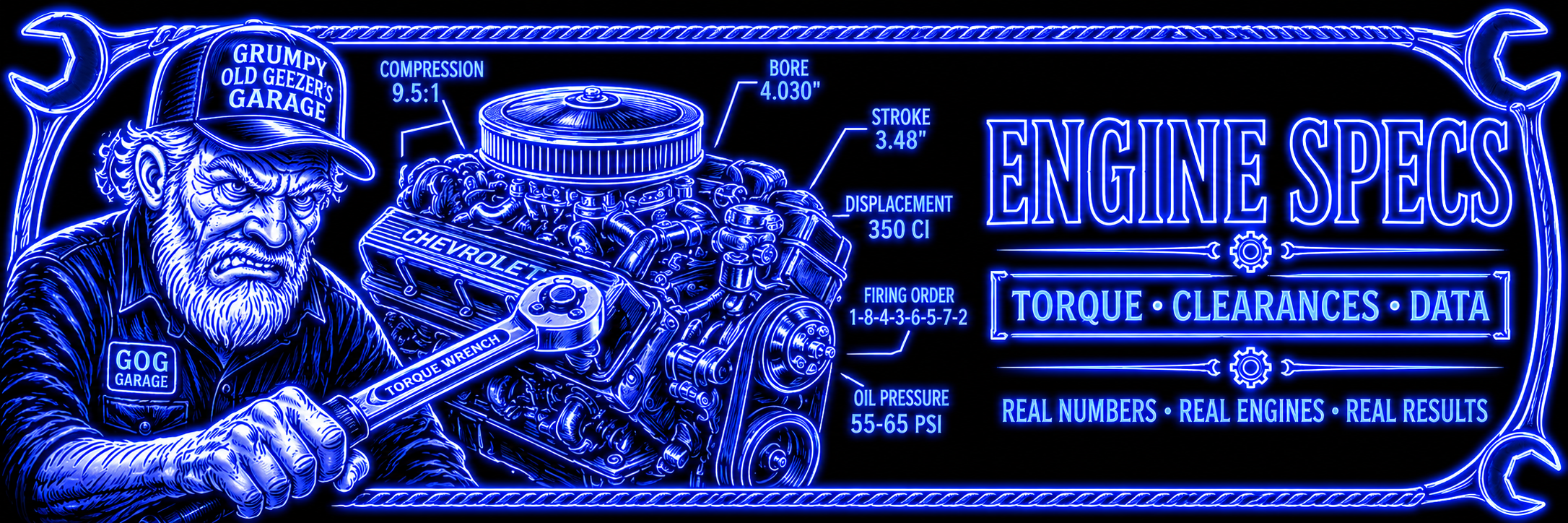
Chevy 427 Engine Specs
On This Page:
Engine Details: General Specs | Variants | Key Notes
Final Word: Bottom Line
Related: Related Links

Intro
➤ See the Family Page for specs common to all engines in this family.
The Chevy 427 is where the Mark IV big block quit being merely Chevrolet’s new engine and became one of the engines everybody else had to worry about. The 396 introduced the production Mark IV in 1965. For 1966 Chevrolet kept its 3.760-inch stroke, opened the bore from 4.094 to 4.250 inches, and came up with 427 cubic inches. That larger bore gave the heads more room to do their job, added useful displacement without turning the engine into a long-stroke torque mill, and created the basic combination behind some of Chevrolet’s most famous performance hardware.
The 427 landed first in a world already primed for trouble. Corvette got 390- and 425-horsepower versions for 1966, while full-size Chevrolets also offered serious 427 power. From there the engine spread through Corvettes, big Chevrolets, special-order muscle cars, drag racing, road racing, and enough dealer and COPO machinery to make the option-code books considerably more interesting. By 1969 a 427 could be hiding in a Camaro or Chevelle that Chevrolet’s ordinary option sheet had never intended to receive one.
For the shared canted-valve architecture, Mystery Motor ancestry, head design, and the rest of the family history, the Mark IV family has the whole story. The important thing here is what made the 427 different from its brothers. It had the same relatively short stroke as the 396 and later 402, but considerably more bore. That combination gave Chevrolet more cubic inches and more breathing room without giving up the willing-to-rev character that separated the 427 from the later long-stroke 454.
And Chevrolet used that foundation every way it knew how. The L36 was the civilized end of Corvette 427 life: oval-port heads, hydraulic lifters, one four-barrel, and enough torque to make “civilized” a relative term. The L68 added three two-barrels without turning the underlying engine into a race piece. The L71 brought solid lifters, rectangular ports, high compression, Tri-Power, and serious intent. The L72 used much of the same hard hardware with a single Holley and became important well beyond Corvette, including full-size Chevrolets and the 1969 COPO muscle-car world. The rare L89 added aluminum heads to the L71-style package.
Then Chevrolet stopped pretending everybody buying one intended to commute with it. The L88, offered in Corvette from 1967 through 1969, was a high-compression, solid-lifter, aluminum-head 427 aimed squarely at competition. Chevrolet officially rated it at 430 horsepower, a number that has caused arguments ever since because the hardware clearly mattered more than the brochure arithmetic. GM itself still describes the L88 as an engine made specifically for racing. Only 20 L88 Corvettes were built in its first 1967 season.
The 1969 ZL1 took the idea over the fence. Its aluminum block joined aluminum heads and race-oriented 427 hardware to create one of Chevrolet’s most exotic production engines. Sixty-nine ZL1 Camaros were built under COPO 9560, while a tiny number also found their way into Corvettes. The iron-block L72 arrived in COPO Camaros under 9561 as another way of putting 427 power where the regular Camaro order form said 396 was supposed to be enough. Chevrolet had found a way around its own rules, which is usually where the entertaining cars come from.
But the 427 name also belongs to engines with entirely different jobs. Chevrolet built heavy-duty tall-deck Mark IV 427s for trucks and commercial service. They are real 427 big blocks and can be strong, useful engines, but they are not displaced Corvette engines waiting for somebody to discover their secret identity. The taller deck, duty-cycle hardware, intake requirements, and intended use put them in a different branch of the same family. A grain truck did not accidentally leave St. Louis with an L88.
There is another trap sitting even farther back in Chevrolet history: the 1963 Z11 427. That engine is a W-Series 427, not a Mark IV at all. Same displacement number, different architecture, different parts, different story. “Chevy 427” therefore does not identify one engine any more reliably than “red Chevrolet” identifies one car. Family, year, application, and hardware still have to come along for the ride.
The Mark IV 427 matters because Chevrolet hit an unusually good balance. It has enough cubic inches to make serious big-block torque, enough bore to let good heads breathe, and a short enough stroke to remain sharp when the rpm climbs. The 454 eventually beat it on displacement. Very few Chevrolet engines ever beat it on reputation. The trick is remembering that the reputation belongs to the combination Chevrolet built, not every block somebody has managed to describe as “a 427.”
↑ Back to the Top, Before the Casting Numbers Start Lying

Overview
The dimensions explain most of the 427’s personality. Its 4.250-inch bore is substantially larger than the 396’s 4.094 inches, while the stroke remains the same 3.760 inches. That matters beyond the extra 31 cubic inches. A larger bore provides more room around the valves and works especially well with the Mark IV’s big-port, canted-valve cylinder heads. Chevrolet could feed the engine hard without needing a long crank throw to make the displacement. The result is a big block with real bottom-end shove that can still feel remarkably eager upstairs when the rest of the combination is willing.
That is the fundamental difference between the 427 and the 454. Both use a 4.250-inch bore, but the 454 stretches the stroke to 4.000 inches. The longer stroke gives the 454 more displacement and generally more easy low-speed torque. The 427 trades those extra cubes for the shorter-stroke character that helped make it such a natural performance engine. A 454 is wonderfully good at making a heavy car forget what it weighs. A properly equipped 427 feels like somebody taught the heavy car to run.
Not every 427 was equipped to exploit that personality the same way. Chevrolet built hydraulic-cam oval-port versions for buyers who wanted big displacement without adjusting valve lash in the driveway. It built Tri-Power street combinations for more power and considerably more underhood theater. Then came the solid-lifter, rectangular-port engines where compression, airflow, valvetrain, forged hardware, and induction were selected around higher-rpm performance. Advertised horsepower alone is a lousy way to understand them. The hardware tells a much better story.
The Corvette lineup shows the range particularly well. The L36 provided the tractable street 427. The L68 added Tri-Power while staying on the hydraulic-cam side of the fence. The L71 combined three two-barrels with solid lifters, rectangular-port heads, and higher-performance internals. The aluminum-head L89 took weight off the nose without changing the basic mission. And the L88 abandoned most concern for ordinary street manners in favor of competition. Those engines share a displacement, but calling them all “basically the same 427” is what happens when somebody stops reading after the air-cleaner decal.
The L72 deserves special attention because it connects several different pieces of Chevrolet performance history. It was a serious solid-lifter, rectangular-port, single-four-barrel 427 rather than a Tri-Power Corvette showpiece, and Chevrolet used it in full-size performance applications before it became the iron-block heart of the 1969 COPO 9561 Camaro and related special-order machinery. In Camaro form Chevrolet rated the L72 at 425 horsepower. The engine was already proven hardware; COPO simply put it in a body the normal option structure was trying to keep away from it.
The L88 and ZL1 are where the 427 legend can get in the way of understanding the engine. The L88 was not merely the next horsepower option above the L71. It was a competition-oriented package with 12.5:1 compression, aluminum rectangular-port heads, a mechanical camshaft, and hardware selected around serious use. The ZL1 pushed even farther with an aluminum block as well as aluminum heads. Chevrolet officially rated the Camaro ZL1 at 430 horsepower and 450 lb-ft, while its construction and intended use made it something much more significant than a five-horse paper improvement over the L72.
That is why horsepower ratings need to stay in their historical cage. These were gross ratings measured under conditions very different from later SAE net ratings, and Chevrolet’s highest-performance engines were not necessarily ranked honestly by the number printed in the sales literature. An L88 did not become a race engine because its brochure said 430, and an L71 did not become nearly the same thing because the printed number sat nearby. Compression, heads, camshaft, induction, exhaust, bottom end, calibration, and intended use matter more than five or ten advertised horses.
The 427 also had a life outside polished Corvettes and COPO folklore. Full-size Chevrolet buyers could get serious 427 power, and heavy-duty truck buyers could get 427 cubic inches for an entirely different reason. Tall-deck truck 427s were built for sustained load and commercial durability rather than quarter-mile glory. They can make excellent foundations for the right project, but their dimensions and supporting hardware create installation and parts-selection differences. Same Mark IV family. Same nominal displacement. Different job description.
As a street engine today, an ordinary 427 may actually be easier to enjoy than one of the famous versions everybody chases. Oval-port heads, sensible compression, a moderate camshaft, good exhaust, proper cooling, and gearing matched to the car can make a 427 brutally effective without requiring race fuel, constant valve adjustment, or an auction-house security detail. Rectangular ports and a giant cam may look better on the parts list, but a street engine spends most of its life nowhere near 7,000 rpm. Building for the tachometer you actually use is cheaper than building for the one you brag about.
Its shortcomings are standard big-block business turned up by the cost of the hardware. The engine is heavy. It makes heat. It drinks fuel. Big-port combinations can become soggy at low rpm when the rest of the engine is too mild. High original compression can be miserable on modern pump fuel. And genuine high-performance pieces have become valuable enough that restoration correctness can fight directly with practical street use. None of that makes the 427 fragile. It means a famous engine can still be assembled stupidly.
The larger problem today is mythology. Original 427s have been raced, blown up, rebuilt, overbored, reheaded, swapped between cars, assembled from service parts, cloned, and occasionally restamped by people whose conscience developed an oil leak. A genuine 427 block is valuable. A genuine L72 is something more specific. A documented born-with L88 or ZL1 combination is another universe entirely. Those claims belong to Identification and documentation, not to the size of the seller’s grin. The existing 427 material is right to treat L71, L72, L88, ZL1, COPO, and truck-engine claims as separate proof problems rather than one big pile of 427 mythology.
That leaves the 427 in a peculiar position today. If the goal is simply cheap cubic inches and easy street torque, a common 454 may be the smarter place to spend money. But that does not make the 427 an overpriced 454 missing 27 cubes. It has its own mechanical character, its own racing and factory-performance history, and some of the most important versions Chevrolet ever built. The 454 won the displacement contest. The 427 had already won enough other arguments that nobody cared.
The reason to care about a 427 now is the same reason people cared in 1966: it is one of Chevrolet’s best combinations of bore, stroke, airflow, torque, and rpm potential. Build an ordinary one intelligently and it is a terrific engine. Find a genuine famous one and preserve the evidence before changing anything. Either way, the 427 does not need borrowed L88 stories or COPO fairy dust. Chevrolet gave the engine enough reputation of its own.
↑ Back to the Top, Before the Casting Numbers Start Lying

General Specs
| Displacement | 427 cu in / 7.0L | Bore / Stroke | 4.250 in × 3.760 in |
| Production / Use Era | 1966–1969 Mark IV big-block performance era | Bore Spacing | 4.840 in |
| Engine Family | Chevrolet Mark IV Big Block | Deck Height | 9.800 in standard-deck passenger-car / Corvette blocks; tall-deck truck blocks separate |
| Block Material | Cast iron; aluminum block on ZL1 | Rod Length | 6.135 in standard passenger-car / Corvette Mark IV |
| Cylinder Head Material | Cast iron; aluminum heads on select performance versions | Main Journal | 2.7488–2.7495 in |
| Fuel / Induction | Carbureted; 4-barrel or triple 2-barrel by version | Rod Journal | 2.200 in |
| Cam Location | In-block camshaft | Main Bearings | 5 |
| Valve Layout | OHV / pushrod, 2 valves per cylinder | Firing Order | 1-8-4-3-6-5-7-2 |
| Common Main Caps | 2-bolt or 4-bolt by block/application | Distributor Rotation | Clockwise |
| Rear Main Seal | 2-piece | Weight | ~630–650 lbs iron block / lighter aluminum ZL1 |
| Balance | Internal | Dimensions | ~30H / ~28W / ~32L |
Exact parts and specs can vary by year, vehicle, performance package, service history, and whether somebody already swapped big-block parts around like every 427 was the same animal. Use these numbers as the family baseline, then verify the actual block, crank, heads, induction, main-cap configuration, deck height, and application before ordering parts or machining anything expensive.
↑ Back to the Top, Before the Casting Numbers Start Lying

Variants
The Mark IV 427 had a real variant tree. Chevrolet could build the same 4.250-inch-bore, 3.760-inch-stroke foundation as a tractable hydraulic-cam street engine, feed it with three carburetors, give it rectangular ports and solid lifters, turn it into a competition engine, cast major pieces in aluminum, or stretch the block upward for heavy-truck duty. Horsepower ratings help describe the results, but heads, camshaft, compression, induction, block construction, and intended use are what separate the engines.
L36 — 390-hp Street 427
What it was: The L36 was the civilized end of the passenger-car 427 family. “Civilized” still meant 427 cubic inches and 460 lb-ft of advertised torque, but Chevrolet built this one for ordinary street driving rather than high-rpm competition.
What changed: The L36 used 10.25:1 compression, cast-iron oval-port heads, hydraulic lifters, and a single four-barrel carburetor. Carburetion changed during the run — early engines used Holley four-barrels while Rochester Quadrajets appeared later — without changing the basic L36 mission. The hydraulic cam was substantially milder than the mechanical cams used in the L71/L72 performance engines. The 1969 version, for example, used approximately .461-inch intake and .480-inch exhaust valve lift.
What that did: Chevrolet rated the Corvette version at 390 gross horsepower and 460 lb-ft. Oval ports, moderate compression, and hydraulic lifters gave the engine strong low- and mid-range torque, good throttle response, and none of the periodic valve-lash attention demanded by the solid-lifter engines. It was the 427 for somebody who wanted to drive the car rather than conduct maintenance ceremonies around it.
Where used: The L36 was offered in Corvettes from 1966 through 1969 and also appeared in full-size Chevrolet 427 applications.
L68 — 400-hp Tri-Power 427
What it was: The L68 was essentially Chevrolet taking the streetable L36 idea and giving it considerably more induction. It stayed on the hydraulic-cam, oval-port side of the family but replaced the single four-barrel with the three-carburetor system that made a big-block Corvette engine compartment look like somebody had quit exercising restraint.
What changed: Compression remained 10.25:1, and the L68 retained cast-iron oval-port heads and hydraulic lifters. The important change was an aluminum intake carrying three Holley two-barrel carburetors. The center carburetor handled normal driving while the front and rear carburetors joined the argument when the throttle opened far enough.
What that did: Chevrolet rated the combination at 400 gross horsepower and 460 lb-ft. The extra induction improved breathing at higher load and rpm without giving up the hydraulic valvetrain and basic street manners of the L36. It was only ten advertised horsepower stronger, but the difference was a real factory induction package, not another decal.
Where used: The L68 was a Corvette option from 1967 through 1969.
L71 — 435-hp Solid-Lifter Tri-Power 427
What it was: The L71 was where the Corvette 427 stopped being merely a large street engine. It kept the three-carburetor layout of the L68 but put serious high-rpm hardware underneath it.
What changed: Compression rose to 11.0:1. Chevrolet replaced the oval-port heads with closed-chamber rectangular-port cast-iron heads using 2.19-inch intake and 1.72-inch exhaust valves. The hydraulic cam disappeared in favor of the mechanical-lifter high-performance cam with roughly .520-inch lift on both intake and exhaust. A forged-steel crankshaft, forged rods and pistons, and four-bolt main caps strengthened the bottom end. Induction remained three Holley two-barrels on an aluminum intake.
What that did: The rectangular ports, solid cam, additional compression, and stronger rotating assembly let the 427 breathe and live farther up the tach. Chevrolet rated it at 435 gross horsepower and 460 lb-ft, with peak power arriving at substantially higher rpm than the street versions. Low-speed civility was still possible, but this engine expected premium fuel, periodic valve adjustment, and an owner who understood what the extra hardware was for.
Where used: The L71 was offered in Corvettes from 1967 through 1969.
L72 — 425-hp Single-Four-Barrel High-Performance 427
What it was: The L72 shared much of the serious hardware philosophy of the L71 but fed it through one large four-barrel instead of Corvette Tri-Power. That made it one of Chevrolet’s most important 427 combinations because it could serve everything from a 1966 Corvette to a full-size Chevrolet and, eventually, the 1969 COPO muscle cars.
What changed: The L72 used 11.0:1 compression, forged domed aluminum pistons, forged-steel crankshaft and rods, four-bolt main caps, rectangular-port cast-iron heads with 2.19/1.72-inch valves, and the mechanical-lifter cam with approximately .520/.520-inch valve lift. A high-rise aluminum intake carried a Holley 4150 four-barrel, commonly around 780 cfm in the 1969 COPO combination.
What that did: The single four-barrel sacrificed the progressive three-carburetor arrangement of the L71 but retained the compression, airflow, camshaft, and bottom-end strength required for serious rpm. Chevrolet commonly rated the L72 at 425 gross horsepower and about 460 lb-ft. It was brutally simple: one big carburetor feeding an engine that already had everything else required to use it.
Where used: The L72 appeared in the 1966 Corvette and full-size Chevrolet performance applications. It returned to center stage in 1969 as the factory-installed 427 used in COPO 9561 Camaros and COPO 9562 Chevelles.
L89 — Aluminum-Head L71
What it was: The L89 was the L71 Tri-Power performance engine with aluminum cylinder heads replacing the standard iron rectangular-port heads. Chevrolet did not create another horsepower tier; it changed a major piece of the engine and took substantial weight off the nose.
What changed: The L89 retained the L71’s 11.0:1-class high-compression short block, forged rotating hardware, four-bolt mains, mechanical .520/.520-inch cam, aluminum Tri-Power intake, and three Holley two-barrels. The important change was aluminum rectangular-port cylinder heads derived from Chevrolet’s high-performance development work, with large 2.19-inch intake valves.
What that did: Chevrolet still advertised 435 horsepower. The advantage was not a brochure horsepower increase; the aluminum heads removed roughly 70 pounds from the front of the car while retaining the high-rpm airflow of the rectangular-port package.
Where used: The L89 was a rare Corvette option from 1967 through 1969.
Identification caution: This one earns the warning because the heads are removable and the original engines are valuable. Correct aluminum heads installed on an L71-style 427 today do not prove that the engine or car was factory-built as an L89.
L88 — Competition 427
What it was: The L88 was not the next street option above the L71. Chevrolet built it as a competition engine and made the surrounding Corvette package suitably unfriendly to buyers who merely wanted the most expensive number on the order sheet.
What changed: The L88 used a four-bolt iron block, forged and specially treated steel crankshaft, forged rods and high-compression forged pistons, aluminum rectangular-port heads, a much more aggressive mechanical camshaft, an open-plenum aluminum intake, a large Holley four-barrel, transistorized ignition, and heavy-duty cooling and oil-control hardware. Early engines used closed-chamber aluminum heads and about 12.5:1 compression. During 1969 Chevrolet changed to open-chamber aluminum heads and roughly 12.0:1 compression as part of the second-design combination. L88 cam specifications also evolved during production, but all were substantially more aggressive than the L71/L72 .520-inch mechanical cam.
What that did: The L88 moved the useful power band upward and traded normal street manners for sustained high-rpm output. Chevrolet advertised 430 gross horsepower, but that number is almost useless for comparing it with the 435-hp L71. The L88 had more compression, considerably more camshaft, competition-oriented cylinder heads and induction, and hardware intended to survive racing. Chevrolet was describing a race engine with a number that happened to fit politely in a brochure.
Where used: The L88 was offered in Corvette from 1967 through 1969. Production was deliberately small, beginning with only 20 cars in 1967.
ZL1 — All-Aluminum 427
What it was: The ZL1 was Chevrolet taking the L88 competition idea and replacing the iron block with aluminum. Calling it merely an aluminum-block L88 gets the family relationship right but understates how exotic the result was for a factory production engine in 1969.
What changed: The ZL1 used an aluminum 9.8-inch-deck block with iron cylinder liners, steel four-bolt main caps, aluminum open-chamber rectangular-port heads, forged rotating hardware, and approximately 12.0:1 compression. Its mechanical cam was hotter than the ordinary L71/L72 grind and carried roughly .560-inch intake and .600-inch exhaust valve lift in period specifications. Induction was a high-rise open-plenum aluminum intake and Holley four-barrel. Production Camaro documentation identifies a 780-cfm Holley, while 850-cfm carburetors became common in service and competition use. Transistorized ignition and heavy-duty supporting hardware completed the package.
What that did: The aluminum block and heads removed a remarkable amount of weight while the hotter cam and race-oriented breathing pushed useful power farther up the rpm range. Chevrolet advertised 430 horsepower, but the ZL1’s construction, airflow, and competition intent put that number in the same filing cabinet as the L88 rating: technically printed and not terribly helpful.
Where used: Chevrolet built 69 COPO 9560 ZL1 Camaros for 1969, plus two factory ZL1 Corvettes. The engine also became important as Chevrolet competition and service hardware.
Identification caution: An original ZL1 claim is rare enough and valuable enough that an aluminum block is only the beginning of the proof. Chevrolet later sold ZL1-type blocks and replacement performance hardware, so the existence of genuine aluminum parts does not establish a factory-installed 1969 ZL1 engine.
427 Tall-Deck Heavy-Duty
What it was: Chevrolet also built a 427 for medium- and heavy-duty trucks, and this one really is a different factory 427 rather than a passenger-car engine with a truck carburetor. It retained the 4.250-inch bore and 3.760-inch stroke but used the tall-deck Mark IV block and durability-oriented hardware for sustained commercial service.
What changed: Deck height increased from the passenger-car 9.8 inches to approximately 10.2 inches. The taller block allowed taller heavy-duty pistons and commercial-duty ring packages while retaining the basic 6.135-inch rod and 3.760-inch stroke. The 427T commonly used four-bolt mains, a forged-steel crankshaft, low-compression pistons, small-port truck heads, conservative camshaft and induction, and heavy-duty cooling and lubrication equipment. The taller deck also spread the cylinder heads farther apart, requiring a wider intake manifold and longer distributor arrangement than a standard-deck passenger 427.
What that did: Everything moved toward durability and sustained load instead of high-rpm horsepower. The tall-deck 427 was happiest pulling weight at modest engine speed for hours at a time. The heavier pistons, small ports, conservative cam, and low compression that make it unimpressive beside an L72 at the drag strip are exactly the sort of pieces that made sense in a loaded commercial truck.
Where used: Tall-deck 427s were installed in Chevrolet and GMC medium- and heavy-duty trucks and commercial chassis for many years after the passenger-car 427 disappeared.
Identification caution: A 427 tall-deck truck block is not an L36, L72, or other passenger-car 427 hiding under commercial hardware. The 10.2-inch deck is a fundamental block difference. It can be useful performance material when somebody deliberately builds around it, but it did not leave the factory dreaming about a Corvette.
One other 427 does not belong in this section: the 1963 Z11. That engine also displaced 427 cubic inches, but it was a W-Series engine derived from the 409, not a Mark IV. Same number on the displacement chart, entirely different family under the valve covers.
↑ Back to the Top, Before the Casting Numbers Start Lying

Key Notes
The 427 is where Chevrolet big-block stories start wearing expensive shoes. Some of the legend is absolutely real. Some of it is seller fog, swapped parts, half-remembered race history, and somebody hoping the buyer gets dizzy when he hears “427.” This engine can be serious business, but the number alone doesn’t prove the hardware, the application, or the value.
The 427’s basic dimensions are part of the story. With a 4.250-inch bore and 3.760-inch stroke, it kept the 396/402-style stroke but added the larger bore that helped the engine breathe, rev, and make serious power. That bore is a big reason the 427 earned its reputation. It gave Chevrolet a big-block that could pull hard without feeling like it was only built for low-speed grunt.
Not every 427 was the same animal. Chevrolet built street engines, Corvette engines, full-size car engines, heavy-duty/truck versions, high-performance solid-lifter versions, and rare race-bred packages. A mild hydraulic 427, an L36, an L68 Tri-Power, an L71, an L72, an L88, a ZL1, and truck/industrial 427 use don’t belong in one lazy pile. Same cubic inches, wildly different hardware, purpose, proof burden, and value.
Big-horse 427 claims have to bring evidence. L71, L72, L88, ZL1, COPO-related, and other high-value claims need the right block, suffix code, casting date, heads, intake, carburetion, camshaft, compression, exhaust context, partial VIN when applicable, vehicle documentation, and application history. A 427 decal and a loud exhaust don’t turn a big block into rare factory thunder.
COPO needs explanation, not magic. Central Office Production Order was Chevrolet’s special-order system, and some legendary 427 combinations came through that channel. But “COPO” isn’t fairy dust sprinkled over every big block with a scary idle. If the order history, vehicle identity, engine code, and hardware don’t line up, the story belongs in the same drawer as fake SS badges and miracle carburetors.
L88 and ZL1 claims should make both eyebrows go up. These weren’t ordinary street engines with bigger bragging rights. They were serious high-performance and race-intent packages with specific hardware, limited production, and major value implications. If somebody waves one of those names around without documentation, the correct response isn’t excitement. It’s paperwork.
A real 427 engine and a born-with 427 car are not the same value claim. A loose, correct 427 can still be valuable. A documented original engine in the right car is a different level of evidence and money. The engine can be real, the car can be real, and the story can still be wrong.
Gross horsepower ratings need period context, especially on the 427. Some factory ratings were conservative, some were shaped by racing, insurance, class rules, or sales realities, and none of them translate cleanly into modern net horsepower. The numbers are part of the story, but they aren’t the whole story. With 427s, the hardware and application often say more than the advertised rating.
Closed-chamber, open-chamber, rectangular-port, oval-port, aluminum-head, and iron-head details matter. Compression, piston shape, head casting, chamber design, port type, camshaft, fuel needs, and intended rpm range all work together. Swapping parts because they’re “big-block Chevy” parts can turn an expensive engine into a mismatch with headers. The 427 has too much value and too many versions for lazy parts mixing.
Factory specs and survivor reality are often far apart. Many 427s have been rebuilt, overbored, re-cammed, re-headed, restamped, swapped, cloned, or assembled from pieces because the number carries value. Casting numbers, dates, stamped codes, bore size, heads, pistons, induction, rotating assembly, and vehicle context need checking before the price starts wearing racing stripes.
Truck and industrial 427s need separation from passenger-car and Corvette performance engines. Heavy-duty 427s can be strong, useful engines, but duty-cycle hardware and performance hardware aren’t the same thing. A truck 427 isn’t automatically a Corvette 427 that took a wrong turn. If the seller blurs that line, he is probably hoping the buyer hears the cubic inches and stops listening.
The 427 makes sense when the car, claim, and build justify it. In a correct Corvette, full-size Chevrolet, COPO Camaro/Chevelle context, period race build, or serious big-block street car, the right 427 can be worth the fuss. For simple street torque or cheap cubic inches, a 454 often makes more sense before the wallet starts bleeding. That doesn’t make the 427 overrated. It means you shouldn’t buy museum-priced confusion when the job only needs grunt.
The 427 earned its reputation the hard way. It doesn’t need fake COPO stories, borrowed L88 shine, restamped blocks, or truck-engine camouflage to be interesting. Verify the version, prove the claims, match the parts to the intended rpm and application, and stop treating “427” like a magic word that turns every big block into a legend.
↑ Back to the Top, Before the Casting Numbers Start Lying

Bottom Line
The Chevy 427 earned its reputation the hard way. Big bore, enough stroke to hit hard, plenty of breathing room, and the kind of factory performance history that made Corvette buyers, racers, and Chevrolet engineers take it seriously. The 454 came later with more stroke and more grunt, but the 427 had the sharper edge. This is the Mark IV that could make a big block feel like it wanted to keep pulling after lesser engines had already started looking for an excuse.
That does not mean every 427 rolled out of Chevrolet wearing a cape. An L36, L68, L71, L72, L88, and ZL1 may all say 427 on the paperwork, but that is about where the easy part ends. Heads, compression, camshaft, induction, block material, application, dates, suffix codes, and documentation decide whether the engine is a strong street piece, a serious factory bruiser, or something rare enough to make grown men start checking bank balances.
And this is where the nonsense gets expensive. Say “427” at a swap meet and suddenly every old block has Corvette history, every missing receipt belonged to a COPO car, and every seller remembers an uncle who knew somebody at the dealership. A seller does not get L88 money because he learned three letters, and a COPO story does not become documentation because it is told quietly with both hands in his pockets.
A good street 427 does not need any of that foolishness. In the right car, with the right heads, compression, cam, induction, gearing, and cooling, it is already one of Chevrolet’s best combinations of torque, airflow, and rpm character. It does not need to pretend it is a 454, and it certainly does not need to dress up like a ZL1 to justify the fuel bill.
So preserve the real high-performance engines, verify the expensive ones, and build the ordinary 427s like the serious Mark IV big blocks they already are. The famous number can start the conversation, but it does not get to finish the paperwork. If the casting numbers, suffix codes, hardware, and documentation agree, pay attention. If they do not, the legend can stay with the seller.
↑ Back to the Top, Before the Casting Numbers Start Lying

Related Links
Torque Specs
Common Factory Pairings
Carburetors
- Holley 4150 — 4-bbl
- Holley 4160 — 4-bbl
- Holley 4175 — 4-bbl
- Rochester 2G / 2GC / 2GV — 2-bbl
- Rochester Quadrajet — 4-bbl
Transmissions
- Muncie SM318 — 3-Speed
- Muncie SM319 — 3-Speed Overdrive
- Saginaw — 3-Speed
- Saginaw — 3-Speed Overdrive
- Borg-Warner Super T10 — 4-Speed
- Muncie M20 / M21 / M22 — 4-Speed
- Muncie SM420 — 4-Speed
- Muncie SM465 — 4-Speed
- New Process A833 Overdrive — 4-Speed
- New Process NP435 — 4-Speed
- Saginaw — 4-Speed
- Aluminum Powerglide — 2-Speed Automatic
- TH350 — 3-Speed Automatic
- TH400 / 3L80 — 3-Speed Automatic