Dick “Dandy Dick” Landy
He Kept Changing the Car Before Drag Racing Had a Name for What Came Next
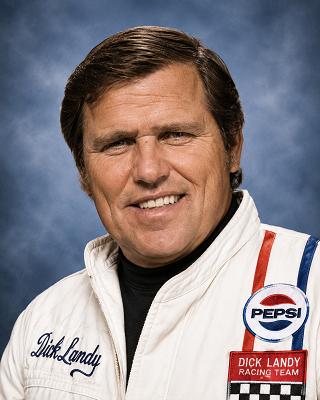
Dick Landy looked more like the fellow Dodge sent to explain the race car than the fellow expected to put it on the rear tires.
Clean white clothes. Sponsor patches where they belonged. Hair combed. Cigar clamped between his teeth, usually unlit. Then somebody opened the staging lanes and the salesman disappeared.
Landy raced through one of the fastest-changing periods drag racing ever saw, and he had a useful habit: when the existing car stopped being the best answer, he changed the car. Stock became Super Stock. Super Stock got stretched into Factory Experimental. The axles moved, nitro arrived, the cars started looking funny, and eventually the factory door-car crowd reorganized itself as Pro Stock.
Dandy Dick was rarely watching those changes from the grandstand.
He was a driver, engine builder, chassis experimenter, businessman and factory representative. Dodge could send Landy to a dealership to explain how to make a Mopar quicker on Friday, then send him to the strip Saturday and let him demonstrate the lesson.
That cigar got the photographs. The machinery underneath him is why the photographs still get recognized.
He Was a Ford Racer First
Richard Landy was born in Southern California in 1937 and started racing as a teenager. His first trip down a drag strip came in a borrowed Ford pickup, which was enough to point the rest of his life in an expensive direction.
Landy studied mechanical engineering and built high-performance marine engines while continuing to race. Early Ford efforts brought him sponsorship from dealer Andy Andrews and taught him something Detroit would later find very useful: winning races and selling cars could be the same job if the racer knew how to do both.
When Chrysler’s factory drag program began getting serious, Landy moved to Plymouth equipment in 1962 and then Dodge for 1964.
That was when the machinery started getting peculiar.
The Hemi Arrived With Better Ideas
Chrysler’s new 426 Race Hemi gave its factory teams enough power to make everybody reconsider where the rest of the automobile ought to be.
Landy received a Hemi-powered Dodge 330 for 1964. He did not treat it as finished factory equipment. He looked at where the weight sat, how the car transferred that weight on launch and what several hundred Hemi horsepower was asking the rear tires to do.
Factory Experimental rules gave him room to experiment. Late in 1964, his Dodge appeared with a dramatically altered stance: the front wheels had moved forward and the rear wheels had moved toward the front.
The idea was straightforward even if the resulting Dodge was not. Moving the axles changed the weight distribution and helped plant the rear tires harder when Landy left the starting line.
The car looked wrong.
It worked.
Then Chrysler Made the Funny Part Official
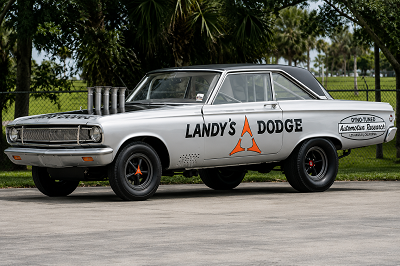
For 1965 Chrysler quit being subtle. Its factory A/FX Dodges and Plymouths arrived with the rear axle moved forward roughly fifteen inches and the front wheels about ten inches forward from their production locations.
Landy’s Coronet became one of the most recognizable of the bunch. At Bakersfield he defeated Butch Leal in another altered-wheelbase Mopar, and the strange-looking Dodges soon became exactly what match-race promoters wanted on their posters.
Landy kept pushing his car farther. Carburetors gave way to fuel injection. Nitromethane arrived. The factory sedan underneath him became less interested in behaving like anything Dodge would sell to somebody’s mother.
Arguments over the first Funny Car can consume an evening and still leave everybody arguing. Landy’s place is easier to settle. His altered-wheelbase Dodges were among the machines that made the new form impossible to ignore, and he was one of the racers pushing the transition rather than merely adapting after it happened.
➤ See how Detroit moved the axles and accidentally helped invent Funny Car in Racing Shenanigans
Dodge Had Found More Than a Driver
Landy’s value to Chrysler went beyond elapsed times. He understood presentation at a time when plenty of serious racers still regarded public relations as the fellow with the microphone bothering them between rounds.
Dandy Dick cultivated the opposite approach. The white clothes stayed clean whenever possible, the sponsor patches were visible and the cigar became part of the package.
The cigar was mostly stage equipment. Landy generally did not light the things. An early sponsor had handed him one for luck, and eventually he said he felt improperly equipped without it.
Dodge also put him on the road conducting performance clinics at dealerships around the country. Landy could explain cylinder heads, intake manifolds, gearing and chassis setup to customers, then climb into the company’s latest factory racer and make the sales presentation considerably louder.
For Landy, the clinic and the race were not separate jobs. Both were ways to show what the machinery could do.
He Could Go Backward Without Going Back
By the later 1960s the early Funny Cars had become spectacular machines, but they were moving farther from anything sitting in a Dodge showroom. Landy shifted his attention back toward Super Stock and the serious heads-up factory combinations.
That did not mean returning to tame automobiles. Dodge Chargers, Coronets and Hemi-powered Darts gave him another set of combinations to develop, and Landy kept doing what he had done with the altered-wheelbase cars: study what the rules allowed and build around the answer.
He won Street Eliminator at the 1968 NHRA Winternationals and returned to Pomona in 1969 to win Modified Eliminator.
By then Landy, Bill “Grumpy” Jenkins, Ronnie Sox, Dyno Don Nicholson and the other leading door-car racers were already giving promoters the show NHRA would soon formalize: recognizable factory-based cars, naturally aspirated engines and no handicap protecting anybody from the fellow in the other lane.
Eventually the rulebook caught up with the racers.
Pro Stock Was the Logical Next Step
NHRA introduced Pro Stock at the 1970 Winternationals, and Landy arrived with a Hemi Dodge Challenger.
He qualified fifth in the first Pro Stock field with a 10.11 and advanced to the semifinals, where a red light against Jenkins ended his chance to become the class’s first winner.
There was some compensation. Landy won Modified Eliminator at the same event.
Pro Stock suited him because it took the factory-car argument Landy had been having for years and gave it a permanent eliminator. Build the better combination. Leave first. Get there first. No explanation required afterward.
Now somebody had to win one for Dodge.
York Put Dodge in the Pro Stock Winner’s Circle
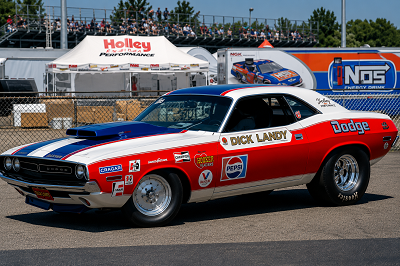
The first NHRA Summernationals came to York U.S. 30 Dragway in Pennsylvania during July 1970. Nearly sixty Pro Stock cars tried to make a sixteen-car field.
Landy survived it. So did Herb McCandless, driving the Sox & Martin Hemi Duster.
The two Mopars met in the final. McCandless red-lighted, handing Landy the victory. McCandless later remembered that Landy missed a gear on the run, which is the sort of detail racers remember considerably longer than the fellow holding the trophy does.
Dandy Dick had won the Summernationals and given Dodge its first NHRA Pro Stock victory.
It was also Landy’s third NHRA national-event win after his 1968 and 1969 Winternationals eliminator victories.
The Hemi Eventually Lost an Argument With the Scale
Early Pro Stock treated Chrysler’s Hemi combinations very well. NHRA’s attempts to balance the class eventually treated them less generously.
As weight breaks changed, smaller wedge-head engines could run in lighter cars. Jenkins famously answered with a small-block Vega. Landy’s Dodge identity remained tied closely to the Hemi, and every additional pound made that relationship more expensive on the scoreboard.
He remained competitive and reached the 1972 Summernationals final before losing to Jenkins, but Landy had seen this movie before. The rulebook had changed the useful answer, just as it had during the Factory Experimental years.
Dandy Dick was not sentimental about yesterday’s combination merely because it had once been fast.
There Were Other Places to Race a Hemi
Landy shifted substantial attention toward AHRA competition and match racing, where the big Mopar combinations still had room to work.
He won AHRA Pro Stock championships in 1973 and 1974 while continuing to develop engines and equipment through his California operation.
Dick Landy Industries eventually became a larger legacy than one driver’s trophy shelf. Landy built and developed engines for numerous forms of motorsports, and his name remained attached to Mopar performance long after his own regular driving schedule slowed.
The fellow who had once moved the wheels around on a Dodge because the original arrangement was not getting the job done never developed much reverence for leaving machinery alone.
Dandy Wasn’t Just a Nickname
Landy’s polished public image separated him from many racers of the period, but it was not merely showmanship. He understood early that professional racing had customers.
Some bought tickets. Some bought speed parts. Some walked into a Dodge dealership Monday morning because the car they had seen at the strip Sunday afternoon carried the same name across the grille.
Landy treated all of them as part of the business.
That made him unusually well suited to the factory wars. Detroit did not need somebody who could only win races. It needed a racer who could develop the car, drive it, explain why it worked and make people remember which company had supplied it.
Dandy Dick could handle all four without removing the cigar.
The Bottom Line
Dick Landy died from kidney failure on January 11, 2007, at age 69.
By then drag racing had placed neat historical names around most of the disorder he had raced through: Super Stock, Factory Experimental, Funny Car and Pro Stock.
Landy had the inconvenient habit of arriving while the names were still being worked out.
He moved the axles when the stock wheelbase stopped being the best answer. He followed the altered-wheelbase cars toward Funny Car, then returned to factory-based racing and helped carry that argument into Pro Stock. When the weight breaks changed again, he changed direction again.
The spotless clothes and cigar made Dandy Dick easy to recognize.
The better signature was underneath him. If yesterday’s race car was no longer the right answer, Dick Landy was already working on the next one.
↑ Back to the Top, Before Dandy Moves the Axles Again