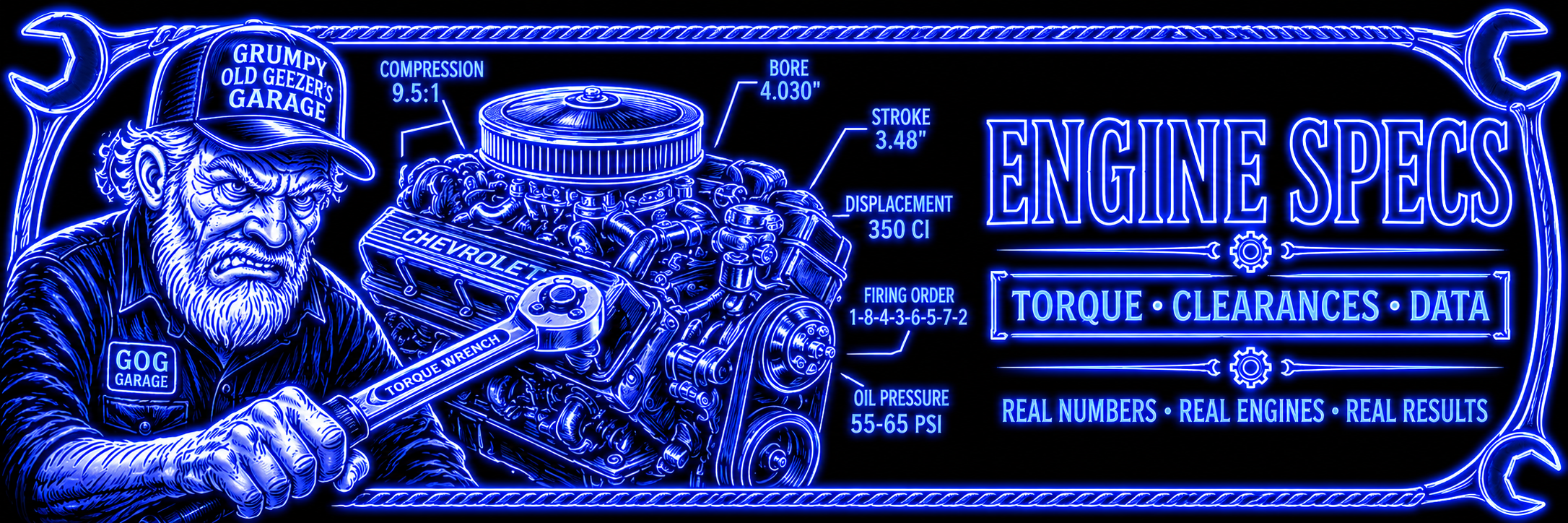
Chevy 267 Engine Specs
On This Page:
Engine Details: General Specs | Variants | Key Notes
Final Word: Bottom Line
Related: Related Links

Intro
➤ See the Family Page for specs common to all engines in this family.
The Chevy 267 arrived for 1979 as another answer to the question Detroit spent most of the late 1970s asking: how do you keep selling a V8 when fuel economy and emissions have moved to the front of the meeting? Chevrolet already had the 305, but the company still wanted an even smaller V8 for ordinary passenger-car duty. The result was 267 cubic inches of familiar small-block Chevrolet wrapped around a very different set of priorities from the engines that had built the family’s reputation.
The dimensions explain most of it. Chevrolet used a tiny 3.500-inch bore with a 3.480-inch stroke. That stroke was familiar small-block territory. The bore was not. It gave the 267 far less room around the valves than a 350 and even less than a 305, putting a hard limit on how much useful airflow the engine could handle. The 267 may look like the other Gen I engines from across the garage. Inside the cylinders, things get crowded in a hurry.
That small bore was not a mistake. Chevrolet was not designing a performance engine and then accidentally making it slow. The 267 was an economy-era passenger-car V8 built around modest compression, small valves, a mild hydraulic camshaft, two-barrel carburetion, emissions calibration, smooth operation, and enough low-speed torque to move an ordinary car without asking the driver to think about any of it.
Factory output generally lived around 115–125 horsepower and roughly 206–214 lb-ft of torque depending on year and application. That is not the sort of number that made anybody circle the dealership after closing time. It is exactly the sort of number that explains what Chevrolet was trying to accomplish: retain the feel and packaging of a V8 without pretending 1979 was still 1969.
The 267 was larger than the short-lived 262 that came before it, but it was not simply an improved version of the same engine. Chevrolet changed the bore-and-stroke formula dramatically. The 262 used a 3.671-inch bore and 3.100-inch stroke. The 267 went to a much smaller 3.500-inch bore and the much longer 3.480-inch stroke. Similar economy mission. Different mechanical personality.
The comparison that really matters is the 305. Both engines lived in the same economy-and-emissions world, but the 305 had more displacement and a larger bore, giving it more torque reserve and more breathing room without abandoning the compact Gen I package. The 267 could do the same basic passenger-car job. The 305 simply gave Chevrolet more engine to do it with.
That is why the 267 disappeared after 1982 while the 305 kept going. Chevrolet had not discovered some hidden small-block masterpiece and then forgotten about it. The 267 occupied a narrow market slot for a few years, and once that slot stopped making enough sense, the broader usefulness of the 305 won the argument.
Today the 267 makes sense primarily as an original engine, a curiosity from the emissions era, or a healthy existing powerplant that does not need replacing just because the cubic-inch number fails to impress anybody. A decent 267 can idle smoothly, cruise happily, and perform ordinary street duty exactly as intended.
What it does not make sense as is a bargain performance core. The small bore limits valve size and airflow, the displacement provides little torque cushion, and machine-shop labor costs money whether the finished engine has 267 or 350 cubic inches. Once serious rebuilding and performance money enter the conversation, arithmetic starts pointing toward another block.
The 267 belongs in the small-block Chevrolet story because it shows just how far the original architecture could be bent around changing priorities. The family that had once chased horsepower-per-cubic-inch headlines was now being asked to satisfy fuel-economy targets with a two-barrel carburetor and a vacuum hose collection. The 267 did that job for four model years. Nobody wrote a song about it. Chevrolet did not ask them to.
↑ Back to the Top, Before the Casting Numbers Start Lying

Overview
The 267 appeared in 1979, four years after Chevrolet had tried the 262 and three years after the 305 had entered production. That timing matters. Chevrolet was no longer experimenting with whether a reduced-displacement Gen I V8 could be built. It was experimenting with how small one could be made while still giving ordinary passenger cars the smoothness, packaging, familiarity, and low-speed behavior buyers expected from a Chevrolet V8.
The 267 carried the L39 designation and had one basic factory personality: an economy-minded two-barrel passenger-car engine. This is not one of those small blocks where five famous option codes, three racing packages, and a dozen horsepower ratings have to be separated before anybody knows what is sitting on the stand. The 267 was born mild and stayed in its lane.
Mechanically it retained the familiar Gen I foundation: 90-degree cast-iron V8 block, 4.400-inch bore spacing, five main bearings, in-block camshaft, pushrods, cast-iron cylinder heads, 5.700-inch connecting rods, and internal balance. Main journals were the later 2.45-inch size and rod journals measured 2.10 inches. Nothing about the general architecture looked revolutionary because Chevrolet was deliberately using an engine family it already knew how to manufacture.
The unusual part was the 3.500-inch bore. That is smaller than the 262’s 3.671 inches, smaller than the 305’s 3.736 inches, and dramatically smaller than the 4.000-inch bore used by the 302, 327, and 350. Chevrolet paired that little cylinder with a 3.480-inch stroke, producing an almost square bore-and-stroke relationship and approximately 267 cubic inches.
That combination shifted the engine away from the traditional short-stroke personality of early little small blocks. A 265 or 283 used a 3.000-inch stroke. The 267 carried almost another half-inch of crank throw while squeezing everything into a smaller bore. The result favored useful low-speed cylinder filling and ordinary driving manners far more than valve area or high-rpm breathing.
The cylinder heads followed the same logic. Small valves matched the small bore and modest airflow demand. Bigger valves are not free horsepower on a 267 because the cylinder wall is sitting close enough to interfere with both physical clearance and airflow around the valve. Valve shrouding becomes part of the argument before somebody reaches the exciting pages of the cylinder-head catalog.
Factory compression was around 8.3:1, using dished pistons and emissions-era combustion hardware. The camshaft was a mild hydraulic flat-tappet piece. Induction came through a Rochester Dualjet two-barrel, with later applications moving into electronic-feedback carburetion as Chevrolet began tying mixture control more closely to emissions systems.
Output generally fell in the 115–125 horsepower range with roughly 206–214 lb-ft of torque depending on year and application. The torque number is more useful for understanding the engine. Chevrolet was not building something meant to come alive at high rpm. It wanted enough low-speed pull to move an ordinary passenger car through an automatic transmission without constant downshifts and complaints.
That is also why the nearly 3.5-inch stroke matters. The 267 did not have much displacement, but Chevrolet gave what displacement it had useful crank leverage. It still could not match a 305 or 350 for torque because cubic inches eventually win that argument, but the geometry suited an engine expected to spend most of its life well below the rpm where high-performance small blocks make their reputation.
The trouble starts when later builders see the familiar small-block shape and assume the usual performance formula applies. A big cam moves the useful rpm range upward while stealing low-speed cylinder pressure. Large-port heads can reduce mixture velocity while the tiny bore limits how much valve area can actually be used. A large carburetor adds capacity the engine never asked for. The 267 does not have enough displacement to cover those mistakes.
A mild build can work much better. Sensible compression, appropriately sized valves and ports, conservative cam timing, clean ignition, a properly functioning carburetor, free but not ridiculous exhaust, and gearing matched to the vehicle let the engine use what it has. Nobody will mistake the result for an LT-1. It can still be a smooth, responsive little street engine instead of a pile of mismatched performance parts wondering why nothing happened.
The 267 also deserves to be separated mechanically from the 262. The earlier 262 used a larger bore but considerably shorter 3.100-inch stroke. The 267 did nearly the opposite: much smaller bore, substantially longer stroke. Chevrolet therefore reached roughly the same small-displacement neighborhood through two different combinations. The market mission was similar. The engineering recipe was not.
Against the 305, however, the 267 has a harder argument. The 305 used the same 3.480-inch stroke but increased bore to roughly 3.736 inches. That added nearly forty cubic inches, increased valve room, improved breathing potential, and delivered more usable torque while keeping the same basic external package. There was no great packaging miracle available from losing those cubes.
That explains the production history better than nostalgia ever will. The 267 lasted from 1979 through 1982. The 305 became Chevrolet’s durable small-displacement V8 answer and survived well beyond it. Once Chevrolet could satisfy fuel-economy and emissions requirements with the larger engine, the 267 had very little unique work left to do.
Its limited performance potential does not make it defective. Chevrolet designed the L39 around exactly the hardware it needed for its intended job: low compression, modest airflow, small valves, mild cam timing, simple induction, and passenger-car drivability. Complaining that it does not respond like a 350 is roughly equivalent to criticizing a station wagon because the trunk will not win a drag race.
Originality can still give a 267 real purpose today. If one belongs in the car and still runs well, there is nothing inherently wrong with keeping it there. The engine is part of Chevrolet’s late-emissions-era history, and replacing every unfashionable factory engine with a 350 eventually leaves us with a lot of old cars supposedly representing a past that never actually existed.
If originality is irrelevant and the engine needs a complete performance rebuild, the calculation changes. Machine work, pistons, camshaft, heads, induction, and assembly cost real money regardless of displacement. A 305 or 350 gives that money more bore, more breathing room, more torque, and vastly broader aftermarket choices. The 267 can be built. The more useful question is why.
That is the engine’s real place in the family. The 262 was Chevrolet’s first brief attempt at a downsized emissions-era small block. The 267 tried another bore-and-stroke solution a few years later. The 305 proved broad enough to survive. The 350 remained the performance and general-purpose benchmark. The 267 was the narrow economy branch Chevrolet could prune without hurting the tree.
↑ Back to the Top, Before the Casting Numbers Start Lying

General Specs
| Displacement | 267 cu in / 4.4L | Bore / Stroke | 3.500 in × 3.480 in |
| Production / Use Era | 1979–1982 emissions-era passenger-car economy V8 | Bore Spacing | 4.400 in |
| Engine Family | Chevrolet Gen I Small Block | Deck Height | 9.025 in |
| Block Material | Cast iron | Rod Length | 5.700 in |
| Cylinder Head Material | Cast iron | Main Journal | 2.45 in |
| Fuel / Induction | Rochester Dualjet 2-barrel carbureted; electronic feedback carburetion on later versions | Rod Journal | 2.10 in |
| Cam Location | In-block camshaft | Main Bearings | 5 |
| Valve Layout | OHV / pushrod, 2 valves per cylinder | Firing Order | 1-8-4-3-6-5-7-2 |
| Common Main Caps | 2-bolt | Distributor Rotation | Clockwise |
| Rear Main Seal | 2-piece | Weight | ~575 lbs |
| Balance | Internal | Dimensions | ~28H / ~26W / ~29L |
Exact parts and specs can vary by year, vehicle, emissions package, service replacement history, and whether somebody already rebuilt the thing with whatever was cheapest at the machine shop. Use these numbers as the family baseline, then verify the specific engine before ordering parts or machining anything expensive.
↑ Back to the Top, Before the Casting Numbers Start Lying

Variants
The 267 stayed remarkably simple during its short life. Chevrolet never developed a performance, four-barrel, heavy-duty, or high-compression version. There were, however, two useful factory combinations: the original mechanically controlled Dualjet engine and the later Computer Command Control version with an electronically controlled feedback carburetor.
1979–1980 L39 — Conventional Dualjet 267
What it was: The original L39 was Chevrolet’s small-displacement economy V8 for passenger-car duty. It was designed to provide smooth V8 operation and adequate low-speed torque while keeping fuel consumption and emissions below what the larger 305 demanded.
What changed: The 267 used a 3.500-inch bore and 3.480-inch stroke, hydraulic flat-tappet camshaft, small-valve cast-iron heads, dished pistons, and a Rochester M2ME Dualjet two-barrel carburetor. Compression was about 8.5:1 for 1979 and settled around 8.3:1 for 1980. The Dualjet was essentially the primary side of a Quadrajet without the secondary barrels, which tells you exactly how much airflow Chevrolet expected this engine to need.
What that did: Output was roughly 125 net horsepower and 215 lb-ft in 1979, dropping to about 120 horsepower for 1980. The tiny bore, mild cam, low compression, and small carburetor concentrated what power the engine had at low rpm. It was smooth and adequate in normal driving, but there was no hidden upper-rpm personality waiting for the secondaries because Chevrolet had thoughtfully neglected to provide any.
Where used: The L39 appeared in Chevrolet Camaro, Malibu, Monte Carlo, El Camino, Impala, Caprice, and related GM passenger-car applications.
1981–1982 L39 — Computer-Controlled Feedback 267
What it was: For 1981 Chevrolet kept the same basic 267 but brought it into the early electronic-emissions era. The mechanical engine underneath remained mild; the important change was how the carburetor and ignition mixture-control system were managed.
What changed: Compression remained about 8.3:1, along with the small-valve heads, dished pistons, and hydraulic camshaft. U.S.-spec engines changed to the Rochester E2ME electronically controlled Dualjet working with GM’s Computer Command Control system. An oxygen sensor, mixture-control solenoid, electronic controls, and related emissions hardware allowed the system to adjust fuel mixture rather than relying entirely on fixed carburetor calibration and vacuum controls.
What that did: The system gave Chevrolet tighter control over mixture and emissions but did nothing to turn the little 267 into a performance engine. Output settled around 115 net horsepower and roughly 200 lb-ft. The engine remained tuned for low-speed drivability and economy while the electronics concentrated on keeping the exhaust clean enough to survive the new decade.
Where used: The feedback-carbureted L39 appeared in 1981–82 U.S.-market Chevrolet passenger cars and related GM applications. Some Canadian-market applications retained the conventional non-feedback M2ME Dualjet, so the presence of an electronic carburetor depends on market as well as model year.
That is the 267 variant story. Chevrolet made a small compression revision and changed ratings during the run, but neither created another meaningful engine family. The one substantial evolution was the move from conventional carburetor control to electronic feedback. No four-barrel 267, no H.O. package, no performance version hiding in the option book — just an economy V8 learning how to answer to a computer.
↑ Back to the Top, Before the Casting Numbers Start Lying

Key Notes
The 267 can fool people because it wears familiar small-block Chevy clothing and uses the same 3.480-inch stroke as the 350. That sounds interesting until the 3.500-inch bore walks into the room and ruins the shortcut. This is still a small-bore, low-output, late-1970s economy-era V8. It shares family architecture, not performance destiny.
The bore is the whole argument. With a 3.500-inch bore and 3.480-inch stroke, the 267 has stroke that looks useful on paper but nowhere near the bore area or breathing room of a 350. The stroke helps it feel less tiny at low speed, but the bore keeps the heads, valves, and airflow on a short leash. That limits valve size, head choice, camshaft tolerance, and how much power the engine can make before it starts acting worse instead of better.
The 267 came from the late emissions-era world, not the performance playbook. It was built for economy, emissions compliance, ordinary drivability, and packaging in late-1970s and early-1980s cars. That does not make it junk. It makes it a product of its assignment. The trouble starts when somebody expects a 267 to do a job Chevrolet never gave it the lungs to handle.
There are no factory hero versions hiding in the weeds. No 267 LT-1. No Fuelie. No L79. No secret factory street bruiser waiting for the right air-cleaner decal. If somebody tries to sell one like uncommon automatically means special, make him prove something besides scarcity. Fewer built does not mean more wanted.
Parts interchange can turn into a trap. Yes, the 267 is a Gen I small block. No, that does not mean every common 305, 327, or 350 part belongs on it. Heads, valve size, intake, carburetion, camshaft, compression, exhaust, timing curve, converter, and gearing all have to respect the small bore and limited airflow. “It bolts on” is where bad 267 plans usually start.
The 267 does not have much cushion for lazy parts choices. A big cam, big carburetor, oversized heads, weak compression, stock smog exhaust, and tall highway gears can turn this engine into a wheezing little complaint with valve covers. A larger small block can sometimes drag a bad combination around until the owner figures it out. The 267 does not have that luxury.
Factory specs only tell the beginning of the story. A surviving 267 may have been rebuilt, overbored, re-cammed, re-headed, swapped, or dressed with larger-engine parts because somebody assumed “small-block Chevy” was enough information. The engine on the stand tells the truth now. Casting numbers, bore, heads, pistons, camshaft, induction, and vehicle context all need to be checked before anyone starts guessing.
Feedback carburetion and emissions-era hardware can matter. Later 267 applications may include feedback carburetors, vacuum controls, sensors, wiring, and calibration pieces that all have to work together. If that system is intact, repair it like a system. If it is being removed, remove it with a plan. Half-unplugging pieces because “old cars are simple” is how a mild engine turns into a drivability mess with extra vacuum leaks.
Overboring is where optimism needs a measuring tool. The 267’s small bore tempts people into thinking they can machine their way toward a better engine. That is usually wishful thinking with a shop bill attached. Measure the block, check wall thickness if the build justifies it, and do not assume the cure for a small-bore engine is automatically making the cylinders bigger.
The 267 earns its keep only when nobody lies about the job. It can make sense in a correct late-1970s or early-1980s application, a mild driver, or a car where originality has value. It does not make much sense as a performance foundation when 305, 327, and 350 cores exist. By the time the machine shop starts fixing the 267’s limitations, a better starting point may already be cheaper.
The 267 is not worthless. It is limited. It belongs in the small-block Chevy story because it shows how far Chevrolet stretched the V8 idea during the economy and emissions squeeze. Keep it mild, verify what it is, do not overpay for rarity, and do not expect a small-bore economy V8 to carry 350 dreams just because the bellhousing pattern looks friendly.
↑ Back to the Top, Before the Casting Numbers Start Lying

Bottom Line
The Chevy 267 is not a mystery. It is an honest little emissions-era small block that keeps getting dragged into arguments it was never built to win. Chevrolet put it into ordinary passenger cars from 1979 through 1982 because fuel economy, emissions rules, and drivability were running the meeting. Nobody in the room was asking for a new street-racing hero.
The real limit is geometry, not attitude. The 3.480-inch stroke gives the 267 a little more low-speed shove than the tiny bore suggests, but that 3.500-inch bore keeps valve size, airflow, head choice, and upgrade potential on a short leash. People see the familiar small-block shape and start imagining possibilities. Then the bore walks in, shuts the toolbox, and ruins the party.
That does not make it junk. A healthy 267 can idle smoothly, move an ordinary car, cruise without drama, and do the modest job Chevrolet gave it. If the engine is original, healthy, and already sitting where it belongs, fine. Tune it, seal it, keep the carburetion and ignition right, and leave it alone long enough to do some honest work.
What usually does not make sense is trying to rescue it from its own assignment. A stock-style repair is reasonable. A little maintenance is reasonable. A pile of cam, heads, machine work, induction, exhaust, tuning, and motivational speeches usually is not. Once the build sheet gets longer than the engine’s list of advantages, somebody chose the wrong starting point.
So keep a good 267 when the car and history call for it, but do not go hunting for one because it seems rare or cheap. Rare does not mean valuable, and small-block Chevy does not automatically mean worth building. If the goal is power, use an engine with enough bore and displacement to appreciate the effort. The 267 already has a job. It does not need a bigger ego.
↑ Back to the Top, Before the Casting Numbers Start Lying

Related Links
Torque Specs
Common Factory Pairings
Carburetors
- Holley 2300 — 2-bbl
- Holley 4150 — 4-bbl
- Holley 4160 — 4-bbl
- Rochester 2G / 2GC / 2GV — 2-bbl
- Rochester Dualjet / E2ME / E2SE — 2-bbl
- Rochester E4ME / E4MC CCC Quadrajet — 4-bbl
- Rochester Quadrajet — 4-bbl
Transmissions
- Saginaw — 3-Speed
- Borg-Warner Super T10 — 4-Speed
- Saginaw — 4-Speed
- TH200 — 3-Speed Automatic
- TH350 — 3-Speed Automatic