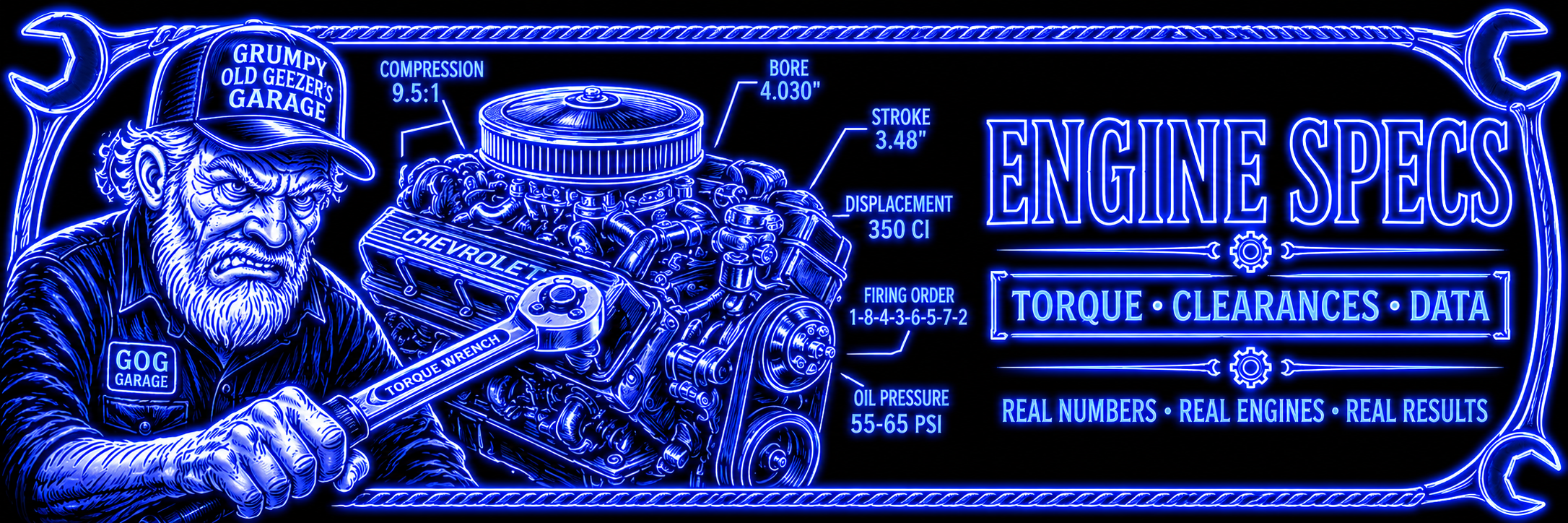
Chevy 305 Engine Specs
On This Page:
Engine Details: General Specs | Variants | Key Notes
Final Word: Bottom Line
Related: Related Links

Intro
➤ See the Family Page for specs common to all engines in this family.
The Chevy 305 arrived for 1976 and became Chevrolet’s successful answer to a problem the 262 had barely solved and the later 267 would not solve for long. Detroit still wanted V8 smoothness, torque, packaging, and customer familiarity, but fuel economy and emissions had joined the engineering department and apparently intended to stay. Chevrolet needed a smaller small block that could survive that new world without becoming useless.
The 305 managed it. With a 3.736-inch bore and 3.480-inch stroke, it kept the familiar Gen I architecture while cutting displacement to five liters. It was smaller and easier on fuel than the 350, but large enough to avoid some of the severe compromises that made Chevrolet’s 262 and 267 such narrow answers. That basic balance is why the 305 lasted while the other little emissions-era small blocks became footnotes.
Do not mistake longevity for performance intent. The original 305 was built around economy, emissions compliance, smooth drivability, and ordinary passenger-car work. Early versions used modest compression, small valves, mild camshafts, and conservative carburetion. Chevrolet was trying to get through the late 1970s with a V8 still on the option sheet, not sneak another Z/28 racing engine past the accountants.
That changed somewhat as the years went on. Four-barrel LG4 and LE9 versions gave the engine better breathing. The L69 H.O. put more compression, camshaft, induction, and calibration into the package. Cross-Fire and Tuned Port Injection dragged the 305 into the electronic performance era. Later throttle-body and Vortec versions turned it into a dependable computer-controlled workhorse. Same displacement. Very different levels of ambition.
That range is why “305” does not tell the whole story. An early low-compression two-barrel passenger-car engine, an L69 H.O., an LB9 Tuned Port engine, and a late L30 Vortec truck engine all share displacement. They do not share induction, heads, controls, performance, or personality.
The 305’s reputation suffers because everybody compares it with the 350. That comparison is understandable and usually unfair. Both share the same 3.480-inch stroke, but the 350 has a 4.000-inch bore instead of the 305’s 3.736 inches. That larger bore gives the 350 another 45 cubic inches, more room around the valves, broader cylinder-head choices, more airflow potential, and enough extra torque to forgive combinations the 305 will expose immediately.
That does not make the 305 junk. A healthy one can be a good street engine. It can idle smoothly, start easily, make useful low- and midrange torque, cruise economically by V8 standards, and provide all the familiar small-block manners people actually wanted when Chevrolet built it. Later TPI and Vortec versions can be considerably better than the old smog-era reputation suggests.
What the 305 does not reward is pretending the bore does not matter. Huge valves, giant ports, too much camshaft, lazy gearing, and a carburetor sized for somebody’s 406 do not turn a 305 into a 350. They usually remove the velocity and cylinder pressure that made the smaller engine useful in the first place.
That is the 305’s real place in the family. It was not Chevrolet’s great performance small block and it was not an engineering embarrassment. It was the small-displacement Gen I that actually worked well enough to stay. Chevrolet used it through the emissions years, electronic-control transition, performance-image revival, truck era, and into the early 2000s because it kept doing the job.
The 350 won the horsepower argument. The 305 won the right to keep showing up for work.
↑ Back to the Top, Before the Casting Numbers Start Lying

Overview
The 305 entered production in 1976, one year after Chevrolet introduced the short-lived 262. The assignment was similar: retain a traditional V8 while lowering displacement and fuel consumption for a market increasingly dominated by emissions requirements and economy concerns. The difference was that Chevrolet gave the 305 enough displacement to remain broadly useful.
Mechanically, the formula was 3.736 inches of bore and 3.480 inches of stroke. The stroke is the same basic dimension used by the 350, so the 305 did not get its smaller displacement by becoming another tiny short-stroke engine. Chevrolet reduced the bore instead. That decision gave the engine reasonable crank leverage and low-speed manners while creating the breathing limitation that follows every 305 performance discussion.
The small bore puts the cylinder wall closer to the valves. That restricts practical valve size and increases shrouding as valve diameter grows. It also means cylinder heads developed around a 4.000-inch-bore 350 do not automatically make sense on a 305. The bolt holes may agree while the airflow does not.
This is why the 305 responds best when the combination stays in scale. Moderate ports, sensible valve sizes, enough compression, appropriate cam timing, good ignition, and induction sized for actual demand can make the engine responsive and useful. Bolt on enormous heads and a cam that does not begin working until the engine is already considering retirement, and the 305 will faithfully demonstrate the difference between interchangeability and suitability.
The early standard engines were built around exactly that conservative idea. The LG3 was a two-barrel economy version with low compression, small valves, mild cam timing, and emissions-era calibration. It did ordinary passenger-car work and made no serious claim to performance.
The LG4 moved to four-barrel carburetion and became one of the familiar passenger-car 305s of the era. The LE9 performed a similar basic job in light-truck applications. More carburetor helped breathing and drivability where the engine could use it, but neither version became a performance engine simply because two more barrels had appeared above the intake manifold.
The sportier versions are where the 305 story gets more interesting. Chevrolet used the displacement in F-bodies and other performance-image applications because the company still needed something that looked and behaved more serious than the ordinary smog-era V8 without stepping outside the fuel-economy and emissions world completely.
The LU5 Cross-Fire 305 was one of the early electronic steps. Dual throttle bodies and computer control gave Chevrolet a fuel-injected performance image during the awkward transition away from carburetors. It was technically interesting and historically important, but the induction system did not remove the 305’s fundamental airflow limits.
The L69 H.O. was the strongest of the traditional carbureted 305 combinations. Higher compression, better cam timing, four-barrel induction, and performance-oriented calibration gave it considerably more attitude than the ordinary LG3 and LG4 engines. It proved Chevrolet could make the 305 interesting when the whole package was improved instead of merely putting decals on the air cleaner.
Tuned Port Injection gave the engine an even better street personality. The LB9 TPI 305 used long intake runners and electronic fuel control to strengthen low- and midrange torque, improve throttle response, and provide drivability the old carbureted engines could not match as consistently. It was still not a high-rpm screamer. The long-runner intake and small bore both favored useful street torque rather than heroic breathing at the top of the tach.
That made the LB9 a good match for the cars Chevrolet actually installed it in. The engine could feel stronger than the raw horsepower number suggested because it delivered useful torque where a street-driven Camaro or similar car spent most of its time. Horsepower arguments happen at the top of the tach. Most traffic lights do not.
Later L03 throttle-body engines moved the 305 toward dependable electronically controlled daily-driver and truck service. Throttle-body injection was not exotic, but it offered clean starting, stable idle, emissions control, and reduced maintenance compared with the carbureted systems that preceded it. By then Chevrolet was asking the 305 to work, not audition.
The L30 Vortec represented the final major factory development of the displacement. Improved Vortec cylinder heads and sequential electronic fuel injection gave the late 305 better airflow and combustion efficiency than the older emissions-era versions. It remained constrained by bore size, but Chevrolet had finally given the little engine heads and controls substantially better than the hardware it had started with twenty years earlier.
That long development arc is why lumping every 305 together is especially useless. An early two-barrel LG3 and a late Vortec L30 are separated by major changes in cylinder heads, induction, ignition, emissions control, rear-main-seal design, electronics, and intended application. The cubic-inch number stayed put while almost everything around it learned new tricks.
The rear of the engine changed too. Early 305s used the traditional two-piece rear-main-seal arrangement. Later production moved to the one-piece rear-main seal along with corresponding crankshaft, oil-pan, flywheel, and flexplate changes. Those differences matter when parts start getting mixed across decades. “It came off a 305” is not enough information when Chevrolet built them for that long.
The 305 survived because it occupied useful ground between tiny economy engines and the ubiquitous 350. The earlier 262 disappeared almost immediately. The later 267 lasted only a few years. Both were even more restricted by displacement or bore size. The 305 gave Chevrolet enough torque and breathing ability to serve normal cars and trucks without giving away the economy argument that had justified a smaller V8 in the first place.
The comparison with the 350 remains unavoidable because the two engines share the 3.480-inch stroke and much of the surrounding Gen I architecture. The difference is bore: roughly 3.736 inches for the 305 versus 4.000 inches for the 350. That additional bore gives the 350 more displacement and more room for airflow. It is why the 350 generally makes more torque, accepts larger valves more comfortably, and responds better when serious performance parts enter the conversation.
For a mild street car, that does not automatically mean the 305 should be thrown away. If the engine is healthy, already installed, and doing the required job, a sensible tune, appropriate gearing, exhaust improvement, and carefully chosen parts can make it perfectly enjoyable. Replacing a good engine merely because another displacement has a better reputation can be an expensive way to solve nothing.
Once a complete performance rebuild is required, the arithmetic changes. Machine work, pistons, camshaft, heads, induction, and assembly cost real money whether the block displaces 305 or 350 cubic inches. When originality does not matter, starting with more bore and more displacement usually buys more power potential for the same pile of receipts.
That is why the 305 deserves neither the contempt nor the mythology it gets. It was Chevrolet’s durable small-displacement Gen I solution, not a failed 350 and not a secret giant killer. Standard versions handled economy duty. H.O., Cross-Fire, and TPI versions gave it some performance personality. TBI and Vortec versions carried it into the electronic workhorse years.
Chevrolet kept improving the 305 because the basic idea remained useful. The bore always set the limit. Everything else was the company learning how much better it could make the engine inside that limit.
↑ Back to the Top, Before the Casting Numbers Start Lying

General Specs
| Displacement | 305 cu in / 5.0L | Bore / Stroke | 3.736 in × 3.480 in |
| Production / Use Era | 1976–early 2000s emissions-era passenger-car, F-body, truck, and service-era small block | Bore Spacing | 4.400 in |
| Engine Family | Chevrolet Gen I Small Block | Deck Height | 9.025 in |
| Block Material | Cast iron | Rod Length | 5.700 in |
| Cylinder Head Material | Cast iron | Main Journal | 2.448 in |
| Fuel / Induction | Carbureted, TBI, TPI, or EFI/Vortec by version | Rod Journal | 2.100 in |
| Cam Location | In-block camshaft | Main Bearings | 5 |
| Valve Layout | OHV / pushrod, 2 valves per cylinder | Firing Order | 1-8-4-3-6-5-7-2 |
| Common Main Caps | 2-bolt | Distributor Rotation | Clockwise |
| Rear Main Seal | 2-piece early / 1-piece later | Weight | ~575–600 lbs |
| Balance | Internal | Dimensions | ~28H / ~26W / ~29L |
Exact parts and specs can vary by year, vehicle, emissions package, induction system, rear main seal style, service replacement history, and whether somebody already rebuilt the thing with whatever was cheapest at the machine shop. Use these numbers as the family baseline, then verify the specific engine before ordering parts or machining anything expensive.
↑ Back to the Top, Before the Casting Numbers Start Lying

Variants
The 305 lasted long enough to live through three different engine-management eras. It began as a low-compression two-barrel smog engine, gained four-barrel and genuine high-output versions, moved through Cross-Fire and Tuned Port injection, and finished as a Vortec truck engine with sequential injection and modern cylinder heads. Same 3.736-inch bore and 3.480-inch stroke. Very different hardware above the pistons.
LG3 — Two-Barrel Economy 305
What it was: The LG3 was the original 305, introduced for 1976 as Chevrolet’s economy-minded passenger-car V8.
What changed: Compression was approximately 8.5:1 in the early engines, with small-valve cast-iron heads, dished pistons, a mild hydraulic flat-tappet camshaft, cast-iron two-barrel intake, and Rochester 2GC carburetor. Compression slipped slightly to about 8.4:1 in some later applications, and Chevrolet replaced the 2GC with the Rochester Dualjet two-barrel for 1979.
What that did: The original 1976 combination produced roughly 140 net horsepower and 245 lb-ft, with the torque peak down around 2,000 rpm. The small carburetor, mild cam, and modest compression kept throttle response and fuel economy reasonable while making absolutely no promises about what happened near the top of the tachometer.
Where used: LG3 305s appeared from 1976 into the early 1980s in Monte Carlos, Malibus, Novas, Camaros, full-size Chevrolets, El Caminos, and related passenger-car applications.
LG4 — Quadrajet Four-Barrel 305
What it was: The LG4 was the mainstream four-barrel 305. It gave Chevrolet considerably better breathing than the LG3 while remaining primarily an economy and general-purpose passenger-car engine.
What changed: Chevrolet added a Rochester Quadrajet four-barrel and larger-valve heads while retaining hydraulic lifters and mild cam timing. Early LG4s ran compression in roughly the 8.4:1 range. Beginning around 1980–81, Computer Command Control brought the electronic E4ME Quadrajet and computer-controlled ignition timing. Later development raised compression first to about 8.6:1 and eventually as high as 9.5:1 in some applications.
What that did: The Quadrajet’s small primaries preserved low-speed response while the large secondaries supplied more airflow when the engine actually asked for it. Depending on year, output generally lived from the mid-140s into the 160-hp range. It was a better-breathing street 305, not a performance engine merely because the carburetor had four holes.
Where used: The LG4 became common in late-1970s and 1980s Camaros, Monte Carlos, Malibus, Caprices, and other Chevrolet passenger cars, including Z28 and early IROC-Z applications where it served as the standard V8 beneath hotter optional engines.
LE9 — Heavy-Duty Four-Barrel 305
What it was: The LE9 was Chevrolet’s truck-oriented four-barrel 305, built around useful low-speed torque and sustained light-truck duty rather than passenger-car economy calibration.
What changed: A representative 1986 LE9 used 9.2:1 compression, hydraulic lifters, four-barrel carburetion, electronic spark control, and truck-specific cam, exhaust, cooling, and calibration hardware. California truck applications could use the related LF3 combination with lower 8.6:1 compression and different emissions calibration.
What that did: Chevrolet rated the 1986 LE9 at 160 net horsepower at 4,400 rpm and 235 lb-ft at only 2,000. The point was broad torque and useful load capability, not pretending a half-ton pickup had accidentally received a Camaro H.O. engine.
Where used: LE9 305s appeared in Chevrolet pickups, Blazers, Suburbans, vans, and other light-truck applications during the carbureted 1980s.
LU5 — Cross-Fire Injection 305
What it was: The LU5 was Chevrolet’s first serious attempt to move the performance-flavored 305 away from carburetion. The Cross-Fire system used two electronically controlled throttle-body injectors on a special aluminum intake.
What changed: Compression increased to about 9.5:1. Chevrolet used a more aggressive performance camshaft, higher-output heads, electronic engine management, and two throttle-body injection units mounted diagonally on a low-profile aluminum intake. The system flowed only about 475 cfm, making the intake the obvious restriction once the rest of the engine started asking for more air.
What that did: The 1982 Camaro version produced about 165 net horsepower; refinement pushed the 1983 rating to roughly 175 horsepower and 250 lb-ft. Throttle response and cold-start control improved over ordinary carbureted engines, but the restrictive intake kept the engine from delivering everything the underlying hardware could have supported.
Where used: The LU5 was used in 1982–83 Camaro Z28 applications and related GM F-body performance models before Chevrolet dropped Cross-Fire from the Camaro lineup.
L69 H.O. — High-Output Carbureted 305
What it was: The L69 was the strongest regular carbureted 305 and one of the few versions Chevrolet deliberately built as a performance engine rather than merely putting into a performance-looking car.
What changed: Compression was 9.5:1 with flat-top pistons. Chevrolet used performance-oriented cylinder heads, a hydraulic cam with approximately .410-inch intake and .423-inch exhaust lift, an aluminum four-barrel intake, performance-calibrated Rochester E4ME Quadrajet, knock sensor, more aggressive electronic spark calibration, dual-snorkel air cleaner in many applications, and a substantially freer exhaust system than the ordinary LG4.
What that did: The Camaro version was rated around 190 net horsepower at 4,800 rpm and 240 lb-ft at 3,200. Compared with the LG4, the torque peak moved upward and the engine kept pulling farther through the rev range. It still had 305 cubic inches, but at least Chevrolet finally gave those cubic inches something useful to breathe through.
Where used: The L69 appeared beginning in 1983 in Camaro Z28s and later IROC-Zs, and it also became closely associated with the Monte Carlo SS, where it continued after Camaro moved toward fuel injection.
LB9 — Tuned Port Injection 305
What it was: The LB9 was the 305’s major electronic-performance step. Tuned Port Injection replaced both carburetion and the compromised Cross-Fire intake with long runners and individual port injectors designed to produce strong street torque and precise fuel delivery.
What changed: Compression was generally around 9.5:1 in the early engines. Chevrolet used tuned aluminum intake runners, eight port-mounted injectors, electronic engine management, performance cylinder heads, and hydraulic camshafts selected around the TPI system. The cam changed substantially during production: the original 1985 engine used about .404/.415-inch lift, while the 1986 version received a much milder roughly .350/.385-inch cam. Later LB9s benefited from roller-cam hardware and continued cylinder-head and calibration development.
What that did: The original 1985 LB9 produced 215 net horsepower and 275 lb-ft. The milder 1986 cam dropped the rating to about 190 horsepower while increasing torque to roughly 285 lb-ft. Later development brought output back upward. The long TPI runners made the 305 especially strong through the low and middle rpm ranges, which is exactly where 305 cubic inches needed the help.
Where used: The LB9 appeared from 1985 through the early 1990s in Camaro Z28 and IROC-Z applications and related Pontiac F-body performance cars.
L03 — Throttle-Body Injection 305
What it was: The L03 was the late passenger-car and light-truck workhorse 305. It abandoned the carburetor for simple electronic throttle-body injection without trying to become another LB9 performance engine.
What changed: Compression was about 9.3:1. Chevrolet used central throttle-body injection, electronic ignition and fuel control, high-swirl cast-iron heads, and a mild camshaft aimed at low-speed torque and emissions. Later passenger-car versions used hydraulic roller camshafts and the revised one-piece-rear-main-seal small-block architecture.
What that did: Typical later passenger-car versions produced around 170 net horsepower with torque in the mid-250-lb-ft range. TBI gave reliable starting, altitude compensation, clean idle, and consistent drivability. It was not glamorous, but neither was crawling under the hood to adjust a choke every time the weather changed.
Where used: L03 305s appeared from the late 1980s into the mid-1990s in Caprices, Camaros, light trucks, vans, and other Chevrolet applications.
L30 Vortec 5000 — Sequential-Injection 305
What it was: The L30 was the final major factory development of the traditional 305 and easily the most sophisticated work-oriented version. Chevrolet combined Vortec cylinder-head development with sequential fuel injection and a hydraulic roller valvetrain.
What changed: Compression rose to about 9.4:1. New Vortec iron heads used fast-burn chambers, improved ports, and approximately 1.84-inch intake and 1.50-inch exhaust valves sized appropriately for the small 3.736-inch bore. Chevrolet added hydraulic roller lifters, sequential port fuel injection, a two-piece intake with aluminum lower and composite upper sections, revised block hardware, and OBD-II electronic controls.
What that did: The better heads and sequential injection made the final 305 considerably stronger and cleaner than its smog-era ancestors. Chevrolet rated the L30 at about 220 horsepower in vans and as much as 230 horsepower and 285 lb-ft in C/K trucks. The bore never got any larger. Chevrolet simply got much better at using the air that would fit through it.
Where used: The L30 Vortec 5000 appeared beginning in 1996 in Chevrolet and GMC C/K pickups and continued in full-size vans into the early 2000s.
The 305 never escaped its small-bore limitation, but its factory hardware evolved enormously. An LG3 two-barrel and an L30 Vortec share displacement and basic Gen I ancestry. Beyond that, comparing them as though Chevrolet built the same engine for twenty-five years is mostly a good way to prove that valve covers are terrible historians.
↑ Back to the Top, Before the Casting Numbers Start Lying

Key Notes
The 305 is where small-block Chevy optimism runs headfirst into bore size. It looks like a 350’s little brother, shares plenty of familiar small-block architecture, and sits in enough cars and trucks that everybody thinks they know what to do with one. Then the small bore, mild factory purpose, weak compression in many versions, and mismatched parts choices start handing out lessons.
The 305’s biggest limitation is its bore. With a 3.736-inch bore and 3.480-inch stroke, it has the same stroke as the 350 but much less breathing room. That small bore limits valve size, head choice, chamber fit, airflow, and camshaft tolerance. The stroke gives the engine decent low-speed manners, but it does not turn the 305 into a small 350. It is a small-bore engine with 350-style expectations constantly being thrown at it.
Not all 305s are the same animal. Chevrolet built weak smog-era 2-barrel versions, 4-barrel passenger-car versions, truck versions, LG4 engines, L69 H.O. engines, LB9 TPI versions, L03 TBI engines, L30 Vortec-style truck engines, and other combinations that changed behavior by year, induction, compression, heads, camshaft, emissions equipment, and vehicle use. A 305 badge tells you the displacement. It does not tell you whether the engine is dead weight, a decent driver, or a version worth keeping.
The better 305s do not belong in the same trash can as the weakest ones. The L69 H.O. brought a stronger factory performance personality for the era. The LB9 TPI leaned into low-to-midrange torque and drivability. The L30 gave the 305 better late factory manners in truck use. None of them turned into 350s, but they were not the same sleepy smog lump either. Treat them like ordinary wheezers and you are being lazy. Treat them like hidden LT-1s and you are being worse.
The 305 behaves when the job stays honest. Mild camshaft, sensible compression, correct heads, proper carburetion or fuel injection, clean ignition, decent exhaust, and appropriate gearing can make one smooth, responsive, and perfectly usable. It just does not have the airflow or cubic-inch cushion to cover sloppy parts choices the way a 350 can.
Big cams and big heads can ruin a 305 fast. Parts that behave on a 350 can make a 305 soft, lazy, and miserable below the rpm range where a street car actually lives. Oversized valves, poor chamber match, too much cam timing, too much carburetor, and weak gearing can turn a usable 305 into a noisy little punishment machine. Catalog parts do not care about bore size. The engine does.
Heads, chambers, valves, and piston choice have to be matched carefully. Too much chamber kills compression. Too much valve or the wrong head can hurt velocity and low-speed response. A 350 head that looks like an upgrade on paper can make a 305 worse in the car. This engine does not have enough airflow cushion to shrug that off.
Factory specs only get you to the front door. Many 305s have been rebuilt, re-cammed, re-headed, swapped, converted, or dressed with parts from larger small blocks because somebody thought “small-block Chevy” was enough information. The engine in front of you decides the truth now. Casting numbers, bore, heads, pistons, camshaft, induction, computer controls, and vehicle context all need checking before anyone starts buying parts.
Computer-controlled and EFI-era 305s bring their own rules. Electronic carburetor, TBI, and TPI combinations depend on sensors, wiring, ECM calibration, fuel pressure, ignition control, emissions hardware, and matching parts. Swapping intakes, cams, injectors, or heads without respecting the system can make the engine worse, not better. Electronics do not forgive bad mechanical choices. They just make the diagnosis more annoying.
The 305 is not automatically a bad engine. It is a bad performance shortcut. That difference gets lost all the time. In a light cruiser, stock-style restoration, mild truck, period-correct driver, or correct late emissions-era application, a healthy 305 can do honest work. As a serious performance build, the money usually points toward a 350 before the machine shop even sweeps the floor.
Overboring is not a magic escape hatch. The 305’s small bore is the central limitation, and you usually do not fix that by pretending the cylinder walls are free real estate. Measure first, check wall thickness if the build justifies it, and do not sink serious machine money into a weak core unless originality or a specific version justifies the fight.
The 305’s value depends heavily on context. A plain low-output 305 core usually is not worth heroic effort. A correct L69, a clean LB9/TPI setup, an L30 truck engine doing stock work, a numbers-appropriate engine, or a healthy driver engine can have a reason to stay. The engine does not need shame, and it does not deserve fantasy. It needs an honest job.
The 305 belongs in the small-block Chevy story because it carried a lot of ordinary cars and trucks through an ugly era. It was not built to replace the 350 as a performance answer. Build it mildly, respect the small bore, keep the parts matched, and it can behave. Ask it to wear 350 expectations with 305 lungs, and the plan is the problem.
↑ Back to the Top, Before the Casting Numbers Start Lying

Bottom Line
The Chevy 305 is not junk, and it is not a secret 350. That settles most of the argument before somebody starts waving a parts catalog around. Chevrolet built the 305 to keep a smaller V8 alive through years when emissions, fuel economy, packaging, and everyday drivability mattered more than bragging rights. It stayed around because it did that job well enough, not because Chevrolet had hidden a muscle engine under an economy badge.
Its limitation is right there in the bore. The 3.736-inch bore and 3.480-inch stroke can make a smooth, responsive street engine, but the smaller bore puts real limits on valve room, airflow, head choice, and how much camshaft the combination wants. Bigger heads, bigger carburetors, bigger cams, and bigger optimism do not make the cylinders any wider. They just make a mismatched 305 easier to hear.
That does not mean every 305 belongs in the same scrap pile. A tired low-compression smog-era engine is one thing. An L69 H.O., LB9 TPI, or good later truck version is another. Some 305s were genuinely better than the reputation suggests, and the right one can belong in a third-generation F-body, Monte Carlo SS, light truck, stock-style cruiser, or original car where drivability and correctness matter more than dyno-room chest beating.
The trick is knowing when to stop. A sensible cam, good ignition, proper carburetion or injection, decent exhaust, and parts matched to the bore can make a healthy 305 enjoyable. Start throwing serious machine-shop money and 350-style airflow parts at it trying to prove cubic inches are optional, and the build has wandered off without the engine.
So keep a good 305 when it belongs in the car, preserve the worthwhile versions, and build the ordinary ones for response and drivability. If the real goal is serious horsepower, quit arguing with the bore and use the larger small block already standing there looking obvious. The 305 is not a legend and it is not a joke. It is simply an engine that works a whole lot better when nobody asks it to lie about what it is.
↑ Back to the Top, Before the Casting Numbers Start Lying

Related Links
Torque Specs
Common Factory Pairings
Carburetors
- Holley 2300 — 2-bbl
- Holley 4150 — 4-bbl
- Holley 4160 — 4-bbl
- Rochester 2G / 2GC / 2GV — 2-bbl
- Rochester Dualjet / E2ME / E2SE — 2-bbl
- Rochester E4ME / E4MC CCC Quadrajet — 4-bbl
- Rochester Quadrajet — 4-bbl
Transmissions
- Saginaw — 3-Speed
- Borg-Warner Super T10 — 4-Speed
- Muncie SM465 — 4-Speed
- New Process A833 Overdrive — 4-Speed
- Saginaw — 4-Speed
- TH200 — 3-Speed Automatic
- TH350 — 3-Speed Automatic
- TH200-4R — 4-Speed Automatic Overdrive
- TH700-R4 / 4L60 — 4-Speed Automatic Overdrive