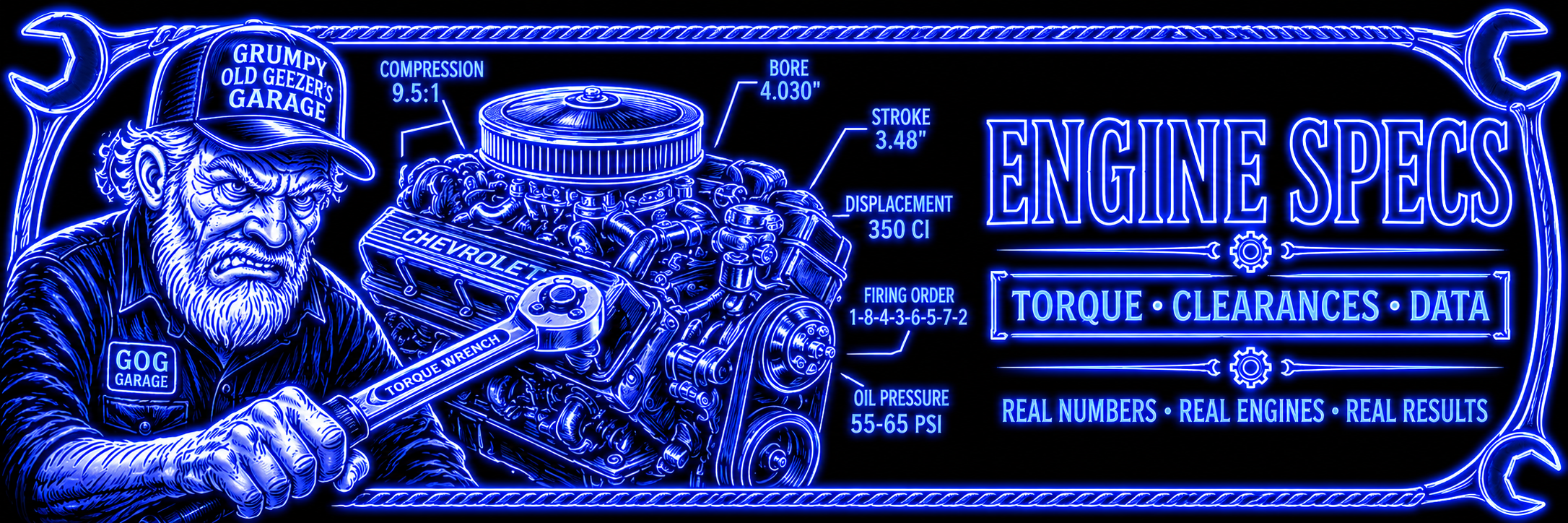
Chevy 350 Engine Specs
On This Page:
Engine Details: General Specs | Variants | Key Notes
Final Word: Bottom Line
Related: Related Links

Intro
➤ See the Family Page for specs common to all engines in this family.
The Chevy 350 arrived in 1967 and eventually became the engine most people picture when somebody says “small-block Chevy.” It did not start the family, set the first horsepower-per-cubic-inch milestone, or have the sharpest racing pedigree. It did something more useful: it landed at the point where displacement, size, torque, breathing room, cost, durability, and parts availability all agreed to quit fighting each other.
The basic dimensions were 4.000 inches of bore and 3.480 inches of stroke. Chevrolet already knew the four-inch bore worked. Adding more stroke brought displacement to 350 cubic inches and gave the engine more low- and midrange torque than the 327 without making the package physically larger. That combination turned out to be hard to beat for ordinary street use.
Then Chevrolet put it everywhere. Passenger cars, Camaros, Corvettes, police cars, pickups, vans, work vehicles, marine applications, service replacements, crate engines, and decades of swaps all helped turn the 350 from one displacement in the Gen I family into the default answer for anybody with an empty engine bay and an opinion.
That popularity hides just how different one 350 can be from another. Chevrolet built legitimate performance versions, ordinary passenger-car engines, low-compression smog-era versions, truck torque engines, electronically injected engines, Vortec-era workhorses, service replacements, and crate engines. A 350 displacement number tells you how big it is. It does not tell you whether the engine under the intake is an LT-1, a tired emissions-era cruiser, a truck mule, or something assembled from three decades of leftovers.
The strong versions earned their reputation. Early performance 350s such as the L48 and L46 showed the displacement could make good street power, while the LT-1 pushed compression, camshaft, airflow, and rpm considerably harder. Later L82, TPI, TBI, and Vortec versions approached the same displacement from very different directions. Chevrolet kept changing what the 350 did because the basic package was useful enough to keep.
That usefulness is the real reason the 350 became so dominant. It has enough displacement to tolerate a sensible street cam without losing all its bottom end, enough bore to support good cylinder heads, enough stroke to make useful torque, and enough aftermarket support to build almost any reasonable combination without hunting swap meets for six months.
It is forgiving. It is not magic. Bad compression, oversized heads, the wrong camshaft, lazy gearing, too much carburetor, poor ignition timing, or a miserable parts combination can still make a 350 run like something assembled during a power outage. Cubic inches help cover mistakes. They do not issue pardons.
There is also a naming trap. A traditional Chevrolet Gen I 350 is not the same engine as every other GM 350, and it is not automatically interchangeable with later Chevrolet 5.7-liter engine families. Buick, Oldsmobile, Pontiac, Gen II LT1-style engines, and later LS-based 5.7s can all share familiar displacement language without sharing the block, heads, intake, cooling system, ignition, or parts rules.
The 350 matters because it became the working standard. The 265 started the family. The 283 proved it could perform. The 327 gave it a sharper edge. The 350 took the same basic idea and made it useful almost everywhere.
That is why there are still so many of them. Chevrolet built a good engine. Hot rodders spent the next several decades refusing to leave it alone.
↑ Back to the Top, Before the Casting Numbers Start Lying

Overview
The Chevy 350 first appeared in 1967 and quickly showed why the Gen I small block had so much life left in it. Chevrolet kept the useful 4.000-inch bore already proven in the 327 and lengthened the stroke to 3.480 inches. That produced 350 cubic inches without changing the basic external package.
Those dimensions are the heart of the engine’s success. The four-inch bore gives the valves and cylinder heads enough room to breathe well. The longer stroke adds the low- and midrange torque the smaller small blocks cannot produce as easily. The result is not as specialized as the short-stroke 302, not as sharp-edged as some 327 combinations, and not saddled with the 400’s special cooling and balance requirements. It sits right in the useful middle.
That middle ground made the 350 unusually forgiving in street cars. It has enough displacement to tolerate moderate camshaft duration, normal gearing, ordinary cylinder heads, and a few less-than-perfect choices without becoming miserable to drive. That does not mean combination planning stopped mattering. It means Chevrolet gave the builder more room before a bad decision started shouting.
The first performance versions established the 350 as more than an ordinary passenger-car engine. The L48 gave the displacement a strong street-performance footing. The L46 pushed compression and performance hardware farther. The LT-1 then became one of the defining factory 350s, using high compression, a solid-lifter camshaft, improved breathing, and an rpm-oriented personality that had little in common with the mild 350 sitting in a family sedan.
The later L82 continued the performance side after compression ratios, emissions requirements, and the horsepower climate had changed. It was not simply an LT-1 with a newer air cleaner. By then Chevrolet was working under a different set of rules, and the engine combinations reflected it.
That changing world is also why horsepower comparisons need some adult supervision. Early 350 ratings came from the gross-horsepower era. Later engines were rated under net standards while carrying accessories, emissions equipment, restrictive exhaust systems, lower compression, leaner calibration, and other installed-condition realities. Comparing those numbers directly as though nothing changed is garage arithmetic with a bad attitude.
The ordinary passenger-car 350s formed the bulk of production. Two-barrel engines, four-barrel street engines, LM1-style combinations, full-size cars, wagons, and later emissions-era versions did the everyday work. They were generally built for smooth idle, useful torque, reliability, and drivability rather than maximum rpm.
As the 1970s wore on, compression dropped, ignition timing became more conservative, emissions systems multiplied, exhaust systems became more restrictive, and fuel economy mattered more. The 350 displacement stayed the same while the hardware around it got considerably less ambitious.
Those engines are often dismissed as “smog motors,” which tells you more about the person talking than the block. A low-compression 350 is not automatically junk. It can be a perfectly good cruiser, truck engine, or rebuild foundation. It simply should not be mistaken for an LT-1 because both engines have the same bore and stroke.
Truck 350s took the displacement in another direction. Their job was low- and midrange torque, cooling, durability, cold starting, load carrying, and long service life. Carbureted truck engines eventually gave way to throttle-body-injected versions and later Vortec combinations, but the basic assignment stayed the same: get the work done without needing a tachometer speech first.
Tuned Port Injection gave the 350 a strong street personality in performance applications. The long intake runners favored low- and midrange torque and throttle response rather than endless high-rpm breathing. That made TPI engines feel strong where street cars actually spend most of their time. Treat one like a carbureted high-rpm LT-1 and the misunderstanding belongs to the person holding the wrench.
Throttle-body-injected 350s were even more workmanlike. TBI versions emphasized easy starting, stable idle, emissions compliance, and truck-friendly torque. They make good drivers and useful swap or rebuild cores, but they were never factory race engines hiding underneath a throttle body.
The late L31 Vortec 350 brought one of the most important factory improvements to the old architecture: substantially better cylinder heads. The Vortec head design improved airflow and combustion efficiency enough to make these engines attractive starting points even after decades of earlier 350 production.
Vortec hardware also brought its own rules. Intake-manifold bolt patterns, center-bolt valve covers, valvetrain details, lift limitations, spring and retainer clearance, fuel-system requirements, and other late-production features need to match the parts being used. “Vortec” means good potential. It does not mean the homework disappeared.
The 350 also lived long enough to cross one of the major dividing lines in Gen I construction. Early engines use the traditional two-piece rear-main-seal arrangement. Later production moved to a one-piece rear-main seal, bringing corresponding changes to the crankshaft flange, flywheel or flexplate, oil pan, and related parts. Chevrolet kept the displacement while changing enough hardware to make year and generation details matter.
Main-cap configuration varied too. Chevrolet built both two-bolt and four-bolt-main 350 blocks depending on year and application. Four-bolt blocks have acquired enough mythology that people sometimes treat two extra bolts as though they produce horsepower by themselves. They do not. Block condition, machining, intended rpm, power level, and the rest of the rotating assembly matter more than winning a bolt-counting contest in the driveway.
Service and replacement engines make the surviving population even harder to sort. Chevrolet sold replacement blocks, complete engines, crate engines, and service assemblies for years. Rebuilders added their own combinations. Marine engines entered the used market. Original engines were overbored, re-headed, re-cammed, converted between carburetion and fuel injection, and swapped between vehicles.
That is why a used 350 has to be judged by what is actually there. Casting numbers, stamped codes, dates, heads, induction, rear-main-seal style, block details, and original application can tell part of the story. Once an engine has been rebuilt several times, inspection may tell more than the air-cleaner sticker ever will.
For street performance, the 350’s advantage remains balance. The 4.000-inch bore supports a broad range of cylinder heads. The 3.480-inch stroke produces useful torque without requiring the special block architecture of the 400. Aftermarket support covers everything from stock replacement pieces to serious performance hardware.
That enormous parts supply is also dangerous. Almost anything can be purchased for a 350, including combinations that should never meet each other. Head flow needs to match displacement and rpm. Cam timing needs to match compression, gearing, transmission, converter or clutch, and vehicle weight. Induction needs to match actual airflow demand. Bigger remains an adjective, not a tuning strategy.
The long production history is what ultimately separates the 350 from most of its siblings. Chevrolet could build one as a performance engine, a family-car V8, a police engine, a truck workhorse, an electronically injected street engine, a Vortec-era mule, or a service replacement without abandoning the basic displacement.
That variety is also why there is no single “best 350.” A correct LT-1 matters to a restoration. A TPI engine makes sense for street torque and electronic drivability. A TBI truck engine can be a dependable workhorse. An L31 Vortec can be an excellent later-production foundation. A low-compression smog engine may be exactly what a mild cruiser needs.
The useful question is not whether a 350 is good. The useful question is what 350 is sitting there and what job somebody expects it to do.
Chevrolet supplied the displacement. Fifty years of owners supplied the confusion.
↑ Back to the Top, Before the Casting Numbers Start Lying

General Specs
| Displacement | 350 cu in / 5.7L | Bore / Stroke | 4.000 in × 3.480 in |
| Production / Use Era | 1967–early 2000s traditional Gen I / Vortec service era | Bore Spacing | 4.400 in |
| Engine Family | Chevrolet Gen I Small Block | Deck Height | 9.025 in |
| Block Material | Cast iron | Rod Length | 5.700 in |
| Cylinder Head Material | Cast iron on most production engines; aluminum on select performance versions | Main Journal | 2.448 in |
| Fuel / Induction | Carbureted, TPI, TBI, or EFI/Vortec by version | Rod Journal | 2.100 in |
| Cam Location | In-block camshaft | Main Bearings | 5 |
| Valve Layout | OHV / pushrod, 2 valves per cylinder | Firing Order | 1-8-4-3-6-5-7-2 |
| Common Main Caps | 2-bolt or 4-bolt by block/application | Distributor Rotation | Clockwise |
| Rear Main Seal | 2-piece early / 1-piece later | Weight | ~575–600 lbs |
| Balance | Internal | Dimensions | ~28H / ~26W / ~29L |
Exact parts and specs can vary by year, vehicle, emissions package, service replacement history, and whether somebody already rebuilt the thing with whatever was cheapest at the machine shop. Use these numbers as the family baseline, then verify the specific engine before ordering parts or machining anything expensive.
↑ Back to the Top, Before the Casting Numbers Start Lying

Variants
The 350 is where a fellow can get himself in trouble by thinking the displacement tells the story. Chevrolet built this thing for more than thirty years and changed nearly everything around the bore and stroke while it was doing it. There were high-compression street engines, a solid-lifter screamer, smog-era versions that could barely frighten a lawn tractor, computerized carburetors, throttle-body injection, Tuned Port Injection, and finally Vortec heads and sequential injection. Same 4.000-inch bore and 3.480-inch stroke. Everything else needs to show its identification.
L48 — Early Street-Performance 350
What it was: This is where the 350 started in 1967. Chevrolet did not introduce it as some sleepy family-car motor. The original L48 went straight into the Camaro SS with enough compression, carburetor, and camshaft to make the new displacement worth noticing.
What changed: Compression was roughly 10.25:1. Chevrolet used hydraulic lifters, 1.94/1.50-inch-valve heads, a hydraulic cam around .390-inch intake/.410-inch exhaust lift, cast-iron four-barrel intake, and a large Rochester Quadrajet. The bottom end was ordinary two-bolt small-block hardware rather than the forged race pieces the later LT-1 would get.
What that did: Camaro versions were rated at 295 gross horsepower, while Corvette versions reached 300. Do not invent two engines out of five brochure horsepower. This was a strong hydraulic street 350 with good low- and midrange torque and enough breathing to keep pulling when an ordinary two-barrel engine had already gone home.
Where used: The early L48 appeared in Camaro SS applications beginning in 1967 and became the base Corvette 350 beginning in 1969, along with other Chevrolet performance applications.
L46 — 350-hp High-Compression Hydraulic 350
What it was: The L46 is the one that proves solid lifters were not required to build a serious early 350. Chevrolet took the street-friendly hydraulic layout and turned everything else up.
What changed: Compression jumped to 11.0:1. Chevrolet retained hydraulic lifters but used a considerably hotter camshaft, performance heads, four-barrel induction, and stronger calibration. The 1969–70 Corvette version used a Rochester Quadrajet on a cast-iron intake.
What that did: Chevrolet rated the L46 at 350 gross horsepower and about 380 lb-ft. It pulled harder and wanted more rpm than the L48 but still spared the owner the solid-lifter valve-adjustment ritual. That was a pretty good arrangement for anyone who preferred driving the car to spending Saturday morning listening for tappets.
Where used: The L46 was a 1969–70 Corvette performance engine.
1970 LT-1 — 11.0:1 Solid-Lifter 350
What it was: Now Chevrolet quit pretending this was merely a street engine. The 1970 LT-1 was the sharp end of the production Gen I 350: forged parts, big valves, solid lifters, serious camshaft, aluminum intake, and enough compression to make ordinary pump gas nervous.
What changed: Compression was 11.0:1 with forged pistons. Chevrolet used a forged-steel crankshaft, four-bolt main block, 2.02/1.60-inch-valve performance heads, mechanical lifters, the high-lift solid “30-30” cam, aluminum high-rise intake, and a Holley four-barrel.
What that did: Chevrolet rated the Corvette LT-1 at 370 gross horsepower at 6,000 rpm and 380 lb-ft at 4,000. Camaro Z/28 versions were rated slightly lower, but the hardware told the same story. This engine liked compression, gear, airflow, and rpm. Put 2.56 gears behind one and complain about low-speed softness if you enjoy blaming machinery for human decisions.
Where used: The 1970 LT-1 powered the Corvette and Camaro Z/28.
Identification caution: LT-1 hardware has been copied for decades, and common 350 blocks can wear aluminum intakes, Holleys, finned valve covers, and reproduction decals before lunch. A real factory LT-1 claim needs the block, stamping, dates, four-bolt bottom end, heads, camshaft, intake, carburetor, and vehicle history to agree.
1971–1972 LT-1 — Low-Compression Solid-Lifter 350
What it was: Chevrolet did not kill the LT-1 when compression started falling. It rebuilt the same high-rpm idea around fuel the owner could actually buy in the new decade.
What changed: Compression dropped to about 9.0:1 through larger-chamber heads and revised pistons. The forged crankshaft, four-bolt block, 2.02/1.60-inch performance heads, mechanical-lifter camshaft, aluminum intake, and Holley four-barrel remained. So no, this was not simply an L48 with an expensive air cleaner.
What that did: The 1971 Corvette version was rated at 330 gross horsepower; by 1972 Chevrolet was quoting 255 SAE net horsepower. Part of that apparent cliff is compression and emissions. Part of it is Chevrolet changing the ruler. The engine still wanted considerably more rpm than the ordinary passenger-car 350.
Where used: The lower-compression LT-1 continued in the 1971–72 Corvette and Camaro Z/28.
1971–1980 L48 / LM1 — Low-Compression Street 350
What it was: This is the 350 most of America actually knew during the 1970s: hydraulic lifters, a Quadrajet, decent torque, and increasingly less interest in upsetting the EPA.
What changed: Compression fell into roughly the 8.2:1 to 8.5:1 neighborhood depending on year and application. Chevrolet used cast pistons, hydraulic camshafts, small-port iron heads commonly carrying 1.94/1.50-inch valves, cast-iron four-barrel intakes, and Rochester Quadrajets. Exhaust, ignition timing, EGR, AIR equipment, catalytic converters, and calibration became progressively more important as the decade wore on.
What that did: Power ratings dropped hard compared with the early L48, but these engines still made useful low-rpm torque and behaved well in ordinary cars. A 1978 Corvette L48, for example, carried only 185 net horsepower but still made about 280 lb-ft at 2,400 rpm. That is not a performance engine having a bad day. That is a different job description.
Where used: Low-compression L48 and closely related LM1 four-barrel 350s appeared throughout Chevrolet passenger cars, Corvettes, Camaros, full-size models, wagons, and other applications during the 1970s.
L82 — High-Performance Hydraulic 350
What it was: The L82 was Chevrolet refusing to let the performance 350 completely roll over and play dead during the emissions years. It did not have LT-1 compression or solid lifters, but Chevrolet gave it considerably better hardware than the base smog motor.
What changed: Compression was generally about 9.0:1. Chevrolet used larger-port heads with 2.02-inch intake and 1.60-inch exhaust valves, a higher-lift and longer-duration hydraulic camshaft, forged-steel crankshaft, impact-extruded aluminum pistons, four-bolt mains, pushrod guideplates, and Rochester Quadrajet induction.
What that did: The original 1973 Corvette L82 was rated at 250 net horsepower and 285 lb-ft. Ratings wandered with emissions changes during the decade, but the L82 remained materially stronger than the base L48. In 1978, for example, the L48 made 185 horsepower while the L82 made 220–225 depending on published specification. Same displacement. The extra hardware was earning its keep.
Where used: The L82 served primarily as the optional high-performance Corvette 350 from 1973 through 1980, with related performance applications elsewhere in Chevrolet’s lineup.
L81 — Computer-Controlled Quadrajet 350
What it was: The 1981 L81 was the bridge between the old carbureted small block and the electronic era. There was still a Quadrajet sitting on top, but now a computer was leaning over the fender too.
What changed: Compression was about 8.2:1. Chevrolet used hydraulic lifters, iron heads, Rochester four-barrel carburetion, and the new Computer Command Control system. An oxygen sensor, electronically controlled mixture system, electronic spark control, and related emissions hardware let the computer trim fuel and timing instead of leaving the whole mess to springs, vacuum cans, and hope.
What that did: Chevrolet rated the L81 at 190 net horsepower and 280 lb-ft, with peak torque arriving at only 1,600 rpm. Nobody was chasing the LT-1 at 6,000 rpm here. The object was clean emissions, reasonable fuel economy, and enough torque to keep a Corvette from feeling completely embarrassed.
Where used: The L81 was the only Corvette engine offered for 1981.
L83 — Cross-Fire Injection 350
What it was: The L83 was Chevrolet taking the carburetor off without yet being entirely certain what ought to replace it. Cross-Fire Injection used two electronically controlled throttle-body units on a special intake. Interesting idea. Intake manifold was still breathing through a straw.
What changed: Chevrolet retained the basic iron-head 350 but replaced the Quadrajet with two throttle-body injectors controlled by the ECM. Compression remained modest, cast pistons stayed, and the low-profile intake was designed as much around Corvette hood clearance and emissions as outright airflow.
What that did: The 1982 Corvette version produced 200 net horsepower and 285 lb-ft. Electronic fuel control improved starting and mixture management, but the restrictive intake kept the engine from taking full advantage of 350 cubic inches.
Where used: The L83 appeared in the 1982 Corvette and returned in the new C4 Corvette for 1984. There was no 1983 production Corvette, so anybody selling you a factory 1983 Corvette L83 probably has several other interesting things for sale.
L98 — Tuned Port Injection 350
What it was: Tuned Port Injection is where the computer-controlled 350 finally stopped apologizing. Long intake runners, individual port injectors, electronic fuel control, and better heads gave the old small block exactly the sort of street torque it had always liked.
What changed: The L98 used Tuned Port Injection with eight port-mounted injectors, electronic engine management, a hydraulic valvetrain, and substantially improved induction compared with Cross-Fire. The original 1985 Corvette used cast-iron heads and 9.0:1 compression. Chevrolet phased in aluminum heads during 1986 Corvette production, and later Corvette versions used them as standard. Camaro and Firebird L98s used their own iron-head combinations, so do not order parts by the three-letter RPO and assume every application underneath was identical.
What that did: The 1985 Corvette made 230 net horsepower. Continued development raised output while preserving the engine’s strongest trick: piles of midrange torque from those long runners. A 1991 Camaro L98 produced 245 horsepower and 345 lb-ft at only 3,200 rpm. It was not built to scream like an LT-1. It was built to hit the throttle at normal street rpm and make the rear tires reconsider their career choices.
Where used: L98 TPI 350s powered Corvettes from 1985 through 1991 and appeared in Camaro and Firebird performance applications from the late 1980s through 1992.
L05 — Throttle-Body Injection 350
What it was: While the L98 was wearing the good shoes, the L05 went to work. Chevrolet built this TBI 350 for police cars, full-size cars, pickups, vans, and anything else that needed dependable torque more than an impressive intake manifold.
What changed: Compression was generally around 9.3:1 in later versions. Chevrolet used swirl-port iron heads, hydraulic lifters, electronic ignition, and a central two-injector throttle-body system controlled by the ECM. The one-piece rear main seal and later Gen I block revisions also belonged to this era.
What that did: Typical versions produced roughly 185–210 net horsepower with around 300 lb-ft of torque depending on year and application. TBI was simple, dependable, and excellent at starting on a cold morning. It was also not particularly interested in feeding a high-rpm cylinder head. For a work engine, that was fine. Trucks do not get paid by the dyno sheet.
Where used: L05 350s appeared from the late 1980s through the mid-1990s in Chevrolet pickups, vans, full-size passenger cars, police packages, and other heavy-duty applications.
L31 Vortec 5700 — Sequential-Injection 350
What it was: Chevrolet saved one of the best factory breathing improvements for the end. The L31 took the old Gen I bore and stroke, gave it genuinely good Vortec heads and sequential fuel injection, and proved the 350 had not been the problem all those years. Some of the junk bolted on top of it had been.
What changed: Compression was about 9.4:1. Chevrolet used fast-burn Vortec iron heads with substantially improved intake ports and combustion chambers, hydraulic roller lifters, sequential fuel injection, computer-controlled ignition, and the late one-piece-rear-main-seal block. The Vortec intake bolt pattern also changed, which is worth remembering before somebody drags an old aluminum manifold across the garage and discovers eight bolts are not going to negotiate with twelve holes.
What that did: Early truck versions produced about 255 net horsepower at 4,600 rpm and 330 lb-ft at 2,800. That is useful power from a factory truck engine running emissions equipment, accessories, and ordinary pump gasoline. More important, the Vortec heads gave the production 350 considerably better airflow than most of the smog-era iron that came before them.
Where used: The L31 Vortec 5700 appeared beginning in 1996 in Chevrolet and GMC pickups, SUVs, and vans and continued into the early 2000s.
That is the factory 350 story without wandering into crate engines, marine engines, rebuilder specials, or whatever somebody assembled behind the NAPA store in 1987. Those can be perfectly good 350s, but they are not additional factory vehicle variants. Chevrolet already gave us enough real ones to keep the parts counter busy.
↑ Back to the Top, Before the Casting Numbers Start Lying

Key Notes
The 350 needs guardrails because everybody thinks he already knows what one is. That’s where the trouble starts. The Chevy 350 is common enough to feel familiar, famous enough to attract tall stories, and varied enough to make lazy assumptions expensive. A 350 can be a real performance engine, a truck workhorse, a smog-era wheezer, a TPI torque engine, a Vortec core, a crate replacement, or a mystery lump with orange paint and three previous lives hiding under the intake.
The production trail gets muddy fast. The Gen I 350 first appeared in 1967, but its useful life didn’t stop neatly with one passenger-car model year. Passenger-car production, truck use, service engines, crate engines, marine applications, replacement blocks, and the Vortec-era continuation of the traditional small-block platform all blur the end date. So when two sources disagree on when the 350 “ended,” they may not be fighting over facts. One may be counting passenger cars. Another may be counting trucks, service engines, or Vortec-era use. That’s how a simple date turns into a paperwork swamp.
Horsepower numbers need a leash. Early 350 ratings came from the gross-horsepower world. Later ratings used net horsepower and lived under emissions equipment, accessory loads, tighter exhaust, lower compression, retarded timing, and leaner calibration. That means a 300-horse early rating and a weaker-looking later rating may not be speaking the same language. Advertised horsepower alone is a fine way to start a bar fight and a lousy way to understand the engine.
There’s no one-size-fits-all “best” 350. Factory performance, restoration correctness, street torque, truck use, EFI drivability, swap simplicity, and cheap rebuild potential are different games. A 1970 LT-1, an L98 TPI engine, an L05 TBI truck engine, a late L31 Vortec truck engine, and a plain low-compression smog-era 350 don’t belong in one bucket just because the bore and stroke match. Same displacement gets them into the family reunion. The hardware decides who brought food and who just showed up wearing a name tag.
Factory specs and rebuilt reality are different animals. Many surviving 350s have been overbored, decked, re-cammed, re-headed, converted from EFI to carburetion, swapped into another vehicle, or rebuilt with whatever was cheap when somebody had the pan off. Factory specs explain what Chevrolet built. They don’t prove what’s inside the engine sitting in front of you. A used 350 may be a good core, a solid runner, or a parts-store casserole with valve covers.
Vortec heads are a good starting point, not a magic spell. The L31/Vortec-era 350 gave the traditional small block much better factory head airflow, and that made it one of the smarter factory 350 cores. But the upgrade still comes with rules. Intake bolt pattern, center-bolt valve covers, valve-lift limits, spring and retainer clearance, fuel-system choices, exhaust fit, and exact core details still have to be checked. “Vortec heads” isn’t the end of the homework. It’s where the homework starts.
TPI engines were built for pull, not screaming RPM. The L98/TPI 350 is a low-to-midrange torque engine with long-runner manners, not a high-rpm hero waiting for somebody to misunderstand it. In the right street car, that early pull can feel excellent. Try to treat it like a screaming carbureted LT-1 and the embarrassment belongs to the builder, not the engine.
TBI truck 350s are honest work engines, not hidden race engines with throttle-body jewelry. They can make good drivers, good truck engines, good swap cores, and good rebuild foundations, but the heads, camshaft, compression, computer control, fuel pressure, wiring, and emissions equipment all shape the result. A truck 350 can be honest iron. It only becomes a problem when somebody prices it like factory heat because the air cleaner says 5.7.
Rear main seal era can bite you. Early 350s used a 2-piece rear main seal, while later traditional small blocks moved to a 1-piece rear main setup. That changes crank, block, oil pan, flywheel or flexplate, and sealing assumptions. Guess wrong there and the engine won’t care how many small blocks you’ve owned.
Small-block interchange is real, but it isn’t universal. Rear main seal style, block era, crank flange, heads, intake pattern, accessory drive, oil pan, fuel system, emissions hardware, and chassis fit still have a vote. “It’s a small-block Chevy” gets you into the right aisle. It doesn’t finish the parts order. That phrase has created more return-counter conversations than bad handwriting on a cam card.
Crate, service, and replacement labels don’t prove the specs. A service 350, crate 350, or replacement 350 may be a solid foundation, a plain replacement engine, or a mixed-era parts package that doesn’t match any original production variant. Those labels don’t automatically prove compression ratio, camshaft, head casting, rear main seal style, main-cap pattern, horsepower, or restoration correctness. Read the actual part number. Inspect the actual parts. Orange paint and a sales receipt aren’t a birth certificate.
Originality and performance are different games. For a restoration claim, suffix code, casting number, casting date, stamped pad, partial VIN, head castings, induction, emissions equipment, and vehicle context all have to agree. A stronger later 350 may be the better driver engine, but that doesn’t make it correct for the car. Correct beats hot when the claim is originality. Hot beats correct when the job is a driver or street build. Trouble starts when somebody tries to charge for both and proves neither.
The aftermarket made the 350 both a blessing and a junk drawer. The parts support is enormous, which keeps the engine useful, affordable, and easy to build. It also means many 350s are nowhere near factory form anymore. Heads, cams, pistons, intakes, rotating assemblies, ignition systems, fuel systems, and dress-up parts get swapped constantly. That can create a better engine, a worse engine, or just a louder mystery. The combination does the talking. The legend can sit down.
↑ Back to the Top, Before the Casting Numbers Start Lying

Bottom Line
The Chevy 350 became the default small block because it earned the job. A 4.000-inch bore gave it breathing room, the 3.480-inch stroke gave it useful street torque, and the whole package stayed compact enough to fit almost anywhere Chevrolet needed it. It was not the first small block, the biggest one, or the sharpest one. It was the one that worked for just about everybody, which is how an engine ends up under half the hoods at the cruise night and the other half under tarps behind garages.
That popularity is also where the circus starts. A 350 might be a serious performance engine, a low-compression passenger-car lump, a truck mule, a TBI workhorse, a TPI torque motor, a Vortec core, a crate replacement, a marine takeout, or fifty years of swapped parts wearing orange paint. Same displacement does not mean same engine, same value, or same future. The number tells you how big it is. It does not tell you whether anybody inside knew what they were doing.
Four-bolt mains do not rescue a worn-out block. Chrome valve covers do not increase compression. A lumpy idle does not prove the camshaft belongs there. And “built 350” is not a specification unless somebody can explain what was built, who machined it, what parts went inside, and why they were chosen. The seller’s story is free. Machine-shop work has a habit of sending invoices.
The 350 is forgiving, but that does not make it a junk drawer for mismatched parts. Heads, compression, camshaft, induction, exhaust, gearing, converter or clutch, cooling, and vehicle weight still have to agree. Get the combination right and a modest 350 can make a street car feel better than a badly planned engine with a much more impressive parts list. Get it wrong and cubic inches will only help hide the mistake for a little while.
So use the 350 for what made it famous in the first place: practical, flexible, honest power. Build a good one around the job, verify anything carrying a valuable story, and quit worshiping the displacement number like Chevrolet engraved commandments on the air cleaner. The 350 earned its reputation because the basic idea worked. Keep the parts working together and it still does.
↑ Back to the Top, Before the Casting Numbers Start Lying

Related Links
Torque Specs
Common Factory Pairings
Carburetors
- Carter AFB — 4-bbl
- Carter WCFB — 4-bbl
- Holley 2300 — 2-bbl
- Holley 4150 — 4-bbl
- Holley 4160 — 4-bbl
- Holley 4175 — 4-bbl
- Rochester 2G / 2GC / 2GV — 2-bbl
- Rochester 4G / 4GC — 4-bbl
- Rochester Dualjet / E2ME / E2SE — 2-bbl
- Rochester E4ME / E4MC CCC Quadrajet — 4-bbl
- Rochester Quadrajet — 4-bbl
Transmissions
- Muncie SM318 — 3-Speed
- Muncie SM319 — 3-Speed Overdrive
- Saginaw — 3-Speed
- Saginaw — 3-Speed Overdrive
- Borg-Warner Super T10 — 4-Speed
- Muncie M20 / M21 / M22 — 4-Speed
- Muncie SM420 — 4-Speed
- Muncie SM465 — 4-Speed
- New Process A833 Overdrive — 4-Speed
- New Process NP435 — 4-Speed
- Saginaw — 4-Speed
- Aluminum Powerglide — 2-Speed Automatic
- TH200 — 3-Speed Automatic
- TH350 — 3-Speed Automatic
- TH400 / 3L80 — 3-Speed Automatic
- TH200-4R — 4-Speed Automatic Overdrive
- TH700-R4 / 4L60 — 4-Speed Automatic Overdrive