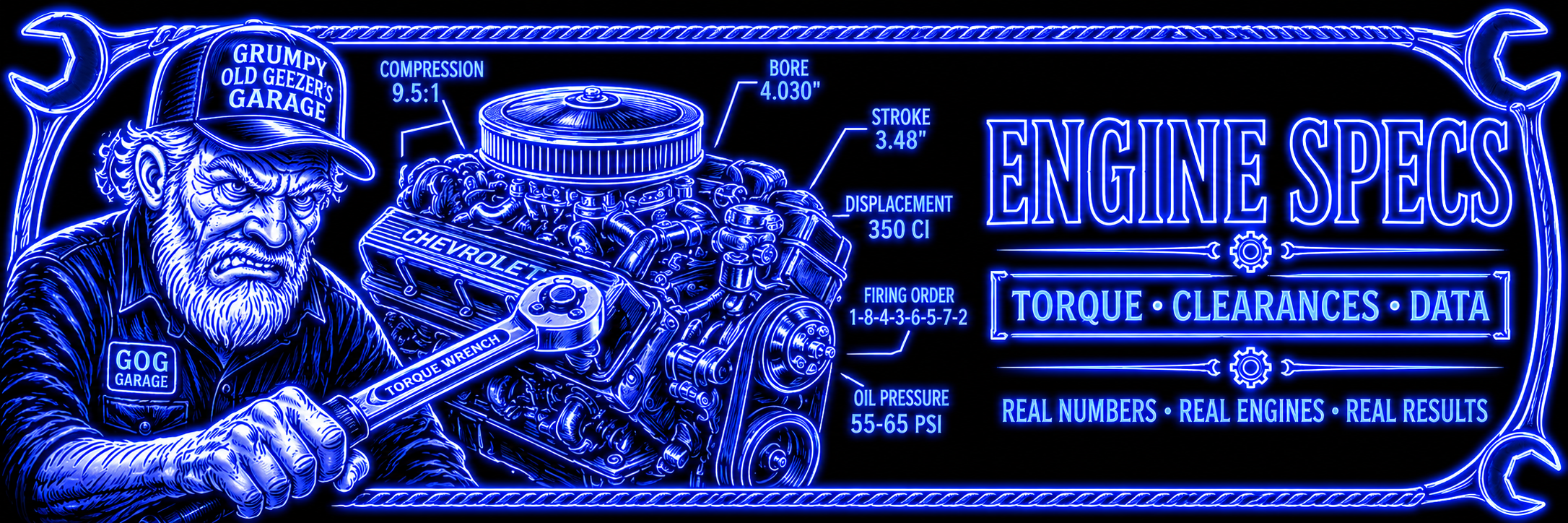
Chevy 302 Engine Specs
On This Page:
Engine Details: General Specs | Variants | Key Notes
Final Word: Bottom Line
Related: Related Links

Intro
➤ See the Family Page for specs common to all engines in this family.
The Chevy 302 was not built because Chevrolet needed another small-block displacement. It was built because the Camaro needed an engine that could live under the SCCA Trans-Am displacement limit and still make enough power to fight Ford on a road course. That is the whole reason the 302 exists, and it explains why this little engine behaves nothing like the mild small blocks sitting next to it in the catalog.
Chevrolet created it by combining a 4.000-inch bore with a 3.000-inch stroke. The bore gave the heads room to breathe. The short stroke kept piston speed under control and helped the engine live happily at the kind of rpm a 350 owner usually starts calling unnecessary. The result was 302 cubic inches of small block built to make power upstairs, not drag a heavy car around at 1,800 rpm and pretend gearing was optional.
Production ran from 1967 through 1969, and the engine belongs tightly to the Camaro Z/28 story. This was not a broad passenger-car engine, a truck engine, or a service replacement that happened to become famous later. Chevrolet built the 302 as part of a specific performance package aimed directly at racing homologation and the showroom credibility that came with it.
The factory hardware matched that purpose. High compression, forged pistons, serious cylinder heads, a solid-lifter camshaft, four-barrel induction, forged crankshaft, and a stout bottom end gave the engine what it needed to breathe and survive at high rpm. Chevrolet rated it at 290 horsepower and 290 lb-ft of torque. That horsepower number has spent decades wearing an innocent expression while everybody who has ever watched one run knows Chevrolet was not exactly straining for honesty.
The 302’s reputation comes from what happens when the rest of the car is built around it. Give it compression, airflow, rear gear, a close-ratio transmission, enough exhaust, and permission to rev, and the engine makes sense immediately. Put one in a heavy cruiser with lazy highway gears and expect 350-style low-speed torque, and the legend suddenly seems to have misplaced something.
That does not make the 302 weak. It makes it specialized. A 350 has another 48 cubic inches available to cover mediocre gearing, mild compression, or a driver who shifts early. The 302 has no interest in covering anybody’s mistakes. It expects the combination to show up ready for work.
That specialization is also why a real 302 deserves more scrutiny than an ordinary small block. Chevrolet did not produce millions of them across a dozen applications. The Z/28 connection creates value, and value creates stories. Blocks get restamped. Correct-looking heads get added later. Short-stroke combinations get assembled from available pieces and suddenly remember spending 1969 in a Camaro.
There is nothing wrong with a properly built 302-style engine. The 4.000 × 3.000 combination is mechanically legitimate whether Chevrolet assembled it or somebody did fifty years later. The problem begins when a good engine starts borrowing factory history it cannot prove.
The 302 matters because Chevrolet took the flexible Gen I small block and used it to solve a very specific racing problem. It was not the biggest small block, the easiest street engine, or the most practical choice for everyday torque. It was the sharp little knife in the drawer.
And like most sharp tools, it works considerably better when somebody knows what it was built to cut.
↑ Back to the Top, Before the Casting Numbers Start Lying

Overview
The 302 entered production for 1967 because Chevrolet needed the new Camaro Z/28 to qualify for SCCA Trans-Am competition, where the displacement ceiling sat at five liters. Chevrolet already had plenty of small-block parts on the shelf. The trick was combining them into an engine that stayed under the limit without giving away the airflow and rpm capability needed for road racing.
The solution was wonderfully simple. Chevrolet paired the 4.000-inch bore used by the 327 with the 3.000-inch stroke familiar from the 283. The arithmetic landed at roughly 302 cubic inches, safely inside the racing limit while preserving a large bore and very short stroke.
That geometry is what gives the 302 its personality. The 4.000-inch bore provides considerably more valve room than the smaller-bore 283 and lets serious cylinder heads breathe without the cylinder wall crowding the valves. The 3.000-inch stroke keeps piston speed relatively modest at high rpm and reduces the crankshaft leverage that helps larger engines make easy low-speed torque.
In other words, the 302 gives away grunt to gain breathing room and rpm capability. Chevrolet did that deliberately. A road-race engine that lives in the upper half of the tachometer does not need to act like a station-wagon 350 leaving a stop sign with three kids and a camper behind it.
The production engine backed up the geometry with real performance hardware. Compression was around 11.0:1. Forged domed pistons, a forged steel crankshaft, performance cylinder heads with large valves, solid flat-tappet camshaft, four-barrel induction, and a strong bottom end all supported the engine’s high-rpm assignment. The combination was not created by bolting a big carburetor onto a small engine and hoping enthusiasm counted as engineering.
Chevrolet officially rated the Z/28 302 at 290 horsepower and 290 lb-ft of torque. That rating stayed conveniently modest while the engine developed a reputation for making considerably stronger power when properly prepared. Factory horsepower figures had several jobs in the late 1960s, and telling the whole truth was not always at the top of the list.
The solid-lifter camshaft is an important part of the character. Mechanical lifters gave Chevrolet better valvetrain control for the rpm range the engine was expected to use, but they also brought the maintenance and noise that come with a serious solid-lifter combination. Valve lash was part of ownership. This was not an engine designed around people who considered opening the hood an inconvenience.
Compression mattered just as much. Around 11:1 compression helped the 302 make cylinder pressure and power, but it also means an original-style engine expects fuel appropriate for the combination. Modern pump fuel, aggressive ignition timing, heat, and old combustion chambers can turn nostalgia into detonation remarkably quickly. The old compression ratio did not bring the old gasoline along with it.
The cylinder heads evolved as Chevrolet improved the Z/28 package, but the philosophy stayed the same: give the engine enough valve area and port flow to keep working at high rpm. This is where the 4.000-inch bore earns its keep. The 302 could use head hardware that would be much less comfortable in the smaller 3.875-inch-bore 283.
Induction was equally serious. Production engines used four-barrel carburetion, and the intake, carburetor, ignition, exhaust, and camshaft all had to work together in the intended rpm range. This is not an engine where a giant carburetor fixes a lazy combination. Airflow only matters when the rest of the engine is capable of asking for it.
The car around the engine was just as important. Z/28 gearing, four-speed transmission choices, chassis tuning, brakes, suspension, and racing intent all helped keep the 302 where it wanted to operate. A high-rpm engine with lazy rear gearing is like giving a greyhound work boots and wondering why he looks annoyed.
That is why the 302 can disappoint people who approach it with 350 expectations. A 350 uses the same 4.000-inch bore but stretches the crank to 3.480 inches. Those additional cubic inches and extra stroke give the 350 more low- and midrange torque and make it much more tolerant of heavy cars, automatic transmissions, highway gears, and mild street driving.
The 302 trades that flexibility for response and rpm. It wants more gear, more compression, more camshaft, and more engine speed before the combination really wakes up. That is not a defect. It is exactly what Chevrolet ordered when the assignment came from a road-racing rulebook instead of a family-car product planner.
The production run was short: 1967 through 1969. That was long enough to establish the Z/28 and the 302 as serious performance hardware, but not long enough to turn the engine into a common small-block commodity. For 1970 the Camaro Z/28 moved to the larger 350-based LT-1 as Trans-Am homologation no longer dictated the production engine in the same way.
That short run also explains why genuine engines attract both collectors and counterfeit history. A real production 302 should be supported by the correct block casting and date, stamped suffix code, partial VIN where applicable, crankshaft, heads, intake, carburetor, distributor, internal hardware, and vehicle context. One correct part does not prove all the others were born together.
The crankshaft is particularly important because the 3.000-inch stroke is what makes a 302 a 302 mechanically. A later 4.000-inch-bore small block fitted with a 3.000-inch-stroke crank can create the same basic displacement and geometry. That engine can be a perfectly good 302-style build. It does not become a documented factory Z/28 engine because the calculator agrees.
There is no shame in a tribute engine when it is described honestly. A carefully assembled 302-style small block with appropriate compression, heads, camshaft, induction, and gearing can deliver much of the same high-rpm personality without pretending the block spent its youth in a factory Z/28. Mechanical truth and collector provenance are two different things.
For normal street use, the biggest question is whether that personality actually fits the car. If the vehicle is light, geared properly, equipped with a transmission that keeps the engine in its useful range, and owned by somebody who enjoys rpm and maintenance, the 302 can be terrific. If the goal is quiet cruising, automatic transmission manners, tall highway gears, and instant low-speed torque, Chevrolet built several other small blocks that already know how to do that job.
That is where the 302 sits in the Gen I family. The 283 proved a small Chevrolet V8 could make serious power. The 327 added displacement while staying responsive. The 350 became the all-purpose answer. The 302 was something narrower and more deliberate: a production racing engine created because the rulebook said Chevrolet could not simply add more cubic inches.
The rulebook gave Chevrolet a limit. Chevrolet answered by building an engine that wanted more rpm instead.
↑ Back to the Top, Before the Casting Numbers Start Lying

General Specs
| Displacement | 302 cu in / 4.9L | Bore / Stroke | 4.000 in × 3.000 in |
| Production / Use Era | 1967–1969 Camaro Z/28 / Trans-Am homologation era | Bore Spacing | 4.400 in |
| Engine Family | Chevrolet Gen I Small Block | Deck Height | 9.025 in |
| Block Material | Cast iron | Rod Length | 5.700 in |
| Cylinder Head Material | Cast iron | Main Journal | 2.448 in |
| Fuel / Induction | 4-barrel carbureted | Rod Journal | 2.100 in |
| Cam Location | In-block camshaft | Main Bearings | 5 |
| Valve Layout | OHV / pushrod, 2 valves per cylinder | Firing Order | 1-8-4-3-6-5-7-2 |
| Common Main Caps | 4-bolt | Distributor Rotation | Clockwise |
| Rear Main Seal | 2-piece | Weight | ~575–600 lbs |
| Balance | Internal | Dimensions | ~28H / ~26W / ~29L |
Exact parts and specs can vary by year, application, service replacement history, and whether the engine is a real Z/28 302 or a later parts-built lookalike. Use these numbers as the family baseline, then verify the specific block, crank, heads, suffix code, and application before trusting anything expensive.
↑ Back to the Top, Before the Casting Numbers Start Lying

Variants
Every production Chevrolet 302 belonged to the first-generation Camaro Z/28, and every one shared the same basic performance formula: 4.000-inch bore, 3.000-inch stroke, 11.0:1 compression, forged internals, 2.02/1.60-inch-valve performance heads, the solid-lifter “30-30” cam, aluminum high-rise intake, and a large Holley four-barrel. But Chevrolet changed the crank journals, connecting rods, pistons, main-cap arrangement, and cylinder-head details enough from 1967 through 1969 that treating all three years as mechanically identical misses real factory hardware changes.
1967 Z/28 302 — Small-Journal Two-Bolt
What it was: The original 302 was Chevrolet’s first Trans-Am homologation engine, created specifically for the new Camaro Z/28. It combined the four-inch bore of the 327 with the three-inch stroke of the 283 and surrounded that geometry with hardware intended to survive sustained high rpm.
What changed: The 1967 engine used a small-journal forged-steel crankshaft with approximately 2.30-inch main journals and 2.00-inch rod journals in a two-bolt-main block. Connecting rods used pressed wrist pins and the smaller early-style rod bolts. Forged domed aluminum pistons produced 11.0:1 compression. The cylinder heads carried 2.02-inch intake and 1.60-inch exhaust valves. A solid-lifter “30-30” cam with approximately .485-inch valve lift, aluminum high-rise dual-plane intake, and roughly 780-cfm Holley four-barrel completed the package.
What that did: The combination traded low-speed torque for breathing and rpm capability. Chevrolet rated it at 290 gross horsepower at 5,800 rpm and 290 lb-ft at 4,200, but the short stroke, serious heads, solid cam, and forged crank were clearly designed for operation well beyond ordinary passenger-car rpm.
Where used: The small-journal 302 was used only in the 1967 Camaro Z/28.
1968 Z/28 302 — Large-Journal Two-Bolt
What it was: Chevrolet kept the same basic Z/28 performance recipe for 1968 but substantially strengthened the rotating assembly. The horsepower rating stayed at 290 because the purpose of the changes was durability and development, not another number for the air cleaner.
What changed: The crankshaft moved to the new large-journal dimensions: approximately 2.45-inch main journals and 2.10-inch rod journals. The block remained two-bolt-main, but the larger forged crank was accompanied by stronger rods with larger 3/8-inch rod bolts. Early 1968 engines retained pressed wrist pins; during production Chevrolet moved to shot-peened rods with floating pins and revised forged pistons. Compression remained 11.0:1. The 2.02/1.60-inch performance heads, solid “30-30” cam, aluminum high-rise intake, and Holley four-barrel remained fundamentally the same.
What that did: The larger crank journals and stronger rods added durability to an engine expected to spend considerably more time near 6,000 rpm than an ordinary small block. The basic power curve did not need changing, so Chevrolet left the rating at 290 horsepower and 290 lb-ft.
Where used: The large-journal two-bolt 302 was used only in the 1968 Camaro Z/28.
1969 Z/28 302 — Large-Journal Four-Bolt
What it was: The final production 302 was the most heavily developed factory version. Chevrolet kept the familiar bore, stroke, compression, camshaft, and basic induction but strengthened the block and refined the rotating assembly and cylinder heads for the engine’s final year.
What changed: The 1969 302 retained the large-journal forged-steel crank but moved to four-bolt main caps on the center three mains with heavier main-webbing in the block. Shot-peened heavy-duty connecting rods used 3/8-inch bolts and full-floating wrist pins. New impact-extruded forged aluminum pistons retained 11.0:1 compression. The 1969 3927186 cylinder heads still used 2.02/1.60-inch valves but added Chevrolet’s swirl-polished valves and revised accessory-mounting provisions. The solid “30-30” cam, aluminum high-rise intake, and 780-cfm Holley remained.
What that did: Four-bolt mains, stronger rods, floating pins, and the revised pistons gave the 302 a more robust bottom end for sustained high-rpm use. Chevrolet again rated it at 290 horsepower and 290 lb-ft. The unchanged rating should not hide the fact that the 1969 engine was mechanically stronger than the original 1967 version.
Where used: The four-bolt 302 was used only in the 1969 Camaro Z/28.
Identification caution: This engine earns one because genuine Z/28 302s carry substantial value and no block casting was exclusive to the 302. Chevrolet shared the relevant block castings with other small-block applications, and a 3.000-inch crank can be installed in a four-inch-bore block today. The engine suffix, partial VIN where applicable, casting and assembly dates, crankshaft, main-cap arrangement, heads, and original vehicle context need to agree before a parts-built 302 becomes a factory Z/28 engine.
The famous cross-ram does not create another production variant. Chevrolet sold the dual-four-barrel cross-ram system through the parts department for racing use beginning in the 1968 era, but Camaro assembly plants never installed it on production Z/28s and it was not shipped in the trunk. It is genuine Chevrolet performance hardware, not another factory-installed 302 combination.
↑ Back to the Top, Before the Casting Numbers Start Lying

Key Notes
The 302 is where the small-block Chevy story gets dangerous because the engine was real, the reputation was earned, and the fake claims practically grow legs. This was not a random small V8 with a sporty decal. Chevrolet built the 302 because the Camaro needed a serious engine for SCCA Trans-Am displacement rules, and that job shaped the whole personality. It was built to rev, breathe, and fight inside a rulebook, not pull stumps or make lazy street torque.
The 302 is not just “a small 350.” Its 4.000-inch bore and 3.000-inch stroke give it a very different character. The bore gives the heads room to breathe. The short stroke helps the engine stay crisp and happy at higher rpm. That combination is why the 302 feels so sharp when the rest of the car is right. It is also why it can feel disappointing when somebody expects big-cube torque from an engine built around rpm.
Every production Chevrolet 302 belongs in the Z/28 conversation. That does not mean every engine claimed as a 302 is a real born-with Z/28 engine. The claim has to be backed by the block, casting date, stamped code, partial VIN when applicable, crank, rods, pistons, heads, intake, carburetor, distributor, and vehicle context. A 4.000-inch bore block and a 3.000-inch crank can create a 302-style combination. That does not automatically create documented Camaro Z/28 history.
A 302-style build can be mechanically honest and still not be a documented Z/28 engine. There is nothing wrong with a tribute until the price tag starts pretending it came with paperwork. Build it, enjoy it, and describe it correctly. The trouble starts when a good parts combination puts on a fake identity and asks for real-history money.
The 302’s reputation depends on the whole package. Solid-lifter camshaft, compression, cylinder heads, induction, ignition curve, exhaust, manual transmission, rear gearing, and vehicle weight all have to work together. Put the wrong gear, soft compression, lazy tune, or mismatched cam in the combination and the magic leaves fast. The 302 is not forgiving. It expects the rest of the car to show up wearing work boots.
This engine does not have much torque cushion. That is not a flaw. That is the nature of the package. The 302 was built to breathe and rev inside a displacement limit, not act like a 350 in traffic with highway gears and a lazy converter. If the car is heavy, under-geared, over-cammed, or tuned by wishful thinking, the engine will make the driver work for every bit of fun.
High-rpm reputation is not permission to abuse one. The 302 likes rpm more than most small blocks, but that does not erase valve control, oiling, balance, spring pressure, bearing condition, or rotating assembly limits. Old parts, unknown rebuilds, tired springs, mystery pistons, and sloppy machine work do not become safe because somebody says “DZ” at a car show. RPM is earned. It is not granted by folklore.
Factory specs and survivor reality have to be separated. Many 302s and claimed 302s have been rebuilt, restamped, re-cammed, re-headed, swapped, or assembled from pieces because the engine’s reputation makes the story valuable. The engine on the stand has to prove what it is now. Numbers help. Hardware helps. Documentation helps. A seller’s confidence is not documentation.
The 1967 engine details are not automatically the same as 1968–1969 details. Early and later 302s can involve different block and crank journal context, different casting and stamping details, and different parts assumptions. Treating every 302 claim like the same pile of interchangeable Z/28 legend is how expensive mistakes get made. The year and application have to match the parts.
Carburetion and induction claims need checking. The 302 used serious factory breathing for its size, but intakes, carburetors, air cleaners, and linkage are easy to swap. A correct-looking intake setup can support the story. It does not prove the story by itself. Performance jewelry can move from engine to engine faster than honesty can catch it.
Restoration-correct and day-two hot-rod-correct are different lanes. A real Z/28 restoration claim has to answer to codes, dates, stampings, castings, induction, ignition, drivetrain, and vehicle history. A period-style 302 build can be a great driver or tribute engine, but it should be priced and described honestly. A tribute is not a sin. Pricing it like documented history is where the wrench slips.
The 302 makes sense when the assignment matches the engine. Correct Z/28 restoration, period Trans-Am flavor, high-rpm street personality, or a lightweight manual-transmission car with enough gear can all fit the engine. Cheap torque, easy cruising, automatic-transmission softness, or heavy-car street use usually points toward a 350 instead. That does not make the 302 weak. It means the engine has a narrow job and does it best when the rest of the car quits arguing.
The 302 earned its name the hard way. It does not need fake stamps, borrowed Z/28 parts, or a seller story with missing paperwork. Verify the claim, match the combination, gear the car correctly, and respect the rpm personality. Ask it to be a 302 and it can be special. Ask it to be a 350 with a shorter stroke and a famous badge, and the disappointment belongs to the plan.
↑ Back to the Top, Before the Casting Numbers Start Lying

Bottom Line
The Chevy 302 is famous because it was focused, not because it was flexible. Chevrolet built it because the Z/28 needed something that could stay under the Trans-Am displacement limit and still go looking for trouble. A 4.000-inch bore gave it breathing room, the 3.000-inch stroke let it wind, and the rest of the package was built around compression, airflow, gear, and rpm. This was the sharp knife in the small-block drawer.
That is also why the 302 gets misunderstood. It does not have 350 torque, it does not appreciate lazy gearing, and it was never intended to lug a heavy car around while the driver waits for something exciting to happen. Put one in the right combination and it comes alive. Put one in the wrong combination and it feels like a little engine patiently waiting for somebody to notice the tachometer.
The famous name also attracts expensive stories. A parts-built 302 can be a fine engine, but it does not become a born-with Z/28 piece because somebody stamped “DZ” where buyers know to look. Block, crank, bore, heads, camshaft, dates, suffix code, induction, and vehicle history still have to line up. A confident seller and a stamped pad are not royal blood. That is just air with a price tag.
And do not improve a real one into something it was never meant to be. A correct Z/28 engine deserves to keep the parts and personality that made it valuable. A tribute build deserves to be called a tribute and enjoyed for what it is. If the actual goal is cheap torque, easy cruising, and forgiving street power, quit pestering the 302 and go find a 327 or 350.
The 302 earned its reputation by doing one job extremely well. Build around rpm, gear, compression, airflow, and the car that can use them. Preserve the real ones, describe the recreated ones honestly, and stop expecting a famous badge to fix the wrong combination. The 302 does not need to be more versatile. It needs the rest of the car to understand the assignment.
↑ Back to the Top, Before the Casting Numbers Start Lying

Related Links
Torque Specs
Common Factory Pairings
Carburetors
- Carter AFB — 4-bbl
- Carter WCFB — 4-bbl
- Holley 2300 — 2-bbl
- Holley 4150 — 4-bbl
- Holley 4160 — 4-bbl
- Holley 4175 — 4-bbl
- Rochester 2G / 2GC / 2GV — 2-bbl
- Rochester 4G / 4GC — 4-bbl
- Rochester Quadrajet — 4-bbl
Transmissions
- Muncie SM318 — 3-Speed
- Muncie SM319 — 3-Speed Overdrive
- Saginaw — 3-Speed
- Saginaw — 3-Speed Overdrive
- Muncie M20 / M21 / M22 — 4-Speed
- Saginaw — 4-Speed
- Aluminum Powerglide — 2-Speed Automatic
- TH350 — 3-Speed Automatic