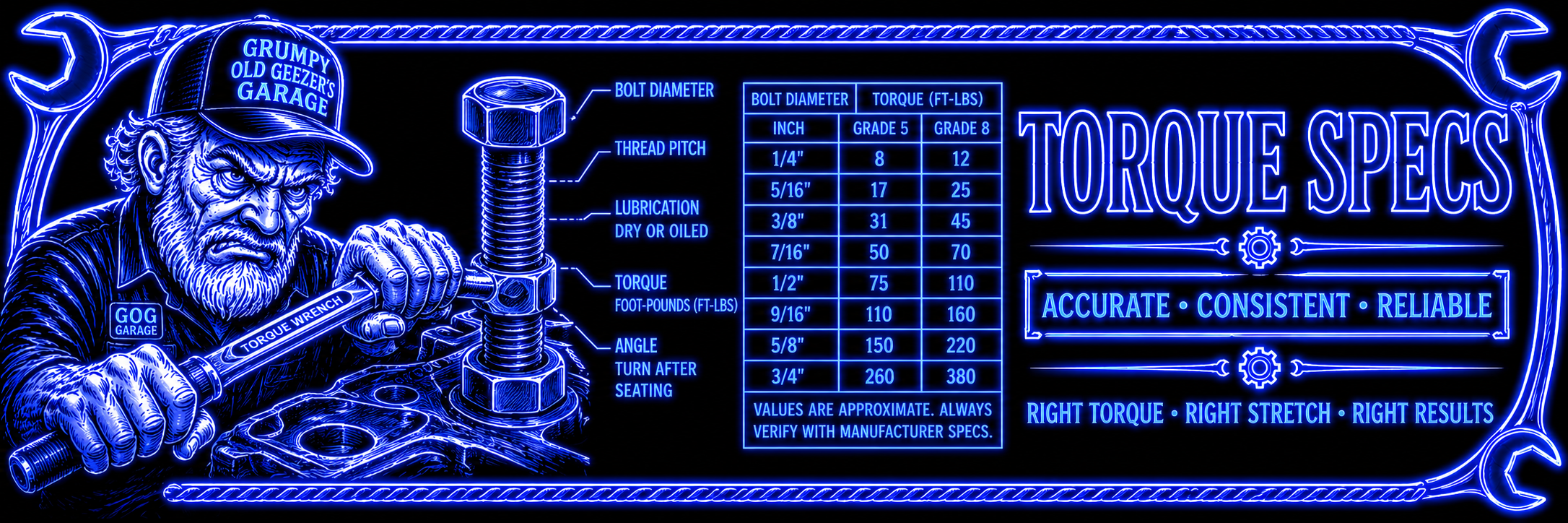
Chevy Gen I Small Block Torque Specs
On This Page:
Intro | Torque Specs | Notes | Mistakes | Bottom Line | Links

Intro
The Gen I small-block Chevy may be the worst engine ever built to approach with the words “everybody knows these.”
The 262, 265, 267, 283, 302, 305, 307, 327, 350, and 400 all belong to the same basic family, but familiarity doesn’t sand the differences off them. Two-bolt and four-bolt mains aren’t handled exactly the same. Rod-bolt diameter changes the connecting-rod specification. The 400 brings its own cooling and head-gasket concerns. Stock adjustable rockers are set by preload, not by one fixed torque number.
Then fifty years of swapping parts walks into the room. Vortec heads, aluminum intakes, aftermarket rods, different fasteners, roller rockers, and mixed parts are common. “Small-block Chevy” tells you what family is on the stand. It doesn’t tell you what somebody bolted to it three rebuilds ago.
↑ Back to the Top, Before “Good and Tight” Breaks Something Else

General Torque Specs
| Bottom End | Top End | ||
|---|---|---|---|
| Main Cap Bolts | 70 lb-ft1 70 / 65 lb-ft2 |
Head Bolts | 65 lb-ft |
| Connecting Rod Bolts | 45 lb-ft3 35 lb-ft4 |
Rocker Arm Nuts | set preload5 |
| Oil Pump to Rear Main Cap Bolt | 60-70 lb-ft | Valve Cover Bolts | 3-5 lb-ft |
| Intake and Exhaust | Driveline Side | ||
| Intake Manifold Bolts | 30 lb-ft6 | Flywheel / Flexplate Bolts | 60 lb-ft |
| Exhaust Manifold Bolts | 20-25 lb-ft | Pressure Plate Bolts | 35 lb-ft |
| Carburetor Mounting Nuts | 8-12 lb-ft | Starter Bolts | 35 lb-ft |
| External Engine | |||
| Harmonic Damper Bolt | 60 lb-ft | Water Pump Bolts | 30 lb-ft |
| Camshaft Sprocket Bolts | 18-20 lb-ft | Fuel Pump Bolts | 25 lb-ft |
| Timing Cover Bolts | 6 lb-ft | Oil Pan Bolts | 8-12 lb-ft |
| Distributor Hold-Down Bolt | 20 lb-ft | Spark Plugs | 15-20 lb-ft |
1 Two-bolt main block.
2 Four-bolt main block: 70 lb-ft inner bolts / 65 lb-ft outer bolts.
3 3/8 in. connecting rod bolts.
4 11/32 in. connecting rod bolts.
5 Stock adjustable rockers are set by lifter preload, not fixed bolt torque.
6 Cast-iron-head Gen I intake value. Aluminum intakes, Vortec-style heads, and aftermarket parts use their own instructions.
The main-cap entry is why one magic SBC number doesn’t exist. A two-bolt block uses 70 lb-ft. A four-bolt block keeps 70 on the inner bolts but drops the outer bolts to 65. The block itself tells you which line belongs on the wrench, provided somebody bothers to look at it.
Rod bolts make the trap even easier to step in. Factory 3/8 in. bolts use 45 lb-ft while 11/32 in. bolts use 35. Both live inside the same engine family, and neither number can crawl off the page and identify the bolt for you.
The rocker-arm line is an adjustment, not a conventional torque specification. Factory adjustable rockers are set by lifter preload. Tightening them to some remembered number doesn’t make the adjustment more precise; it just replaces the right procedure with the wrong one.
The 30 lb-ft intake figure belongs to the cast-iron-head Gen I arrangement covered here. Bolt on Vortec-style heads, an aluminum intake, aftermarket heads, or different fasteners and the old number doesn’t get grandfathered in; those parts can use entirely different values and patterns.
Aftermarket bolts, studs, rods, roller rockers, aluminum heads, intake manifolds, and replacement fasteners use the part maker’s torque and lubrication instructions. Once the hardware changes, the factory chart loses jurisdiction over that part.
↑ Back to the Top, Before “Good and Tight” Breaks Something Else

Important Notes
- The 400 small block deserves its own identification before cylinder-head work begins. Its cooling and head-gasket details aren’t something to borrow from a 350 just because the head bolts look familiar enough to tempt you.
- Four-bolt mains aren’t four copies of the two-bolt arrangement. The inner and outer bolts have separate listed values, and the outer bolts don’t need somebody “simplifying” the chart by rounding them up to match the inner pair.
- Connecting-rod bolt diameter belongs in the inspection, not in the guessing. The difference between 3/8 in. and 11/32 in. hardware changes the listed torque by 10 lb-ft, which is plenty of reason to use your eyes before your memory.
- Stock adjustable rocker nuts establish hydraulic-lifter preload. That procedure belongs to the valvetrain setup and cannot be replaced by treating the nut as a fixed-torque fastener.
- Vortec-style heads and many aftermarket intake combinations leave the old 30 lb-ft intake habit behind. Use the actual head, manifold, gasket, and fastener instructions.
- Valve-cover bolts at 3-5 lb-ft and timing-cover bolts at 6 lb-ft do not need heroic effort. Thin covers and gasket rails lose shape long before a larger wrench runs out of leverage.
↑ Back to the Top, Before “Good and Tight” Breaks Something Else

Common Mistakes
- Using one remembered “small-block Chevy” main-cap number without even checking whether the block has two-bolt or four-bolt mains.
- Putting the 45 lb-ft 3/8 in. rod-bolt value on 11/32 in. hardware, or using 35 lb-ft on the larger bolt, because both rods came out of an SBC.
- Treating a 400 head-gasket and cooling arrangement like an ordinary 350 installation and ignoring the engine-specific details that go with the 400.
- Torquing stock rocker nuts because a number feels more official than actually setting lifter preload.
- Using the old cast-iron-head intake number on Vortec, aluminum, or aftermarket parts that specify a different value or tightening pattern.
- Crushing valve-cover, timing-cover, or oil-pan gaskets because small fasteners were tightened with big-fastener enthusiasm.
- Using original factory torque numbers on replacement rods, studs, bolts, or other hardware while ignoring the manufacturer’s lubricant and procedure.
↑ Back to the Top, Before “Good and Tight” Breaks Something Else

Bottom Line
The Gen I small-block Chevy became America’s universal V8 because it was simple, durable, adaptable, and built by the millions. Somewhere along the way, familiarity convinced people that ten displacements and decades of parts swapping ought to fit on one torque chart. They don’t.
Main-cap layout changes the bottom-end procedure. Rod-bolt diameter changes the rod number. The 400 carries details the 350 does not. Adjustable rockers need preload. Later heads, intakes, rods, and fasteners can rewrite the factory instructions one part at a time.
Call it an SBC all day long. Before tightening it, identify what’s actually there. Familiar engines are still perfectly capable of punishing familiar assumptions.
↑ Back to the Top, Before “Good and Tight” Breaks Something Else

Related Links
Engine Specs
- Chevrolet Gen I 262 V8 Engine Specs
- Chevrolet Gen I 265 V8 Engine Specs
- Chevrolet Gen I 267 V8 Engine Specs
- Chevrolet Gen I 283 V8 Engine Specs
- Chevrolet Gen I 302 V8 Engine Specs
- Chevrolet Gen I 305 V8 Engine Specs
- Chevrolet Gen I 307 V8 Engine Specs
- Chevrolet Gen I 327 V8 Engine Specs
- Chevrolet Gen I 350 V8 Engine Specs
- Chevrolet Gen I 400 V8 Engine Specs
Engine Family
↑ Back to the Top, Before “Good and Tight” Breaks Something Else