Chevrolet Gen I Small Block V8 Family Specs and Identification
On This Page:
Start Here: Intro | Engines in This Family | Overview
Family Details: General Family Specs | Identification | Shared Design Patterns
Use and Fit: Choosing Within this Family | Compatibility Notes
Problems and Myths: Common Family Problems | Common Family Misconceptions
Final Word: Bottom Line
Related: Related Links

Intro
The Gen I small-block Chevy is one of those engines that became bigger than the company that built it. Chevrolet introduced the 265 in 1955, then spent nearly half a century enlarging it, shrinking it, racing it, strangling it for emissions, feeding it with carburetors and fuel injection, putting it in everything from Corvettes to work trucks, and selling enough replacement parts that half the hot rods in America eventually seemed to have one whether Chevrolet intended it or not.
The family earned that kind of reach because the original idea was remarkably good. It was compact, relatively light, simple, inexpensive to manufacture, easy to service, and small enough to fit ordinary Chevrolet engine bays without making the front suspension file a grievance. It could power a family sedan quietly on Monday and become a race engine by Saturday with the right parts and enough disregard for the warranty.
The displacement story shows just how far Chevrolet stretched the same basic idea. The 265 started it. The 283 gave the young small block real performance credibility. The 327 added displacement without losing the eager personality that made the early engines fun. The 302 went the other direction and used a short stroke and big bore to satisfy a racing rulebook. The 350 hit the sweet spot and became the small block everybody remembers. The 400 pushed the package toward maximum factory displacement and torque.
Then there are the engines history usually leaves sitting at the folding table. The 307 was a practical everyday replacement for the aging 283. The 262, 305, and 267 came from the fuel-economy and emissions years, when Chevrolet still wanted V8 smoothness and familiarity even though horsepower had been sent to the principal’s office. They were not failed 350s. They were engines built for different jobs during different times.
That range is why “small-block Chevy” describes a family, not one engine wearing ten different air-cleaner decals. A 302 wants rpm and gearing. A 327 likes airflow and response. A 350 tolerates almost anything sensible and became the great all-around answer. A 400 makes torque and brings special cooling and balance requirements with it. A 305 can be a perfectly decent driver engine while still having less breathing room than a 350. Same bloodline. Different assignments.
The family’s greatest strength became its greatest source of bad decisions. Small-block Chevrolet parts are everywhere, and enough pieces physically interchange that people start assuming everything does. It does not. Bore size, crank journals, rear-main-seal design, balance, head chambers, valve size, intake patterns, valve-cover attachment, cooling provisions, flywheels, flexplates, and accessory arrangements changed over the decades. “It bolts on” is not an engineering specification.
The aftermarket made the problem even more entertaining. There are enough heads, cams, cranks, pistons, intakes, carburetors, injection systems, and complete rotating assemblies available to build a small block Chevrolet into almost anything. That does not mean every combination deserves to exist. Huge valves do not fix a small bore. A racing cam does not create compression. A giant carburetor does not make a mild 305 become ambitious. Fifty years of parts catalogs have proved only that bad ideas can be shipped overnight.
Its weaknesses are mostly the price of age, variety, and familiarity. Old blocks have been bored, decked, frozen, overheated, raced, rebuilt, restamped, and assembled from whatever was lying under the bench. Early engines have restoration-specific details. Late engines have different seals, covers, intakes, and fuel systems. The 400 has its own cooling and external-balance rules. High-compression early engines want better fuel than the corner station usually provides. None of that makes the family difficult. It makes guessing expensive.
And there is another naming trap worth killing early. Gen I is the traditional Chevrolet small block that began in 1955. The later Gen II LT1 and the Gen III LS-family engines are descendants of the same Chevrolet small-block idea, not later versions of the same Gen I parts pile. A 5.7-liter label can describe more than one Chevrolet engine family. Displacement is not genealogy.
The Gen I small block still matters because very few engines ever combined affordability, packaging, durability, performance potential, factory variety, racing history, and parts support this well. The 265 started a revolution. The 283 and 327 proved it could perform. The 302 went racing. The 350 became shop furniture. The 400 made torque. The smaller emissions-era engines kept the family alive when horsepower was not the only line on the work order.
That is the family in one sentence: Chevrolet designed a compact V8 for ordinary cars and accidentally created the engine hot rodders would spend the next half-century stuffing into everything that held still long enough.
↑ Back to the Top, Before the Casting Numbers Start Lying

Engines in This Family
This is the Gen I small-block lineup covered here. Same family, different jobs. Pick the engine you actually have, not the one the valve covers are trying to sell.

Small-displacement emissions-era small block. It belongs in the family, but it’s mostly a context engine, not where you go hunting for cheap power.
The original 1955 small-block Chevy. This one matters because it started the family, not because it’s the easiest place to build modern power.
Small-bore emissions-era engine built for economy and basic transportation. Useful in the right context, but it’s not a hidden performance foundation waiting for a catalog miracle.
Early small-block that proved the family could be crisp, useful, and more than basic transportation. Respect it for what it is, not for what a bigger small block can do easier.
Short-stroke, high-rpm small block best known for Z/28 use. Famous for a reason, but it wants rpm, gear, and the right car around it.
Common small-bore car and truck engine. It gets blamed for not being a 350, which is a pretty lazy complaint unless somebody priced it like one.
Practical passenger-car small block with more usefulness than glamour. It’s usually transportation hardware, not a performance legend hiding under dust.
Performance-era small block with a 4.000-inch bore, crisp rpm character, and enough real history to make sellers add extra shine to the story.
The default small-block Chevy because it earned the job. Common, flexible, forgiving, and usually the easiest place to start when originality isn’t running the show.
Largest factory Gen I small block. Strong torque engine with block-specific rules people ignore because apparently buying parts twice builds character.

Overview
The Gen I small-block story starts before the first 1955 Chevrolet ever reached a showroom. Chevrolet chief engineer Ed Cole and his engineering group were developing an all-new passenger-car V8 for a company whose reputation still leaned heavily on durable inline sixes. Ford already had modern overhead-valve V8 power sitting in ordinary driveways, and Chevrolet needed something better than another big lump of iron designed by adding metal until the complaints stopped.
The answer was a clean-sheet V8 built around compact dimensions, low manufacturing cost, light weight, and enough room for Chevrolet to keep changing its mind for decades. The original small block used 4.400-inch bore spacing, thin-wall iron casting techniques, five main bearings, wedge-style cylinder heads, an in-block camshaft, and a pushrod valvetrain. None of those ideas by itself was revolutionary enough to make anybody fall off a stool. The trick was how efficiently Chevrolet packaged the whole pile together. It was small where it needed to be small, strong where it needed to be strong, and cheap enough that Detroit could build the things by the trainload.
The stamped-steel rocker-arm system was a good example of the thinking. Instead of heavy rocker shafts, each rocker pivoted independently on a stud-mounted ball. Oil traveled through the lifters and hollow pushrods to lubricate the valvetrain. That reduced weight, machining, parts count, and cost while still supporting the rpm Chevrolet expected from the engine. People looked at those little stamped rockers in 1955 and wondered whether the flimsy things would survive. Several billion valve cycles later, the stamped pieces have had plenty of time to quit being offended by the question.
The first production version was the 265-cubic-inch Turbo-Fire for 1955. It used a 3.750-inch bore and 3.000-inch stroke. At a time when a lot of American V8 development still seemed to follow the theory that more power required more engine in every direction, Chevrolet produced a V8 compact enough for a Corvette and ordinary passenger car while leaving enough room inside the architecture for substantially more cubic inches later. That little detail would turn out to be worth considerably more than whatever it cost the drafting department.
The 1955 engine also provides the first warning against treating “Gen I” as one giant fifty-year pile of interchangeable parts. The original 265 lacked the later block-mounted full-flow oil-filter arrangement, and early cylinder heads used valve-cover details that changed as the family matured. Chevrolet was still improving the engine while customers were already putting miles on it. Anybody expecting the first-year version to follow rules written twenty years later is volunteering for an expensive history lesson.
For 1957 Chevrolet enlarged the bore to 3.875 inches while retaining the 3.000-inch stroke, creating the 283. The extra displacement mattered, but Chevrolet did not merely make the hole bigger and send everybody home. Higher-performance camshafts, improved induction, stronger cylinder-head combinations, and Rochester mechanical fuel injection pushed the top version to an advertised 283 horsepower. One horsepower per cubic inch is ordinary barroom arithmetic now. In 1957 it was the kind of number that made people put down the coffee and pay attention.
The 283 also established one of the basic truths that would follow the small block for the rest of its life: displacement alone does not tell you what kind of engine you are looking at. A mild two-barrel 283 could spend its life hauling groceries without frightening anybody. A high-compression fuel-injected version of the same displacement could live in a Corvette and become magazine material. Same bore. Same stroke. Very different reason for owning one.
The next major expansion came in 1962 with the 327. Chevrolet opened the bore to 4.000 inches and lengthened the stroke to 3.250 inches. The four-inch bore gave the cylinder heads more room around the valves, while the moderate stroke kept the quick, willing-to-rev personality that made the early small blocks fun. Mild 327s handled ordinary passenger-car duty. High-output Corvette versions with serious heads, camshafts, carburetion, or fuel injection made the same displacement one of the most respected numbers Chevrolet ever stamped into a parts book.
Then Chevrolet demonstrated just how much personality could be changed by rearranging dimensions already sitting on the shelf. For the 1967 Camaro Z/28, Trans-Am rules limited displacement to five liters. Chevrolet combined the 327’s 4.000-inch bore with the old 3.000-inch stroke and created the 302. The engine gave away easy low-speed displacement in exchange for bore area and rpm capability. It was not a little 350 waiting to grow up. It was a racing-rule engine designed to live where the tachometer stopped being polite.
That same 1967 model year brought the engine that eventually swallowed the public identity of the whole family: the 350. Chevrolet retained the 4.000-inch bore and increased stroke to 3.480 inches. The result landed almost perfectly in the middle of the small-block universe. It had enough bore for good cylinder heads, enough stroke for useful torque, enough displacement to forgive ordinary street combinations, and none of the special cooling requirements Chevrolet would discover when it stretched the architecture farther. Chevrolet did not invent the perfect engine. It came uncomfortably close to inventing the perfect excuse for never throwing one away.
The 350 became the family default because Chevrolet used it everywhere. Passenger cars, Camaros, Corvettes, police packages, pickups, vans, commercial vehicles, boats, replacement engines, crate engines, race cars, and swaps all took their turn. It could be a low-compression smog-era grocery getter, a strong truck engine, a high-performance LT-1, or the foundation for whatever somebody with a catalog, a tax refund, and too much confidence decided to build. Few engines have ever managed to be that ordinary and that useful at the same time.
The 307 arrived for 1968 by combining the 283’s 3.875-inch bore with the 327’s 3.250-inch stroke. That combination explains most of its personality before anybody starts inventing legends for it. It gained useful displacement and low-speed pull over the 283 but retained the smaller bore, which limited valve room and airflow compared with the 4.000-inch-bore engines. Chevrolet built it mainly as an ordinary passenger-car V8. History treated it accordingly, which is probably why nobody has yet figured out how to charge collectible prices for one with a straight face.
For 1970 Chevrolet took the Gen I architecture about as far as normal factory displacement could go. The 400 used a 4.125-inch bore and 3.750-inch stroke to become the largest production small block in the traditional family. Those extra cubes made excellent torque, but Chevrolet had stretched the original package hard enough that some of the old rules finally stopped applying.
The 400 used siamesed cylinder bores, which eliminated the normal coolant space between adjacent cylinders. Chevrolet provided steam passages through the block, head gaskets, and cylinder heads to control trapped vapor and local hot spots. Those steam holes are not an old mechanic’s superstition and they are not decorative little souvenirs from Detroit. When the block, heads, and gaskets require them, they are part of the cooling system. Ignore that because somebody on a forum said his cousin never bothered, and the engine may explain the difference in degrees Fahrenheit.
The 400 also uses external balance, unlike the traditional internally balanced small-block combinations that came before it. Its harmonic damper and flywheel or flexplate are part of the balancing job. Mixing ordinary small-block balance pieces onto a 400 because the bolt pattern looked cooperative is an excellent way to make a perfectly good engine shake like it is trying to get out of the car before the rest of the parts fail with it.
Then the 1970s changed what Chevrolet needed from the family. Compression ratios fell. Emissions equipment multiplied. Fuel economy climbed the priority list. Horsepower stopped being the only number anybody in Detroit was allowed to brag about without somebody from Washington clearing his throat. Chevrolet responded by developing smaller-displacement branches instead of abandoning the V8 altogether.
The 262 appeared for 1975 as a short-lived economy-era small block. The 305 followed in 1976 and became the far more successful smaller-displacement answer, surviving for decades in passenger cars, performance-image models, vans, and trucks. The 267 arrived for 1979 as another attempt to reduce displacement and fuel consumption while keeping V8 smoothness and familiarity. These engines did not fail because they lacked 350 performance. They were never assigned that job. Blaming a 267 for not being a 350 makes about as much sense as blaming a pickup for losing a road race.
The smaller bores used by engines such as the 262, 267, and 305 also demonstrate why family interchangeability has limits. A cylinder head with large valves that works beautifully on a 350 can create shrouding or actual clearance problems on a small-bore block. Bigger valves do not automatically mean better heads when the cylinder wall is standing where the valve wants to go. The parts catalog can print whatever horsepower number it likes. The bore still gets a vote.
The small block survived the emissions era because Chevrolet kept adapting the package instead of freezing it somewhere around 1965 and hoping gasoline never changed. Electronic controls arrived. Computer-managed carburetion gave way to increasingly sophisticated fuel injection. Cross-Fire Injection appeared in the early 1980s, Tuned Port Injection followed, and throttle-body injection carried traditional small blocks into huge numbers of trucks and passenger vehicles. The iron underneath was still recognizably descended from 1955 even though a laptop was becoming more useful than a screwdriver for certain parts of the tune.
Mechanical details evolved right along with the fuel systems. Beginning in 1986, production small blocks moved to a one-piece rear-main-seal arrangement that required corresponding changes to the rear crankshaft flange, oil pan, and flywheel or flexplate. Hydraulic roller-cam provisions became common in later engines, and center-bolt valve covers arrived as Chevrolet continued modernizing an architecture already old enough to have opinions about unleaded gasoline. Those changes improved sealing and durability. They also ended the fantasy that every small-block part made since Eisenhower bolts onto every other one.
The final major factory development of the traditional 350 came with the Vortec truck engines of the 1990s. Improved cylinder heads and combustion chambers gave the old small block substantially better breathing and efficiency, which naturally encouraged people to start bolting Vortec pieces onto everything that would sit still. Once again Chevrolet had changed enough details to make parts matching matter. Vortec intake-manifold bolt patterns, center-bolt valve covers, roller valvetrain hardware, and late-block features need to be treated as a system rather than as prizes pulled from different shelves.
While all of this was happening, Chevrolet had already begun replacing the traditional architecture in performance cars. The Gen II LT1 arrived in the Corvette for 1992 with reverse-flow cooling and other major changes. The completely redesigned Gen III LS1 followed in the 1997 Corvette. Neither one turned the existing Gen I engines into antiques overnight. Traditional small blocks continued working in trucks, service applications, marine engines, crate programs, hot rods, race cars, and garages where nobody particularly cared what Chevrolet’s latest brochure said.
That overlap is why the term “small-block Chevy” needs context. It can describe the historic Gen I architecture, the related but substantially revised Gen II engines, or the later LS-based generations depending on who is doing the talking and how much accuracy the conversation can tolerate. A 350 and a 5.7-liter badge can therefore identify several completely different Chevrolet engines. Displacement tells you how much room the pistons sweep. It does not tell you whose family reunion you just walked into.
The other reason Gen I survived so long was hot rodding. Once millions of blocks were in circulation, racers and aftermarket companies had every reason to keep developing them. Better heads fixed old airflow limitations. Stroker crankshafts created combinations Chevrolet never offered. Roller cams reduced some of the compromises of flat-tappet valvetrains. Aluminum heads and intakes cut weight. Complete crate engines eventually let a builder order an entire small block instead of spending six months collecting greasy parts from three counties and claiming the hunt was part of the fun.
That aftermarket depth made the Gen I small block unusually forgiving, but it also encouraged the idea that combination planning was optional. It is not. Bore controls valve room. Stroke changes torque and rpm character. Compression has to match the chamber, camshaft, and fuel. Heads need an engine large enough to use their airflow. Camshaft timing has to match vehicle weight, gearing, converter or clutch, and intended rpm. Chevrolet supplied one of the most flexible foundations ever built. Physics never signed the interchange agreement.
Taken as an engineering progression, the family is remarkably tidy once the chrome valve covers and swap-meet mythology are pushed out of the way. The 265 established the compact architecture. The 283 proved it could make serious specific output. The 327 added bore and displacement without losing response. The 302 rearranged the dimensions for racing rpm. The 350 found the all-purpose middle. The 307 handled ordinary street duty. The 400 stretched the block toward torque. The 262, 305, and 267 kept V8 power alive through the economy and emissions years. Fuel injection, roller valvetrains, improved sealing, and Vortec heads then carried the same basic idea into a technological world the 1955 engineers could barely have recognized.
That is why the Gen I small block deserves more than the usual “cheap, common, and easy to build” summary. Chevrolet created a compact engine in 1955 that was adaptable enough to survive the horsepower war, the emissions era, two fuel crises, electronic engine controls, changing truck duty, racing, marine service, and nearly fifty years of hot rodders asking it to do things the original engineers never put in the brochure. Plenty of engines have had glorious moments. Very few stayed useful long enough to become part of the furniture.
The amazing part is not that Chevrolet eventually replaced it.
The amazing part is that the old thing made them work nearly half a century before they finally had a good enough reason.
↑ Back to the Top, Before the Casting Numbers Start Lying

General Family Specs
| Engine Family | Chevrolet Gen I Small Block V8 | Production / Use Era | 1955 into the early 2000s |
| Configuration | 90-degree V8 | Valve Layout | OHV / pushrod, 2 valves per cylinder |
| Cam Location | In-block camshaft | Bore Spacing | 4.400 in |
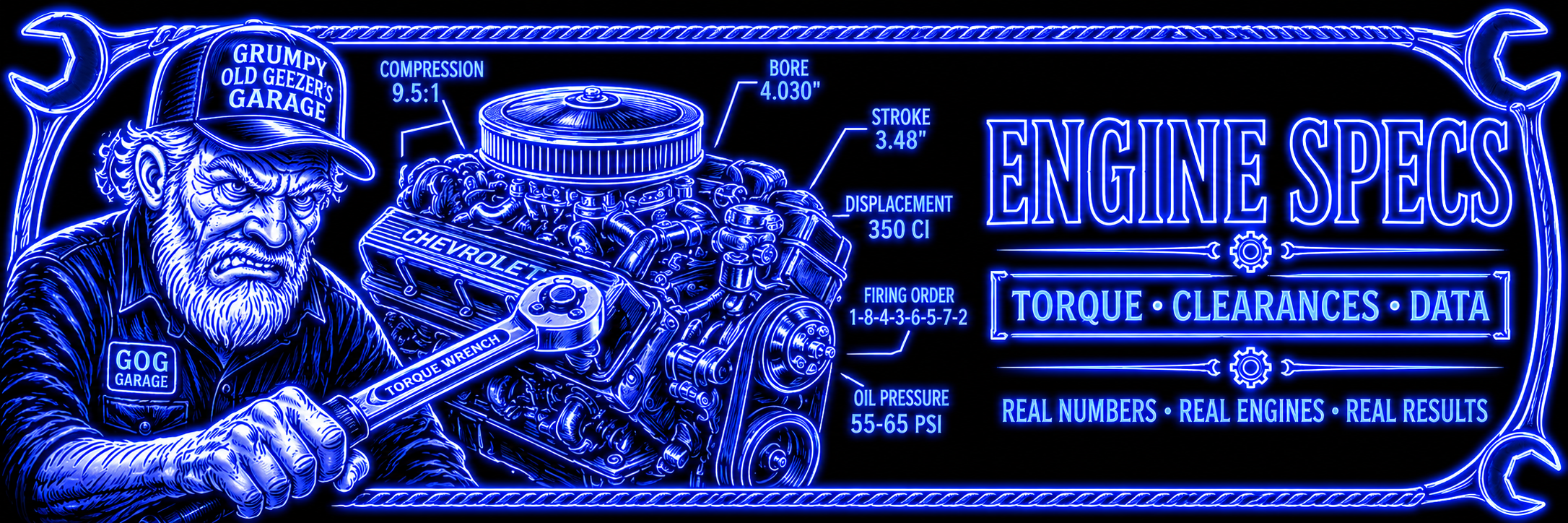
| Firing Order | 1-8-4-3-6-5-7-2 | Distributor Rotation | Clockwise |
| Distributor Location | Rear-mounted | Common Block Material | Cast iron |
| Common Head Material | Cast iron | Oiling System | Wet sump |
| Typical Bellhousing Pattern | Traditional Chevrolet small-block bellhousing pattern | Major Factory Displacements Covered Here | 262, 265, 267, 283, 302, 305, 307, 327, 350, 400 |
The table gives you the family baseline, not permission to quit checking parts. The Gen I SBC shares a familiar layout, but Chevrolet changed enough details over the years to keep careless builders busy buying the wrong pieces.
The big traps are the ones people assume away. Early and late engines don’t all use the same crank journals, rear main seal style, flywheel, flexplate, oil pan, dipstick location, accessory brackets, or water-pump setup. Most Gen I small blocks are internally balanced, but the 400 isn’t. Some head and intake combinations look familiar until bolt angles, chamber size, valve size, gasket choice, or steam-hole needs start ruining the party.
That’s why “small-block Chevy” is a starting point, not a parts order. A 265, 327, 350, and 400 all belong to the same family, but they don’t all want the same crank, heads, balance parts, cooling details, or build plan. A part can be small-block Chevy and still be wrong for the engine on the stand. That’s the difference between knowing the family and knowing what you’ve actually got.
↑ Back to the Top, Before the Casting Numbers Start Lying

Identification
A Gen I small-block Chevy is usually easy to recognize. It is compact, the distributor sits at the rear of the intake, the timing cover is up front, and the intake sits low between the cylinder heads. That basic shape stayed recognizable from the first 265 through the late 305 and 350 versions, which is one reason the small-block became American shop furniture.
Do not confuse family recognition with displacement identification. A 283, 302, 327, and 350 can look almost identical from ten feet away. A 305 can wear 350 valve covers and intake hardware before lunch. Heads move, intakes move, oil pans move, distributors move, and somebody has been selling chrome valve covers for these things since approximately the invention of chrome.
The later generations are easier to separate. A Gen II LT1/LT4 has its distributor drive at the front of the engine rather than the traditional rear-mounted Gen I distributor, and the later LS family is an entirely different engine architecture. Within the Gen I family itself, however, Chevrolet spent nearly half a century making different displacements look remarkably alike.
Start With the Block Casting Number
The block casting number is the first serious identification tool. Look at the rear of the block where the transmission bellhousing bolts on, usually on the driver-side upper ledge behind the cylinder head. The number is raised as part of the casting, not stamped into a machined pad. Later blocks may move things around slightly, but the rear bellhousing area is where the search starts.
Clean the number before decoding it. Chevrolet used six-, seven-, and eight-digit casting numbers, and one greasy digit can turn a 305 into a 350 on paper without changing a thing inside the block.
The important warning is that one casting number does not always equal one displacement. Chevrolet reused some small-block castings for several engines.
- 3703524 is an early 1955 265 casting and is especially distinctive because the original version had no integral full-flow oil-filter provision.
- 3731548 was used for both 265 and 283 production in 1957.
- 3892657 was used for 302 and 327 applications in 1967.
- 3914678 was used for 302, 327, and 350 applications in 1968.
- 3932386 and 3956618 can appear under 302, 327, and 350 applications around the 1969 period.
- 355909 is a particularly good trap: it appears as a 262 casting in 1975 and as a 305 casting in later production. The casting date matters.
- 14016376 is strongly associated with the 267.
- 330817 and 3951509 are familiar 400 castings.
- Later blocks may have metric displacement markings such as 5.0 or 5.7 cast into the block. Those are very useful clues for separating a late 305 from a late 350.
That list demonstrates the rule better than any lecture can. Casting numbers are strong evidence, but shared castings exist. If the number points to more than one displacement, Chevrolet is telling you to keep looking.
Find the Block Casting Date
The block casting date is normally found around the rear bellhousing ledge, commonly toward the passenger side, although location changed on some later blocks. It tells you when the block was poured, not when the complete engine was assembled.
Typical Chevrolet date coding uses a letter for the month, followed by the day and a year digit. A is January, B February, and so forth through L for December. The casting number and production era establish the decade when the year is represented by only one digit.
The date can be decisive when Chevrolet reused a casting. That 355909 block is a fine example. A 1975 casting date points toward the 262 application; a later date moves the same casting number into 305 territory.
The chronology also has to make sense. The block was cast before the engine was assembled. If the assembly stamp says the engine was built before the block was poured, somebody read a number wrong or somebody has been improving history.
Read the Front Stamping Pad
The engine assembly stamp is normally on the machined pad at the front passenger side of the block, immediately ahead of the cylinder head. Alternator brackets, grime, paint, and forty years of neglect can hide it, but this is one of the most useful pieces of information on the engine.
A Chevrolet production engine code normally combines the engine assembly plant, assembly month and day, and an application suffix. Depending on year, plant letters include familiar Chevrolet codes such as Flint and Tonawanda. The suffix identifies the original engine application and can narrow displacement, horsepower, transmission, carburetion, emission package, and vehicle application.
The suffix must be decoded for the correct year. Chevrolet reused suffix letters. Reading two letters without establishing the casting date and model year first is how perfectly ordinary engines become rare Corvette motors in classified ads.
A factory stamp is also only evidence of how Chevrolet assembled the engine originally. It cannot tell you whether somebody installed a different crankshaft thirty years later.
Partial VIN and Service-Replacement Markings
Later production engines may also carry a partial vehicle VIN near the engine production code or in another factory stamping location. Depending on year and assembly plant, some Chevrolet V8 partial VINs were stamped elsewhere on the block, including around the rear or oil-filter area.
A matching partial VIN is powerful evidence that a particular block belongs with a particular vehicle. It does not magically identify what rotating assembly is inside after decades of rebuilding, but for originality work it carries considerably more weight than an air-cleaner decal.
Service-replacement blocks can carry replacement-engine markings rather than the normal original-production identification. A legitimate Chevrolet replacement block therefore may not decode like the engine that originally left the assembly plant in the car. Replacement does not mean fake. It means the identification job changes.
Also remember that decking a block during machining can weaken or completely remove the front-pad stamping. A blank pad on an old rebuilt SBC is not automatic evidence of fraud. A suspiciously fresh stamp on a freshly machined pad is not automatic evidence of Detroit, either.
Early-Block Clues
The first small-blocks have external clues that help narrow the era before any numbers are decoded.
The original 1955 265 is the oddball grandfather of the bunch. Early versions did not have the familiar integral full-flow oil-filter boss used on later small-blocks. Chevrolet revised the block as production developed, so the absence of the normal filter provision is an excellent clue to very early 265 iron.
Early blocks also differ in engine-mount provisions. The familiar side engine-mount bosses near the block freeze-plug area arrived after the earliest design. A block lacking those later side-mount provisions belongs to the early end of the small-block family, which immediately eliminates a whole pile of later displacement claims.
That still does not automatically separate every 265 from every 283. Chevrolet even shared a 1957 casting between the two. On an original engine, casting date, assembly suffix, vehicle application, and other period hardware have to finish the job.
Later-Block Clues
At the other end of the family, the 1986 change to a one-piece rear main seal is an important era clue. It identifies a later Gen I block and effectively moves the search into the late 305/350 world for normal production engines rather than the 265/283/302/307/327/400 era.
Beginning around 1987, center-bolt valve covers also became common on later Gen I heads. They are useful for dating the top end, but remember the heads bolt on. Center-bolt covers identify the heads far more reliably than they identify the short block.
Throttle-body injection, tuned-port injection, serpentine accessory drives, late alternator brackets, and other modern hardware can help establish the production period when the engine remains reasonably original. None of them is worth arguing with the block casting number.
Heads and Intake Tell Their Own Story
Cylinder-head casting numbers and dates are normally under the valve covers between the rocker-arm stands. These can identify the head design, production period, chamber size family, valve arrangement, and sometimes the original performance level.
They identify the heads. That distinction matters. Double-hump heads do not prove there is a 302 or 327 underneath them. Vortec heads do not prove the block underneath them was born in the 1990s. Small-block Chevy heads have been swapped so often that a matching pair deserves congratulations but not blind faith.
Intake-manifold casting numbers are usually found around the carburetor mounting area on cast-iron manifolds. Aluminum intake dates can be much harder to see once installed. Carburetor type, fuel injection, intake style, exhaust manifolds, distributor, accessories, brackets, pulleys, smog equipment, and ignition can all support a year or application identification when several pieces agree.
When five original dated components all tell the same story, listen. When the heads are 1968, the intake is 1974, the distributor is 1985, and the valve covers came from a catalog last Tuesday, believe the block first.
Separating the Small Displacements
The 262 is a 1975–1976-era economy small block with a 3.671-inch bore and 3.100-inch stroke. Casting number and date are the best assembled-engine clues. Be especially careful with casting 355909 because Chevrolet later used that number for 305 production.
The 265 uses a 3.750-inch bore and 3.000-inch stroke. Its 1955–1957 production window and early block architecture make it easier to place by age than many later SBCs. The very early no-filter block is the strongest external clue, but a later 265 can share enough hardware with a 283 that casting, date, and suffix still matter.
The 267 is the strange little one: only a 3.500-inch bore combined with the 3.480-inch stroke used by the 305 and 350. Its late-1970s/early-1980s production period and 14016376 casting make it much easier to identify by block number than by staring at the valve covers.
The 283 uses a 3.875-inch bore and 3.000-inch stroke. Externally it overlaps heavily with other early small-blocks, particularly the 265 and later 307. A 1957 3731548 block can even belong to either a 265 or 283, so the casting alone does not always finish the job.
The Famous 302 / 327 / 350 Problem
These three are where casual small-block identification falls apart.
The 302, 327, and 350 all use a nominal 4.000-inch bore. Chevrolet made the displacement changes with stroke: 3.000 inches for the 302, 3.250 for the 327, and 3.480 for the 350.
Worse, some late-1960s block castings were shared among two or even all three. A casting such as 3914678 or 3932386 therefore does not automatically make the engine a Z/28 302, a Corvette 327, or a 350. Casting date and suffix code become essential.
The original 302 has the narrowest factory window of the three: 1967–1969 Camaro Z/28 production. A casting and date outside that window eliminate an original factory 302 immediately. Inside the window, the correct assembly suffix and application evidence have to support the claim because the bare block may also have served another displacement.
The 327 appeared much more broadly through the 1960s. Its 4.000-inch bore and 3.250-inch stroke distinguish the actual engine, but the assembled short block often requires casting/date/suffix evidence because the exterior does not.
The 350 became the long-running default and therefore has the broadest range of castings, heads, induction systems, seal styles, and applications. Later blocks carrying a factory 5.7 casting mark make the identification easy. Earlier 350s can be externally indistinguishable from their 302/327 relatives until the numbers are decoded.
This is also why every unidentified SBC at a yard sale mysteriously becomes a 350. Odds are sometimes on the seller’s side. Proof is better.
Separating the 305 and 350
The 305-versus-350 question became the later small-block version of the old 283-versus-327 argument. Both commonly use the 3.480-inch stroke, but the 305 has a 3.736-inch bore while the 350 has a 4.000-inch bore.
Externally, there is no universal valve-cover, intake, carburetor, distributor, or accessory trick that proves which one you have. Later blocks make life easier because many carry 5.0 or 5.7 cast into the iron. When that marking is present on the block itself, pay attention.
Otherwise, casting number, casting date, and assembly suffix are the sensible route. Heads can help with the original application, particularly when 305-specific small-chamber/small-valve castings are present, but heads remain bolt-on evidence.
The 307
The 307 combines the 283’s 3.875-inch bore with the 327’s 3.250-inch stroke. It was built from 1968 into the early 1970s and has several displacement-specific castings, including familiar numbers in the 39146xx and 39323xx families.
A stock 307 is usually straightforward once the casting number and date are found. The bigger problem is that nobody brags about having one, so old 307s occasionally acquire 327 or 350 identities by verbal horsepower.
The 400 Has the Best External Clues
The 400 small block is the easiest major Gen I displacement to suspect from external hardware because Chevrolet had to change more than the bore.
First, the 400 is the factory Gen I small block that uses external balance at both ends of the crankshaft. A stock-style 400 harmonic damper has an offset balance weight, and the factory flywheel or flexplate carries the corresponding external imbalance. The other production Gen I small blocks covered here are normally internally balanced.
That makes the damper a very useful clue on an assembled engine. It is not absolute proof. Aftermarket rotating assemblies can be internally balanced, 400-style cranks can appear in stroker engines, and fifty years of parts swapping can put the wrong damper on almost anything.
The famous freeze-plug trick also needs a correction before it causes trouble. Some 400 blocks have three core plugs on each side instead of the usual two. Other 400 castings have three cast bosses but only two plugs actually machined and installed. Therefore three plugs are a strong 400 clue; two plugs do not eliminate a 400.
The 400 also uses siamesed cylinder bores and steam-hole provisions in the decks and matching heads/gaskets, but those are not useful external assembled-engine identification features. If the heads are still on, do not claim you identified the block by steam holes you cannot see.
Casting numbers such as 3951509 and 330817, combined with the production date and 400-style balance hardware, make a far stronger case than counting freeze plugs alone.
Do Not Confuse a Stroker With a Factory Displacement
The Gen I small block may be the most commonly modified engine family on earth, and that creates one identification problem Chevrolet never put in the parts book.
A factory 350 block can contain a 383 stroker rotating assembly. A 400 block can carry a 350-style crank and become a 377. Aftermarket cranks can turn familiar blocks into all sorts of cubic-inch combinations that never appeared on a Chevrolet assembly line.
The block casting number identifies the block. The factory suffix identifies how Chevrolet originally assembled it. Neither one can see through the oil pan and tell you what crank somebody installed later.
That is why an old modified engine with no trustworthy history eventually stops being a decoding problem and becomes a measuring problem.
What Evidence Deserves Trust?
- Paint, decals, chrome, valve covers, and air cleaner: decoration. Enjoy them. Do not decode cubic inches from them.
- Carburetor, intake, distributor, exhaust, brackets, and accessories: useful year or application clues when original, but easily changed.
- Cylinder-head casting numbers and dates: strong identification of the heads; supporting evidence for the short block.
- Early oil-filter and engine-mount architecture: strong clues for narrowing very early 265/283-era blocks.
- Late 5.0 / 5.7 casting marks: strong evidence for identifying the block as a late 305 or 350.
- 400 external-balance hardware and three-core-plug configuration: strong clues, but neither is absolute by itself.
- Block casting number: one of the strongest assembled-engine clues, provided the casting was not shared.
- Casting number plus casting date plus assembly suffix: usually enough to identify how Chevrolet originally built the engine.
- Matching partial VIN where applicable: strong evidence tying the block to a particular vehicle.
- Measured bore and stroke: what the engine actually is now.
That last distinction matters more on a small-block Chevy than on almost anything else. There are too many interchangeable cranks, too many shared castings, too many rebuilds, and too many strokers in circulation to assume an old engine still contains what Chevrolet installed.
If the casting number, date, suffix code, vehicle history, heads, and external hardware all agree, you can usually identify an untouched production engine confidently without removing a head. If the evidence disagrees, the pad has been machined away, the casting was shared, or the engine has an unknown rebuild history, outside identification eventually reaches its limit.
At that point, bore and stroke are the final identification test. Stroke can sometimes be checked or approximated with the engine assembled by carefully measuring piston travel through a spark-plug opening, but exact bore measurement normally means getting access to the cylinder. Once both dimensions are known, the decals can go back to being decoration.
Bore / Stroke Reference
| Displacement | Bore | Stroke | Displacement | Bore | Stroke | |
|---|---|---|---|---|---|---|
| 262 | 3.671 in | 3.100 in | 265 | 3.750 in | 3.000 in | |
| 267 | 3.500 in | 3.480 in | 283 | 3.875 in | 3.000 in | |
| 302 | 4.000 in | 3.000 in | 305 | 3.736 in | 3.480 in | |
| 307 | 3.875 in | 3.250 in | 327 | 4.000 in | 3.250 in | |
| 350 | 4.000 in | 3.480 in | 400 | 4.125 in | 3.750 in |
↑ Back to the Top, Before the Casting Numbers Start Lying

Shared Design Patterns
The Gen I small-block family didn’t have one personality. It had a few basic patterns, and you need to know which one you’re dealing with before you start throwing parts at it.
The smaller-bore engines usually lived in the economy and everyday-driver end of the family. The 262, 267, 305, and 307 are the obvious caution signs here. That doesn’t make them useless, but it does limit how much air and valve they can use. A small bore can only give the heads so much room to work. Pretend otherwise, and you’re not building power. You’re buying parts for a hole that isn’t big enough to use them.
The larger-bore engines gave Chevrolet more room to breathe. The 302, 327, 350, and 400 all benefit from more bore area, but they don’t all use it the same way. A 302 wants rpm and gear. A 327 likes response and balance. A 350 gives the broadest all-around answer. A 400 turns bore and stroke into torque, then hands you a cooling and balance rulebook. Same family. Different assignments.
Stroke changes the attitude too. Shorter-stroke combinations tend to feel sharper and happier with rpm. Longer-stroke combinations usually bring more low-speed pull and more forgiveness on the street. That’s why the small-block family can cover crisp little rpm engines and gruntier torque engines without being the same animal under the paint.
Compression, cam timing, heads, induction, gearing, and vehicle weight still get the final vote. Bore and stroke set the personality. The rest of the combination decides whether that personality works or just makes noise. The SBC is forgiving, but it’s not here to babysit a bad parts list.
↑ Back to the Top, Before the Casting Numbers Start Lying

Choosing Within This Family
The Gen I small-block family covers everything from engines worth keeping because they belong in the car to some of Chevrolet’s best performance foundations. Picking one by cubic inches alone is how people end up with the right engine for somebody else’s project. Restoration, cruising, rpm, street torque, vehicle weight, gearing, parts availability, originality, and what you actually expect the car to do all matter. The biggest number does not automatically win, and the famous number does not get to ignore the rest of the car.
-
Choose the 262 or 267 mostly when the car already has one and keeping it original matters.
Both are small-bore, low-output engines built when fuel economy and emissions were higher on Chevrolet’s list than making teenagers grin. A healthy survivor can handle ordinary driving just fine, but serious performance spending on either one is usually money trying to escape. The 267 gets the longer 3.480-inch stroke, but its tiny 3.500-inch bore still puts airflow and valve size on a very short leash. Keep a good one where history says it belongs. Do not empty a speed-parts catalog into it and expect cubic inches to appear out of gratitude. -
Choose the 265 when early Chevrolet correctness and history matter most.
This is the engine that started the whole small-block mess in 1955, and that alone gives it a reason to survive in the right car. A correct 265 belongs naturally in an early Chevrolet, Corvette, or period build where the engine itself is part of the story. Its small bore, early block details, and limited breathing room make it a poor place to chase cheap modern horsepower. That is not a defect. Asking the grandfather of the family to compete with fifty years of development is the defect in the plan. -
Choose the 283 when you want early small-block character with enough performance potential to make it interesting.
The 283 has more breathing room than the 265, keeps the short 3.000-inch stroke, and can make a crisp, responsive street engine that feels livelier than its displacement suggests. It still gives away low-rpm torque and headroom to a 327 or 350, so compression, camshaft, gearing, vehicle weight, and airflow have to cooperate instead of expecting cubic inches to cover the mistakes. In an early Chevrolet, Corvette, Nova, Chevelle, or period hot rod, that quick little personality is the whole reason to use one. A 283 built like a 283 can be a joy. A 283 built from leftover 350 ideas is usually just a smaller disappointment. -
Choose the 302 when rpm is the point, not something that happens on the way to torque.
Its 4.000-inch bore and 3.000-inch stroke were created around a racing rulebook, and the dimensions tell you exactly what kind of engine Chevrolet intended. The 302 makes the most sense in a real Z/28, a serious period Trans-Am-style build, or a light car with enough compression, airflow, gearing, and drivetrain to let the engine work upstairs. Put one in a heavy cruiser with highway gears and then complain that it feels soft below 3,000 rpm, and the engine is not the confused one. The famous number does not repeal leverage. -
Choose the 305 or 307 when mild street duty, originality, and using what you already have matter more than winning a horsepower argument.
Both can make good drivers when the parts stay sensible. The 305 uses the same 3.480-inch stroke as the 350 and can provide decent street manners, especially in its better factory combinations, but the smaller 3.736-inch bore limits valve and head choices. The 307 is similarly happiest as a smooth cruiser. Its 3.875-inch bore and 3.250-inch stroke do not secretly turn it into a discount 327 no matter how encouraging the seller sounds. If the engine is healthy and belongs in the car, use it. If the plan starts with expensive heads, a giant cam, and a promise to “wake it up,” price a better starting point before the credit card gets involved. -
Choose the 327 when crisp response, rpm character, and traditional Chevrolet performance matter more than maximum low-speed torque.
The 4.000-inch bore gives the heads room to work, while the shorter 3.250-inch stroke keeps the engine lively. That combination suits Corvettes, traditional hot rods, lighter street cars, and period performance builds where response and willingness to rev matter as much as brute pull. A good 327 has a character worth preserving rather than turning it into an imitation 350. The tradeoff is simple: heavier cars, lazy gearing, and low-rpm expectations require more careful planning. A 327 likes a car that participates. -
Choose the 350 when practical power, parts availability, flexibility, and not making the job harder than necessary are the priorities.
This is the family’s broadest all-around answer because it earned the job. The 4.000-inch bore gives it breathing room, the 3.480-inch stroke makes useful street torque, and the parts supply is deep enough to build anything from a stock replacement to a strong street engine without searching three counties for one obsolete bracket. The danger is complacency. Because almost anything is available for a 350, people start assuming almost anything belongs on one. The 350 forgives more average combinations than most of its relatives. That is not permission to assemble one by catalog page number. -
Choose the 400 when low- and midrange torque are the job and you are willing to follow the 400’s rules.
Heavy cars, trucks, wagons, cruisers, and street builds that benefit from easy pull are where the 400 earns its keep. The 4.125-inch bore and 3.750-inch stroke give it the most factory displacement and grunt in the Gen I family, but Chevrolet had to stretch the architecture far enough that cooling and balance stopped following the ordinary small-block script. Block condition, siamesed bores, steam-hole provisions, external balance, correct damper and flywheel or flexplate, and good cooling-system planning matter. A 400 rewards somebody who wants torque. It punishes somebody who thinks it is just a 350 that ate more breakfast.
The short version is simple. Preserve the 262 and 267 when they belong. Use the 265 when early Chevrolet history is part of the reason for owning the car. Pick the 283 for crisp early-small-block character, the 302 when rpm is the assignment, the 305 or 307 for honest mild-driver duty, the 327 for responsive period performance, the 350 when you want the broadest practical answer, and the 400 when torque matters enough to accept its extra rules.
Pick the job first. Then pick the engine that naturally wants to do it. Chevrolet already spent fifty years giving this family different personalities. There is no prize for choosing the wrong one and trying to beat it into submission with aftermarket parts.
↑ Back to the Top, Before the Casting Numbers Start Lying

Compatibility Notes
The Gen I small-block Chevy has excellent parts support, and that’s exactly where people get careless. A lot of parts fit. Some almost fit. Some bolt on just long enough to make the next mistake expensive. Compatibility has to follow the actual engine, not family folklore.
-
Head and Intake Compatibility
Head and intake fit is where a lot of small-block confidence goes to die. Early heads, later heads, Vortec-style changes, chamber size, valve size, port shape, bolt angles, steam holes, and gasket choice all affect what actually works. A mismatched intake can leak, seal poorly, kill the combination, or make a bad parts pile look more expensive than it is. -
400 Steam-Hole Issues
The 400 isn’t just a 350 with extra cubes. It has cooling details that need to be respected, especially steam holes when the heads and gaskets call for them. Ignore that, and the engine may teach the lesson with heat instead of words. -
Internal vs External Balance
Most Gen I small blocks are internally balanced, but the 400 is the major factory exception. The balancer and flexplate have to match the engine. Wrong balance parts can create vibration, bearing trouble, and a whole lot of “but it bolted on” excuses. -
Rear Main Seal Differences
Two-piece and one-piece rear main engines don’t use all the same crankshaft, flywheel, flexplate, and seal-related parts. Order by the engine on the stand, not by what somebody called it in an ad. -
Water Pump and Accessory Drives
Short pump, long pump, car brackets, truck brackets, pulley alignment, alternator mounts, power steering, A/C, and chassis clearance can turn a simple swap into a belt-throwing mess. The parts may be small-block Chevy. That doesn’t mean they line up in your engine bay. -
Oil Pan and Dipstick Location
Car, truck, marine, and swap applications don’t always use the same pan, pickup, or dipstick setup. Crossmembers, steering linkage, ground clearance, and chassis layout all get a vote. The wrong pan can fit the engine and still be wrong for the vehicle. -
Flywheel and Flexplate Matching
Tooth count, crank flange, rear main style, balance, clutch or converter setup, and transmission choice all have to agree. If the rotating assembly is wrong, the engine won’t care how close the parts looked online.
That’s the rule for Gen I SBC compatibility: fitment gets the part bolted on. Matching keeps the engine alive, aligned, cooled, balanced, and worth the work.
↑ Back to the Top, Before the Casting Numbers Start Lying

Common Family Problems
The Gen I small-block Chevy does not have one great family curse waiting to jump out from behind the timing cover. Most of its recurring trouble comes from something less dramatic: age, heat, worn parts, neglected maintenance, bad fuel, old rebuilds, and half a century of people assuming that anything shaped like a small-block part belongs on every small block ever made. Chevrolet built a forgiving engine. Previous owners have spent decades testing exactly how forgiving.
-
Oil Leaks and Lubrication Neglect
Valve covers, intake ends, timing covers, oil pans, rear main seals, and decades-old gasket surfaces are common leak points. After enough heat cycles, rebuilds, overtightened bolts, bent sheetmetal covers, and gasket kits installed on Saturday night, a little oil on the outside should not come as a spiritual crisis. Early engines deserve extra attention because the original 1955 265 did not use the later block-mounted full-flow oil-filter arrangement. None of this makes the small block fragile. It means sixty-year-old sealing surfaces and unknown oil-change habits do not become trustworthy because somebody sprayed the block Chevrolet orange. -
Timing-Set and Distributor Wear
Stretched timing chains, worn gears, tired distributors, worn bushings, sticky advance mechanisms, and old vacuum cans can make an otherwise healthy small block lazy, inconsistent, or miserable to tune. Nylon-tooth timing gears used in some production engines deserve particular suspicion once age gets involved. When cam timing is arriving late and ignition timing wanders around like it forgot where it parked, replacing the carburetor usually just gives the wrong diagnosis a shiny new accomplice. -
Flat-Tappet and High-RPM Valvetrain Trouble
Flat-tappet cams and lifters need the correct parts, lubrication, spring pressure, adjustment, and break-in. Skip any of those because somebody said small-block Chevys are indestructible and the lobes may provide a fairly expensive second opinion. High-rpm combinations such as the 302 add another layer because weak springs, bad geometry, tired lifters, questionable rocker gear, poor ignition, and unknown bottom-end work reveal themselves quickly when the tachometer gets ambitious. A properly built small block can live happily at rpm. A bucket of mystery parts does not gain courage because the throttle is open. -
Detonation From Heat, Timing, Fuel, and Compression
High-compression early engines, some 305 combinations, and torque-heavy 400s can all suffer when fuel quality, ignition timing, chamber condition, quench, mixture, and cooling are wrong. Detonation can pound pistons, rings, bearings, and head gaskets long before the outside of the engine gives anybody a useful clue. The muscle-era engines were designed around fuel that existed when leaded premium was not a specialty product. The compression ratio may have survived fifty years. The gasoline did not come along for the ride. -
Fuel-System and Electronic-Control Drivability Trouble
Rochester mechanical fuel injection on early 283 and 327 performance engines can become temperamental when worn, incomplete, badly adjusted, or serviced by somebody whose entire diagnostic procedure is turning screws until the idle changes. Later feedback carburetors, TBI, and TPI systems add aging sensors, injectors, vacuum lines, wiring, grounds, connectors, and control hardware to the argument. When those systems are hacked or neglected, the short block often gets blamed for a problem sitting on top of it holding a multimeter. -
Cooling, Coolant-Leak, and Heat-Damage Problems
Weak radiators, clogged passages, poor fans, missing shrouds, lean mixtures, bad ignition timing, tired water pumps, and neglected cooling systems can overheat any small block. Later Vortec 350s add intake-gasket coolant leaks and cylinder heads that deserve careful crack inspection after a serious overheating episode. The 400 gets its own warning because the siamesed cylinder bores require the proper steam-hole path through compatible blocks, gaskets, and heads. Ignore that because the holes look insignificant and the engine may demonstrate their purpose by turning coolant temperature into the most interesting gauge in the car. -
Old Rebuilds and Mismatched Parts
This may be the most authentically small-block Chevy problem of all. The parts supply is so enormous, and so much hardware physically interchanges, that generations of builders have assembled engines from whatever fit, almost fit, or happened to be cheapest when the machine shop called. Small-bore 267 and 305 engines can lose compression, airflow, or valve clearance with badly chosen heads. Early and late 327 hardware crosses journal-size changes. A 350 may contain pieces from three decades of production and two previous owners’ garage shelves. A 400 that has been overheated, heavily overbored, or poorly machined can hide cylinder-wall trouble under fresh paint. Bolting together proves the holes lined up. It does not prove the combination was a good idea. -
Wrong Balance Parts
The 400 makes this lesson impossible to ignore because the factory engine uses external-balance components. The harmonic damper and flywheel or flexplate have to match the rotating assembly. Install ordinary internally balanced small-block pieces because they bolt on and the reward can be vibration, bearing stress, cracked parts, and an expensive demonstration of why “small-block Chevy” is a family name rather than a universal interchange specification. If an engine is shaking hard enough to rearrange the mirrors, quit admiring the exhaust note and find out why.
Most Gen I problems are therefore not mysterious. Check the engine’s actual identity, inspect what sixty years of use and rebuilding have done to it, match the parts instead of the labels, and fix the cooling, lubrication, ignition, fuel, and valvetrain systems before blaming the basic architecture.
The small-block Chevy survived nearly half a century of factory production and another lifetime of hot-rodding because the design is fundamentally tough. What it cannot survive indefinitely is neglect, mismatched hardware, and an owner who keeps saying, “It ought to work. It’s all small-block Chevy.”
↑ Back to the Top, Before the Casting Numbers Start Lying

Common Family Misconceptions
The small-block Chevy earned its reputation. Then fifty years of swaps, speed parts, famous option codes, and garage folklore turned that reputation into permission to assume almost anything. The family is simple. The mythology is not.
-
“All Gen I small blocks are basically the same engine.”
They share a family architecture, not one universal parts list. Bore size, crankshaft journals, balance, rear-main-seal style, heads, chambers, valves, intake patterns, cooling provisions, and rotating assemblies can change the answer. A 262, 305, 350, and 400 can all be small-block Chevys while still having very different limits and requirements. -
“The famous version comes with the displacement.”
It does not. A 283 is not automatically a Fuelie, a 302 is not automatically a genuine Z/28 engine, a 327 is not automatically an L79 or Corvette prize, a 305 H.O. is not automatically serious high performance, and a 350 is not automatically one of the desirable factory versions. Blocks, dates, stampings, heads, induction, camshaft, compression, application, and supporting hardware have to prove expensive claims. -
“The right bolt-on parts turn any small block into a performance engine.”
Dual quads, mechanical fuel injection, Camel Hump heads, Vortec heads, TPI, a large carburetor, or a big cam can all belong on the right combination. None can rescue poor compression, the wrong bore size, weak gearing, bad exhaust, mismatched airflow, or a worn short block. Performance parts do not vote as a group and overrule physics. -
“More cubes, more rpm, or a famous number automatically means better.”
A 302 is not automatically better because it revs. A 327 is not automatically better than a 350 because people remember it fondly. A 350 is not automatically the best small block because it is common, and a 400 is not automatically better because it has the most displacement. The car, gearing, rpm range, originality, torque requirement, and intended use decide which engine makes sense. -
“The unloved small blocks are either junk or hidden sleepers.”
The 262, 267, 305, and 307 do not need either fairy tale. Most were built for ordinary transportation, economy, emissions-era duty, or mild street use. They can be perfectly serviceable when healthy, but limited bore, displacement, compression, and factory hardware do not disappear because somebody discovered a performance catalog. A decent cruiser does not have to be a secret race engine to justify existing. -
“Rare, old, or uncommon automatically means valuable.”
Scarcity does not create demand by itself. An uncommon 262 or 267, an old 265, a surviving 307, a base 327, or a questionable 400 core is worth what its identity, condition, completeness, application, and actual desirability support. Sometimes an engine is uncommon because nobody saved many. That is not the same thing as everybody wanting one. -
“Any small-block Chevy is cheap and worth rebuilding.”
Parts availability makes the family easier to support, not free to rebuild. Machine work, pistons, heads, crankshaft work, valvetrain, induction, ignition, and missing specialty pieces still cost money. A healthy original engine may make sense to preserve while a worn low-demand core may make no economic sense at all. Cheap parts reputation does not pay the machine-shop bill. -
“Casting numbers, badges, or one visible part prove what the engine is.”
They provide clues. They do not prove the complete engine. Blocks have been bored, decked, restamped, re-headed, re-cammed, and assembled from mixed parts for decades. Even the familiar 5.7-liter label does not automatically mean a Gen I 350 because Chevrolet used that displacement in later engine families too. Identification starts with numbers and hardware. It does not stop there. -
“Truck, crate, or replacement engine tells you whether it is good.”
Those labels describe application or source, not condition or capability. A truck engine can be an excellent foundation or a worn-out core. A crate 350 can be a mild replacement engine or a serious performance package. Service engines and replacement assemblies may be useful while being completely wrong for an originality claim. Labels save time only when somebody still checks what is behind them.
↑ Back to the Top, Before the Casting Numbers Start Lying

Bottom Line
The Gen I small-block Chevy earned every bit of its reputation. It started with the 265, learned to bite with the 283, went racing with the 302, got downright lively with the 327, turned the 350 into the answer to half the questions asked in American garages, and stretched itself all the way to the torque-heavy 400. Along the way it powered family cars, Corvettes, trucks, boats, hot rods, race cars, and enough backyard swaps to keep junkyards in business for generations.
That enormous success is also why people get lazy around it. Somewhere along the line, “small-block Chevy” became shorthand for “everything fits everything.” It does not. A 302 and a 400 may share the family name, but one wants rpm and the other wants torque. A 305 and a 350 look friendly enough beside each other until bore size and airflow start settling the argument. Early and late engines can disagree about crankshafts, seals, balance, cooling, brackets, flywheels, and enough other details to turn one supposedly easy parts order into a weekend vocabulary lesson.
And not every displacement was trying to become a legend. The 262 and 267 were economy-era answers to ugly times. The 305 spent years doing ordinary V8 work while everybody compared it to a 350. The 307 quietly moved regular Chevrolets without demanding applause. Those engines belong in the family just as surely as the famous ones do. A family this large needs workhorses, oddballs, compromises, and a few relatives nobody mentions until somebody needs one.
The beauty of the Gen I small block is that there is usually a good answer somewhere in the family. The danger is assuming the answer is automatically the engine sitting under the valve covers. Orange paint proves almost nothing. Chrome proves less. A familiar block shape certainly does not tell anybody which crank, heads, balance parts, compression, cooling setup, or fifty years of previous-owner creativity are hiding inside.
So enjoy the reputation, because Chevrolet earned it. Just do not let that reputation do the measuring. Identify the displacement, check the hard parts, understand what that particular version was meant to do, and build around the engine that is actually sitting on the stand. The small-block Chevy made engine building easier for millions of people. It never promised to make guessing smarter.
↑ Back to the Top, Before the Casting Numbers Start Lying