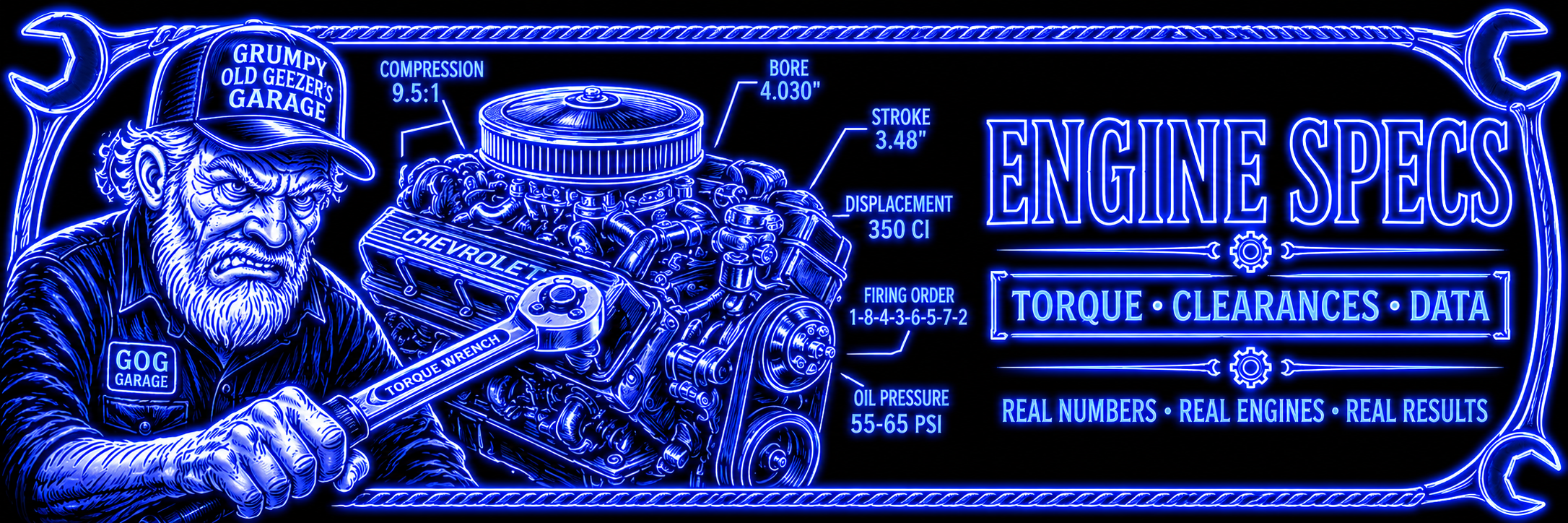
Chevy 265 Engine Specs
On This Page:
Engine Details: General Specs | Variants | Key Notes
Final Word: Bottom Line
Related: Related Links

Intro
➤ See the Family Page for specs common to all engines in this family.
The Chevy 265 is where the small-block Chevrolet story actually begins. Introduced for 1955, it was Chevrolet’s clean-sheet modern overhead-valve V8 and the engine that changed the company from a builder known largely for dependable six-cylinder transportation into a serious participant in the V8 performance fight. The later 283, 302, 327, 350, and 400 made more power, more torque, or more noise. Every one of them was standing on the 265’s shoulders.
That matters more than the displacement. Chevrolet was not trying to win a cubic-inch contest in 1955. It needed a V8 compact enough for ordinary passenger cars, light enough not to turn them into nose-heavy barges, inexpensive enough for mass production, smooth enough for normal buyers, and strong enough to leave room for performance development. The 265 managed all of that in a package considerably smaller and lighter than many contemporary V8s.
The original dimensions were a 3.750-inch bore and 3.000-inch stroke. That short-stroke layout gave the little engine a lively character and helped establish one of the traits people would associate with early small-block Chevrolets for years: they liked to rev without needing a block large enough to qualify as furniture.
The first passenger-car versions were deliberately ordinary. The base 1955 two-barrel engine was rated at 162 horsepower, while the four-barrel Power Pack version reached 180. Corvette received a hotter 265 rated at 195 horsepower. None of those figures looks outrageous now. In 1955, the important part was that Chevrolet had gone from talking about modern V8 performance to selling it.
Then the development started moving fast. For 1956 Chevrolet improved the engine, raised output, and expanded the performance choices. The ordinary two-barrel version climbed to 170 horsepower, the four-barrel Power Pack reached 205, and a dual-four-barrel 265 with higher compression and a solid-lifter cam was rated at 225 horsepower. More serious Corvette hardware pushed the little engine farther still. Chevrolet had needed only one model year to start teaching its new family-car V8 bad habits.
The 265 also carries some first-generation peculiarities that disappear if somebody approaches it like a generic later small block. The 1955 block did not have the familiar block-mounted full-flow oil filter used beginning in 1956. Early heads, valve-cover details, induction, brackets, castings, and other pieces matter when originality is the goal. A later small block may fit where a 265 sat. That does not make it the same engine with a newer birth certificate.
By 1957 the 283 had arrived with a larger bore and more breathing room, and Chevrolet’s performance development moved quickly toward the new displacement. The 265 remained available in lesser applications, but its job as the family’s headline engine was finished. That was not failure. Chevrolet replaced it because the basic design had worked well enough to deserve enlargement.
Today the 265 makes the most sense where history, originality, and early small-block character matter. It is not the easiest way to build horsepower. The small bore limits valve size and airflow compared with later engines, early parts can be harder to find, and restoration-specific hardware can cost more than the horsepower-per-dollar crowd considers reasonable.
That crowd is missing the point. A correct 265 belongs in a Tri-Five Chevrolet or early Corvette because it is part of what made those cars important. It has the compact look, eager response, period hardware, and mechanical simplicity that started nearly half a century of small-block Chevrolet development. Replacing one with a 350 may make the car faster and cheaper to maintain. It does not make the 265 irrelevant.
The 265 was not Chevrolet’s greatest small block. It was the one that made all the later arguments possible.
↑ Back to the Top, Before the Casting Numbers Start Lying

Overview
The 265 arrived at exactly the right moment. Chevrolet had just redesigned its full-size passenger cars for 1955, styling was moving quickly, buyers were becoming more interested in performance, and Ford had already made its overhead-valve V8 part of the competitive conversation. Chevrolet’s dependable inline six was not going away, but it was no longer enough to define the company’s future.
The new engine had to solve several problems at once. It needed to be compact enough to fit comfortably in Chevrolet’s passenger-car chassis, light enough to preserve handling and front suspension behavior, simple enough for high-volume production, inexpensive enough to offer across a broad model range, and adaptable enough that engineers could keep improving it after launch. That last requirement may have mattered more than anyone realized in 1955.
Chevrolet’s answer was remarkably compact. The 265 used a 90-degree V8 layout, 4.400-inch bore spacing, a 3.750-inch bore, 3.000-inch stroke, five main bearings, wedge-style combustion chambers, an in-block camshaft, pushrods, and lightweight stamped-steel rocker arms. The block was short, narrow, and comparatively light for its output. That basic architecture became the template for decades of Chevrolet small blocks.
The short stroke was a major part of the engine’s personality. Three inches of stroke kept mean piston speed modest and allowed the 265 to rev freely by mid-1950s standards. It did not make enormous torque simply through displacement, so gearing, compression, airflow, camshaft, and induction mattered more as Chevrolet pushed the performance versions.
The base 1955 passenger engine used a two-barrel carburetor and was rated at 162 gross horsepower. The Power Pack version added four-barrel induction and other tuning changes for 180 horsepower. Corvette got a hotter version rated at 195. Those were respectable numbers, but the important thing was how much room the engine still had to improve.
Chevrolet improved it almost immediately. For 1956 compression increased on several versions, cylinder heads and induction were revised, and the performance catalog spread from ordinary hydraulic-lifter street engines to dual-four-barrel solid-lifter combinations. The basic passenger engine reached 170 horsepower, the Power Pack climbed to 205, and dual-quad versions reached 225 horsepower.
Corvette development pushed farther. Higher compression, mechanical lifters, more aggressive cam timing, dual Carter four-barrels, and freer exhaust helped turn the little V8 into a serious sports-car engine. By 1956 the same fundamental architecture could serve a family sedan in the morning and spend the afternoon teaching road racers why Chevrolet had finally become interesting.
The first-year engine also had details that later small-block familiarity tends to erase. The 1955 block did not have the full-flow, block-mounted oil filter boss that became familiar beginning in 1956. Original oil filtration relied on an optional bypass-style canister system. That makes a genuine 1955 block immediately different from later pieces even before casting numbers enter the discussion.
Valve-cover attachment is another early detail. The first small blocks used staggered valve-cover bolt holes rather than the later straight-across pattern. That difference survived into early 1959 before Chevrolet standardized the later arrangement. Originality-minded restorers therefore care about details that a generic small-block rebuild may never notice.
The 265’s small bore is both part of its character and its main performance limitation. A 3.750-inch bore physically restricts valve size and can increase valve shrouding compared with the larger-bore 283, 327, 350, and 400. Chevrolet could still make impressive power from the displacement, but airflow improvements eventually became easier by enlarging the engine rather than asking the little bore to keep making room.
That is exactly what happened for 1957. Chevrolet increased bore to 3.875 inches while retaining the 3.000-inch stroke, producing the 283. The extra bore added displacement and gave the valves more breathing room without changing the compact package that made the original engine successful. Chevrolet did not replace the 265 architecture. It developed it.
The 265 remained available for a short period in lower-output applications after the 283 became the performance focus. That overlap is important because “1957 small block” does not automatically mean 283. Vehicle application, casting, stamping, induction, and other details still have to identify what Chevrolet actually installed.
For modern street use, a stock or mildly improved 265 can be very pleasant in a light early Chevrolet. Its small displacement and short stroke produce a crisp engine when compression, camshaft, carburetion, gearing, and exhaust are kept realistic. Trying to duplicate later small-block power numbers usually requires spending money against the limitations of the bore rather than working with the engine’s strengths.
That is why a 265 often belongs in restoration and period-style builds more than modern horsepower projects. A larger-bore Gen I block is usually cheaper and easier when the assignment is simply to make power. But a 350 cannot recreate the mechanical significance of the first small block Chevrolet put into mass production.
The real achievement of the 265 was not any single horsepower rating. It was the package. Chevrolet created a light, compact, inexpensive V8 that could be built mildly enough for ordinary transportation, hot enough for Corvette, and flexibly enough to become the foundation for a family that survived through changing fuels, emissions rules, electronics, racing classes, trucks, and decades of hot-rodding.
Everything after 1955 became an argument about how Chevrolet should enlarge, feed, cam, cool, inject, and modify the basic idea. That is a pretty good sign the first idea was right.
↑ Back to the Top, Before the Casting Numbers Start Lying

General Specs
| Displacement | 265 cu in / 4.3L | Bore / Stroke | 3.750 in × 3.000 in |
| Production / Use Era | 1955–1957 early Gen I small-block era | Bore Spacing | 4.400 in |
| Engine Family | Chevrolet Gen I Small Block | Deck Height | 9.025 in nominal |
| Block Material | Cast iron | Rod Length | 5.700 in |
| Cylinder Head Material | Cast iron | Main Journal | 2.300 in small-journal |
| Fuel / Induction | 2-barrel, 4-barrel, or dual 4-barrel by version | Rod Journal | 2.000 in small-journal |
| Cam Location | In-block camshaft | Main Bearings | 5 |
| Valve Layout | OHV / pushrod, 2 valves per cylinder | Firing Order | 1-8-4-3-6-5-7-2 |
| Common Main Caps | 2-bolt | Distributor Rotation | Clockwise |
| Rear Main Seal | 2-piece | Weight | ~575 lbs |
| Balance | Internal | Dimensions | ~28H / ~26W / ~29L |
Exact parts and specs can vary by year, vehicle, Corvette versus passenger-car application, service history, and whether somebody already mixed early and later small-block parts. Use these numbers as the baseline, then verify the actual block, crank, heads, induction, oil-filter arrangement, and application before ordering parts or machining anything expensive.
↑ Back to the Top, Before the Casting Numbers Start Lying

Variants
The 265 had a surprisingly broad factory range for an engine that spent only a few seasons in the spotlight. Chevrolet started with mild hydraulic-lifter two- and four-barrel passenger engines, then quickly added hotter Corvette combinations, dual four-barrels, mechanical lifters, higher compression, and increasingly serious camshaft and exhaust packages. The displacement stayed the same. The intent did not.
1955 162-hp — Two-Barrel Passenger Engine
What it was: The base 1955 265 was Chevrolet’s ordinary new V8. It was intended to give full-size passenger cars smooth power, reasonable fuel economy, and modern V8 performance without turning every Bel Air into a race car.
What changed: Compression was approximately 8.0:1. The engine used hydraulic lifters, a mild camshaft, small-valve cast-iron heads, a cast-iron intake, and a Rochester two-barrel carburetor.
What that did: Chevrolet rated it at 162 gross horsepower. The combination emphasized smooth low- and midrange street operation rather than rpm or maximum airflow.
Where used: Full-size Chevrolet passenger cars for 1955.
1955 180-hp Power Pack — Four-Barrel
What it was: The Power Pack was the first step up from the base engine and the first indication that Chevrolet intended to give ordinary passenger-car buyers something more interesting than basic transportation.
What changed: Compression increased, and the engine received a four-barrel carburetor, four-barrel intake, and appropriate ignition and exhaust calibration while retaining hydraulic lifters and street-oriented cam timing.
What that did: Output increased to 180 gross horsepower with better breathing at higher load while preserving ordinary street manners.
Where used: Full-size Chevrolet passenger cars as the optional Power Pack V8.
1955 Corvette 195-hp — Four-Barrel Performance
What it was: Corvette received the strongest 1955 production 265, giving Chevrolet’s sports car the V8 it badly needed after two seasons relying on the Blue Flame six.
What changed: Corvette used higher-performance induction, exhaust, ignition, and calibration than the ordinary passenger engine. Compression and camshaft specifications were selected for more rpm and power while the basic 265 architecture remained intact.
What that did: Chevrolet rated the Corvette 265 at 195 gross horsepower. More importantly, the V8 transformed the Corvette from an attractive curiosity into a car with serious performance potential.
Where used: 1955 Corvette.
1956 170-hp — Two-Barrel Passenger Engine
What it was: Chevrolet refined the base engine for 1956 rather than replacing it. The ordinary two-barrel 265 remained the bread-and-butter V8 while benefiting from the first full year of development.
What changed: Compression increased and detail improvements appeared in the block, heads, oiling system, and calibration. The important mechanical change for serviceability was adoption of the familiar block-mounted full-flow oil filter provision.
What that did: Output increased to 170 gross horsepower while retaining quiet hydraulic-lifter street manners.
Where used: 1956 full-size Chevrolet passenger cars.
1956 205-hp Power Pack — Four-Barrel
What it was: The 205-hp Power Pack continued the idea of a stronger street 265 without requiring the maintenance and temperament of the solid-lifter performance packages.
What changed: Higher compression, four-barrel induction, improved heads, and revised exhaust and ignition calibration increased breathing and cylinder pressure while retaining hydraulic lifters.
What that did: Chevrolet rated the combination at 205 gross horsepower, giving ordinary passenger cars a meaningful performance option without moving into the dual-quad end of the catalog.
Where used: 1956 Chevrolet passenger cars.
1956 225-hp Dual-Quad — Solid-Lifter
What it was: This was Chevrolet teaching the young small block some genuinely bad habits. Dual four-barrels, higher compression, and mechanical lifters turned the 265 into a serious factory performance package only one year after introduction.
What changed: The engine used two Carter four-barrel carburetors on an aluminum intake, higher compression, mechanical lifters, a more aggressive camshaft, stronger valve springs, and performance-oriented exhaust and ignition calibration.
What that did: Output reached 225 gross horsepower. The solid cam and extra induction shifted useful power upward and required the owner to accept the valve-lash maintenance that came with the performance package.
Where used: High-performance 1956 Chevrolet passenger-car and Corvette applications depending on specific equipment and production package.
Identification caution: Dual-quad induction is highly visible and highly swappable. Two Carter carburetors and an aluminum manifold prove what is installed today. They do not prove Chevrolet built the engine that way.
↑ Back to the Top, Before the Casting Numbers Start Lying

Key Notes
The 265 deserves respect for what it started, not because every surviving block is some hidden performance treasure. This was Chevrolet’s first production small block, and the early engines have details later small-block people can overlook because fifty years of interchangeability trained everybody to assume parts are parts.
The 1955 block is the big early warning. It did not use the familiar block-mounted full-flow oil filter introduced for 1956. If a supposedly original 1955 265 has later filter provisions, that deserves investigation before the restoration invoice starts using the word “correct.”
Early valve-cover bolt patterns matter too. The original staggered bolt arrangement is part of the early small-block identity. Later straight-across valve-cover patterns, heads, covers, and dress pieces can be made to work, but originality and interchangeability are different jobs.
The 265’s 3.750-inch bore limits valve size and airflow. That is not a flaw somebody forgot to correct. It is part of the engine’s original dimensions. Large-valve heads that make sense on a 327 or 350 can run into physical and airflow problems on the small bore. The cylinder wall does not care what the parts catalog says.
Performance claims need evidence. Chevrolet built two-barrel, four-barrel, dual-quad, passenger-car, and Corvette versions with different compression, camshaft, induction, exhaust, and output. A correct-looking carburetor or intake can be added in an afternoon. The engine’s casting, stamping, dates, heads, induction, and vehicle context need to agree before the story gets expensive.
Small-journal crankshaft dimensions are another early-family detail. The 265 belongs to the first small-journal generation of the Gen I small block, using smaller main and rod journal diameters than later large-journal engines. Cranks, rods, bearings, and blocks have to be matched accordingly. “Small-block Chevy crank” is not enough information.
Do not assume every later small-block part is a smart upgrade just because it can be adapted. The small displacement, small bore, short stroke, early cooling and oiling details, and restoration value can make modern mix-and-match thinking more complicated than it first appears.
The 265 responds best to realistic combinations. Moderate compression, sensible heads, a mild or period-appropriate camshaft, properly sized induction, good ignition, free exhaust, and appropriate gearing can make a light early Chevrolet lively. Oversized heads and carburetion can remove the velocity and throttle response that make a small-displacement engine enjoyable.
High original compression and early performance calibrations were designed around fuel quality that does not map perfectly onto modern pump gasoline. A restoration can preserve the hardware while still requiring careful ignition timing, fuel choice, cooling, and operating expectations.
Rebuild economics depend on the assignment. If originality matters, spending more to save a correct 265 can make perfect sense. If the goal is cheap horsepower and the engine has no historical reason to remain a 265, a later 327 or 350 block usually gives more airflow, more displacement, more parts choice, and more return for the same machine-shop labor.
That does not make the 265 obsolete. It makes it historical hardware with a specific reason for existing. A correct Tri-Five Chevrolet or early Corvette can lose part of its identity when the original-style engine disappears, even if the replacement makes more horsepower.
The 265 is worth preserving because Chevrolet got the architecture right the first time. The later engines improved almost everything around the basic idea, but they did not erase where that idea started.
↑ Back to the Top, Before the Casting Numbers Start Lying

Bottom Line
The Chevy 265 is where the entire small-block argument starts. Not with the 283, not with the 327, not with the 350 everybody has owned three of. Chevrolet needed a modern V8 in 1955, built one compact enough for ordinary cars, light enough not to wreck the front end, cheap enough to mass-produce, and flexible enough to become almost anything afterward. Then everybody spent decades proving how right the basic idea was.
That does not mean every 265 deserves race-engine treatment. Most of them were ordinary passenger-car engines, and even the serious early versions were working with a small 3.750-inch bore and only 265 cubic inches. The engine rewards sensible compression, sensible heads, sensible camshaft, and sensible gearing. Apparently “sensible” became less fashionable once chrome valve covers were invented.
The early details matter more than later small-block habits suggest. A 1955 block is not just a later block with an older casting date. Oil-filter provisions, valve-cover patterns, heads, induction, brackets, stampings, and other pieces can separate a correct early engine from something assembled to look close enough from six feet away.
For cheap horsepower, the 265 is rarely the smartest place to spend machine-shop money. A larger Gen I block gives more cubic inches, more breathing room, and far more parts flexibility for similar labor. But that is not the only reason engines exist. In a correct Tri-Five Chevrolet or early Corvette, the 265 is part of the car’s identity, not merely an inconvenient way to make less power than a 350.
So keep the real ones honest, prove the fancy versions, and stop apologizing for the displacement. The 265 did not need to be Chevrolet’s greatest small block. It only needed to be good enough that Chevrolet would spend the next half century refusing to stop developing the idea.
↑ Back to the Top, Before the Casting Numbers Start Lying
Related Links
Torque Specs
Common Factory Pairings
Carburetors
- Carter AFB — 4-bbl
- Carter WCFB — 4-bbl
- Holley 2300 — 2-bbl
- Holley 4150 — 4-bbl
- Rochester 2G / 2GC / 2GV — 2-bbl
- Rochester 4G / 4GC — 4-bbl
Transmissions
- Muncie SM318 — 3-Speed
- Muncie SM319 — 3-Speed Overdrive
- Borg-Warner T10 — 4-Speed
- Cast-Iron Powerglide — 2-Speed Automatic
- Aluminum Powerglide — 2-Speed Automatic