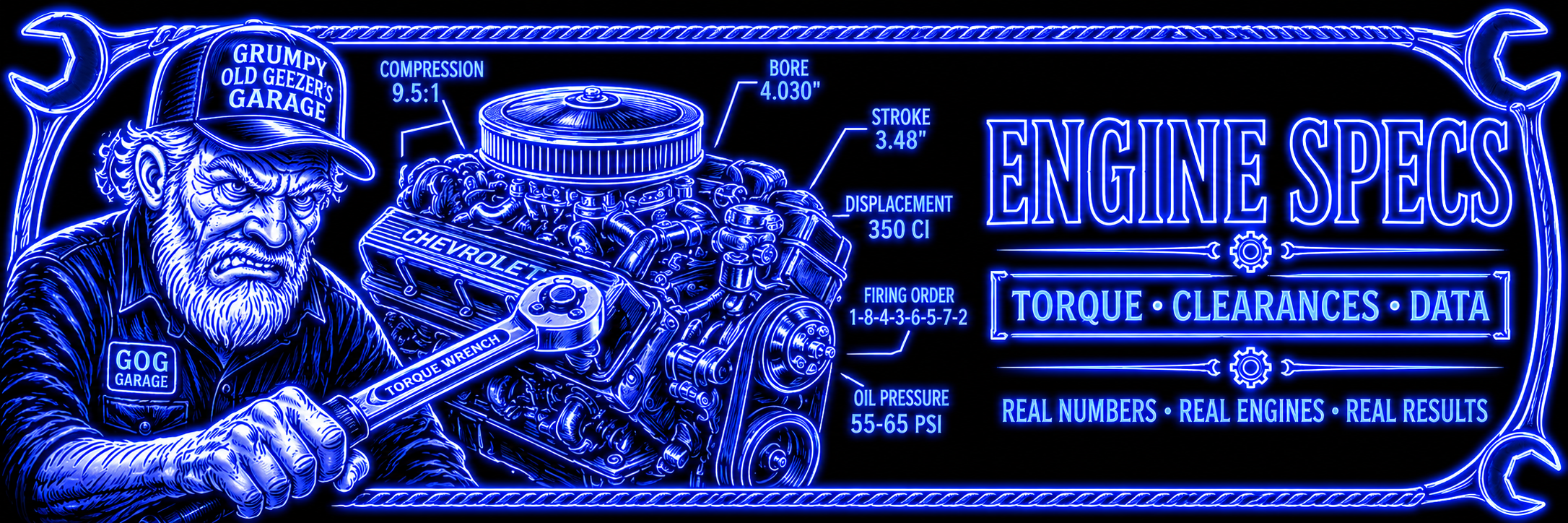
Chevy 327 Engine Specs
On This Page:
Engine Details: General Specs | Variants | Key Notes
Final Word: Bottom Line
Related: Related Links

Intro
➤ See the Family Page for specs common to all engines in this family.
The Chevy 327 arrived for 1962 and hit one of those combinations engineers spend years looking for and hot rodders spend decades arguing about. Chevrolet took the small block out to a 4.000-inch bore, gave it a 3.250-inch stroke, and ended up with enough cubic inches to make real torque without losing the quick, eager personality that had made the early 283 so much fun.
That bore-and-stroke combination is the heart of the 327. The 4.000-inch bore gave the cylinder heads more room to breathe than the smaller-bore 283 and 307. The 3.250-inch stroke added useful displacement without turning the engine into a long-stroke torque motor. A good 327 feels willing. It pulls harder than a 283, still likes rpm, and does not need the extra 23 cubic inches of a 350 to justify itself.
Chevrolet also gave the 327 one of the broadest performance ranges of the early small-block era. Mild passenger-car versions handled ordinary street duty. Stronger four-barrel engines added enough compression, airflow, and camshaft to make the displacement genuinely lively. L79-style hydraulic-cam engines delivered serious street performance without requiring solid-lifter maintenance. L76 and L84 versions moved into the expensive end of the neighborhood with solid lifters, more rpm, and, in the L84, Rochester mechanical fuel injection.
That range is exactly why the 327’s reputation causes trouble now. A plain two-barrel passenger-car 327 is still a real 327. It is not automatically an L79, a 365-horse solid-lifter engine, a fuel-injected Corvette jewel, or anything else the seller remembered after checking auction prices.
The famous versions earned the reputation. High-compression 327s with serious heads, camshafts, four-barrel induction, or mechanical fuel injection could make impressive power without big-block displacement or weight. Chevrolet offered factory ratings that climbed through 300, 340, 350, and 365 horsepower, with the fuel-injected L84 reaching 375. That was plenty of evidence that a small block did not need 400 cubic inches to become unpleasant company.
The 327 also sits in a useful middle ground mechanically. It has more torque reserve than a 283 and considerably more breathing room than a 307, yet it retains a shorter stroke than the 350. That is why people still describe a good 327 as crisp or eager. Some of that is nostalgia. Enough of it is bore, stroke, airflow, and rpm that the nostalgia did not appear from nowhere.
There are limits. A 327 still has less displacement than a 350, so it cannot cover lazy gearing, a mismatched camshaft, weak compression, or oversized ports quite as easily. Build one around the idea that rpm will fix everything and a heavy street car can feel sleepy until the engine finally reaches the part of the tachometer where the parts start agreeing with each other.
The long production span also means not every 327 follows identical bottom-end rules. Early versions used the small-journal crankshaft dimensions associated with the first generations of the small block. Later versions moved to larger main and rod journals. That does not make one automatically better. It makes “327 crank” insufficient information when the parts counter starts asking questions.
Today the 327 makes sense for more than restoration. It is still an excellent displacement for a responsive street small block when the car, gearing, compression, heads, and camshaft are chosen around its personality. A 350 may usually be cheaper horsepower. That does not make it more interesting.
The 283 proved the small block could perform. The 350 eventually became the universal answer. The 327 lived between them and found something neither one quite duplicated: enough cubes to hit hard, enough bore to breathe, and just enough stroke to keep acting like it wanted another thousand rpm.
↑ Back to the Top, Before the Casting Numbers Start Lying

Overview
The 327 joined the Chevrolet lineup for 1962 at exactly the right point in small-block development. The basic architecture had already been proven by the 265 and 283, Chevrolet understood how to make the little V8 breathe, and the performance market was demanding more power. Instead of abandoning the compact engine for something physically larger, Chevrolet simply gave the existing design more room to work.
The important change was the bore. Chevrolet opened it to 4.000 inches and paired it with a 3.250-inch stroke, producing 327 cubic inches. That four-inch bore became one of the most useful dimensions in small-block Chevrolet history because it provided substantially better room around the valves than the 3.875-inch bore used by the 283 and later 307.
The stroke was equally important. At 3.250 inches, it added enough crank leverage and displacement to make the 327 noticeably stronger in the middle of the rpm range without pushing the engine toward the longer-stroke personality the 350 would later have. That combination is why the 327 developed its reputation as an engine that could make respectable torque and still feel enthusiastic when the tachometer started climbing.
Chevrolet did not reserve that displacement for one kind of buyer. Ordinary passenger-car 327s were built with mild compression, conservative camshafts, simple carburetion, and normal street manners. They were smooth, useful V8s rather than disguised race engines. Those versions matter because they kept the production lines busy while the high-performance combinations built the reputation.
The stronger four-barrel engines showed what the basic dimensions could do with better breathing and compression. Chevrolet offered several street-performance combinations that retained reasonable manners while producing considerably more power than the ordinary passenger engines. The 327 did not need exotic hardware to feel good. A well-sorted four-barrel version with decent compression and gearing already had plenty of personality.
The L79 became one of the best examples of that middle ground. It combined serious performance with a hydraulic camshaft rather than requiring the valve-lash routine of Chevrolet’s more radical solid-lifter combinations. That made it an unusually effective street package: enough cam, compression, airflow, and rpm to earn a reputation without requiring the owner to act like he had qualified for Daytona every time the hood came up.
Above that sat the solid-lifter engines. The L76 moved the 327 farther toward high-rpm performance with more aggressive cam timing and the hardware to support it. These were not simply mild passenger engines with different air-cleaner decals. They were combinations built around higher engine speed, stronger breathing, and considerably less concern for quiet operation.
The L84 mechanical-fuel-injection engine sat at the top of the factory 327 ladder. With Rochester mechanical fuel injection, high compression, serious cylinder heads, solid lifters, and performance calibration, it carried a 375-horsepower rating and became one of the defining Chevrolet small blocks of the 1960s.
That fuel-injection system deserves period context. This was mechanical injection, not modern electronic fuel injection with sensors correcting mixture every few milliseconds. Proper adjustment mattered. Temperature, condition, calibration, and knowledgeable maintenance mattered. When everything was right, it was impressive technology. When everything was wrong, a carburetor started looking wonderfully simple.
The performance ladder is why horsepower claims need evidence. Chevrolet built 327s carrying ratings around 300, 340, 350, 365, and 375 horsepower, but those numbers represented different combinations of compression, camshaft, heads, induction, exhaust, and application. They were not one identical engine with progressively more optimistic advertising departments.
Nor should those gross-horsepower ratings be compared blindly with later net ratings. The famous 327 numbers belong to the gross-rating era, when published horsepower was measured under very different conditions from the installed net ratings that became standard later. The engines were legitimately strong. The measuring stick changed.
The 327 also evolved underneath as production continued. Early engines used small-journal crankshafts with roughly 2.300-inch main journals and 2.000-inch rod journals. Later versions moved to approximately 2.448-inch mains and 2.100-inch rod journals as Chevrolet standardized around the larger-journal small-block bottom end.
That change creates one of the practical traps in modern rebuilding. Early and late 327 cranks, rods, bearings, and blocks cannot be sorted correctly by displacement alone. A pile of parts can all be “327 stuff” and still fail to belong together. Chevrolet changed details while keeping the same cubic-inch number on the air cleaner.
The cylinder heads vary just as much by purpose. Mild passenger engines did not need the same ports, valves, springs, or combustion chambers as the serious performance versions. A 327 block therefore establishes displacement. It does not establish horsepower. The rest of the hardware has to finish the sentence.
That becomes especially important with Corvette claims. High-performance Corvette engines are valuable enough that ordinary blocks have spent decades developing remarkable memories. Correct-looking finned valve covers, aluminum intakes, fuel-injection units, and other desirable parts can all be added later. Hardware is evidence. It is not a birth certificate by itself.
The 327 also appeared in enough other Chevrolet applications that assuming every one came from a Corvette is nonsense on stilts. Chevrolet built large numbers of ordinary 327s because the displacement made an excellent general passenger-car engine. The glamorous versions were the minority that made everybody remember the number.
For a street build, the 327 rewards restraint more than people expect. Its 4.000-inch bore gives it good cylinder-head choices, but 327 cubic inches still need port volume and valve size matched to actual demand. Huge runners can sacrifice the velocity that gives the engine its crisp response, especially below the rpm range where a street car spends most of its life.
Camshaft choice works the same way. The 327 can tolerate considerably more cam than a little 283, especially with compression and gearing to support it, but there is still no prize for installing more duration than the car can use. A big cam, tall rear gears, low compression, and an automatic transmission can turn a famously responsive engine into something that sounds angry while waiting for permission to move.
A sensible combination keeps the engine’s best traits intact: enough compression, cylinder heads sized for the displacement, a camshaft matched to gearing and vehicle weight, properly sized induction, good exhaust, and an ignition curve that actually belongs there. The result can be one of the nicest street personalities in the Gen I family.
The comparison with the 350 is unavoidable because both use a 4.000-inch bore. The difference is stroke: 3.250 inches for the 327 and 3.480 for the 350. The 350 therefore has more displacement and usually more low- and midrange torque. It is more forgiving in heavy cars and easier to make power with cheaply.
The 327 answers with a little less reciprocating travel and a personality that rewards rpm. That does not mean every 327 automatically revs higher than every 350. Camshaft, valvetrain, rotating assembly, heads, and preparation decide safe engine speed. Bore and stroke create tendencies. They do not issue permission slips.
By 1969 the 350 was taking over more of Chevrolet’s small-block workload, and the 327’s production run ended. That did not happen because the 327 had suddenly become obsolete or defective. The 350 simply offered more displacement in essentially the same package and made better economic sense for a growing number of applications.
What the 327 left behind was a reputation stronger than its production life. Mild versions proved it could be a perfectly civilized passenger engine. Strong four-barrel versions made excellent street power. L79 combinations became favorites because they mixed performance with usability. L76 and L84 engines showed how serious the same displacement could become when Chevrolet quit worrying about whether grandma liked the idle.
That range is the real 327 story. It was never one magical engine. It was a particularly good bore-and-stroke combination that Chevrolet could turn from ordinary transportation into one of the nastiest small blocks of its era simply by changing the hardware around it.
Same 327 cubic inches. Entirely different reasons to open the hood.
↑ Back to the Top, Before the Casting Numbers Start Lying

General Specs
| Displacement | 327 cu in / 5.4L | Bore / Stroke | 4.000 in × 3.250 in |
| Production / Use Era | 1962–1969 early Chevrolet performance and passenger-car small-block era | Bore Spacing | 4.400 in |
| Engine Family | Chevrolet Gen I Small Block | Deck Height | 9.025 in |
| Block Material | Cast iron | Rod Length | 5.700 in |
| Cylinder Head Material | Cast iron | Main Journal | 2.300 in early small-journal versions / 2.448 in later large-journal versions |
| Fuel / Induction | Carbureted or Rochester mechanical fuel injection by version | Rod Journal | 2.000 in early small-journal versions / 2.100 in later large-journal versions |
| Cam Location | In-block camshaft | Main Bearings | 5 |
| Valve Layout | OHV / pushrod, 2 valves per cylinder | Firing Order | 1-8-4-3-6-5-7-2 |
| Common Main Caps | 2-bolt or 4-bolt by block/application | Distributor Rotation | Clockwise |
| Rear Main Seal | 2-piece | Weight | ~575–600 lbs |
| Balance | Internal | Dimensions | ~28H / ~26W / ~29L |
Exact parts and specs can vary by year, application, compression, carburetion, camshaft, fuel injection setup, journal size, main-cap configuration, and rebuild history. Use these numbers as the family baseline, then verify the actual engine before buying parts, ordering machine work, or trusting a seller with a confident grin.
↑ Back to the Top, Before the Casting Numbers Start Lying

Variants
The 327 is where Chevrolet proved that one bore and stroke could cover everything from grandma’s full-size sedan to a Corvette that considered 6,000 rpm a perfectly reasonable place to spend the afternoon. Do not sort these engines by the number painted on the air cleaner. Chevrolet changed compression, heads, valves, camshafts, induction, pistons, and valvetrain hardware enough to create several genuinely different 327s.
250-hp 327 — Mild Four-Barrel
What it was: This was the original civilized 327. Chevrolet wanted the extra torque and breathing room of the new 4.000-inch bore and 3.250-inch stroke without making every buyer adjust valves or buy the most expensive gasoline in town.
What changed: Compression was 10.5:1. Chevrolet used hydraulic lifters, a mild camshaft, cast-aluminum flat-top pistons, cast-iron intake, and a single Rochester 4GC or Carter WCFB four-barrel depending on year and application. It was a noticeably stronger engine than the ordinary 283 without borrowing the hard parts from the high-rpm Corvette combinations.
What that did: Chevrolet rated it at 250 gross horsepower at 4,400 rpm and 350 lb-ft at 2,800. There is the assignment in two numbers. It made its torque early, drove smoothly, and did not need a rear axle ratio that made highway travel sound like a dental drill.
Where used: The 250-hp 327 appeared beginning in 1962 Corvettes and spread into full-size Chevrolets, Chevelles, Chevy IIs, and other passenger-car applications during the early and middle 1960s.
300-hp 327 — High-Flow Street Four-Barrel
What it was: The 300-hp version was the stronger hydraulic street 327. Same basic manners as the 250, but Chevrolet let it breathe considerably better instead of pretending fifty horsepower would crawl out of a different decal.
What changed: Compression generally remained 10.5:1 in the early version. Chevrolet used larger-port heads with 1.94-inch intake and 1.50-inch exhaust valves, a larger-capacity Carter AFB, a better-flowing cast-iron intake, and freer dual exhaust. The camshaft remained hydraulic and comparatively mild. Late versions evolved with changing carburetion and compression, including the 10.0:1 300-hp Corvette combination for 1968.
What that did: The early engine made 300 gross horsepower at 5,000 rpm and 360 lb-ft at 3,200. Better heads, carburetion, and exhaust moved the breathing ceiling upward without turning the engine into a cantankerous solid-lifter piece. This is the sort of 327 that built a lot of the engine’s street reputation while the expensive versions were busy getting magazine covers.
Where used: 300-hp 327s appeared in Corvettes, full-size Chevrolets, Chevelles, and Chevy IIs through much of the 1960s.
LF7 — 210-hp Two-Barrel 327
What it was: By 1967 Chevrolet also had a 327 for buyers who wanted eight cylinders without making a hobby out of buying premium fuel. The LF7 was the late, regular-fuel, two-barrel version.
What changed: Compression dropped to about 8.75:1. Chevrolet used small-port heads with 1.72-inch intake and 1.50-inch exhaust valves, cast flat-top pistons, hydraulic lifters, the general-performance camshaft, a cast-iron intake, and Rochester two-barrel carburetion.
What that did: Output fell to 210 gross horsepower, but that number needs to quit sulking. The LF7 was built for regular fuel, smooth idle, easy starting, and low-speed passenger-car work. It did that perfectly well. It simply had no intention of impersonating an L79 after supper.
Where used: LF7 327s appeared prominently in 1967–69 Camaros and other late passenger-car applications.
L30 — 275-hp Street-Performance 327
What it was: The L30 sat between the grocery-getter LF7 and Chevrolet’s expensive high-performance engines. This was the later 327 for somebody who wanted some snap without signing up for solid lifters and racing manners.
What changed: The later L30 used roughly 10.0:1 compression, 1.94/1.50-inch-valve double-hump heads, hydraulic lifters, a .390-inch intake/.410-inch exhaust-lift camshaft, cast-iron four-barrel intake, and a Rochester Quadrajet rated around 750 cfm. Earlier 275-hp applications differed somewhat in compression and carburetion, but the basic combination remained a higher-compression, better-breathing hydraulic street 327.
What that did: Chevrolet rated it at 275 gross horsepower at 4,800 rpm and about 355 lb-ft at 3,200. It pulled harder and farther than the LF7 without surrendering normal hydraulic-lifter manners. Put an M20 four-speed and decent gears behind one and the supposedly ordinary 327 suddenly quit acting particularly ordinary.
Where used: The 275-hp L30 appeared in Chevy II/Nova applications and became especially notable in 1967–68 Camaros.
1962–1963 L76 — 340-hp Solid-Lifter 327
What it was: Now the Geezer puts the sensible shoes back on the shelf. The early L76 was Chevrolet’s serious carbureted 327, built from the same basic high-performance foundation as the fuel-injected engine but with a big four-barrel on top.
What changed: Compression jumped to 11.25:1 with forged pistons. Chevrolet used a forged-steel crankshaft, high-flow heads, mechanical lifters, the famous Duntov “097” solid cam, an aluminum intake, and a large Carter AFB four-barrel. This was not the 300-hp engine with the idle screw turned another quarter-turn.
What that did: Output reached 340 gross horsepower at 6,000 rpm with roughly 344 lb-ft at 4,000. Notice where everything moved. Less interest in making its point at 2,500 rpm, much more enthusiasm once the tach got serious. The solid cam and high compression expected premium fuel, valve adjustment, and an owner who understood why Chevrolet installed a tachometer.
Where used: The 340-hp solid-lifter 327 was a 1962–63 Corvette performance engine.
1962–1963 L84 — 360-hp Fuel-Injected 327
What it was: Take the early high-compression solid-lifter 327, remove the carburetor, and let Rochester mechanical fuel injection handle the feeding. That was Chevrolet’s top 327 for 1962–63.
What changed: The L84 shared the 11.25:1 compression, forged performance bottom end, high-flow heads, and Duntov mechanical cam with the 340-hp engine. Rochester Ramjet mechanical fuel injection replaced the Carter four-barrel and aluminum carburetor intake.
What that did: Chevrolet rated it at 360 gross horsepower at 6,000 rpm and roughly 352 lb-ft at 4,000. The injection supplied excellent mixture distribution and throttle response while letting the high-rpm hardware use the airflow it had been built for.
Where used: The 360-hp L84 was offered in 1962–63 Corvettes and became mandatory equipment with the original 1963 Z06 performance package.
1964–1965 L76 — 365-hp Solid-Lifter 327
What it was: Chevrolet did not get another twenty-five horsepower in 1964 by finding a more optimistic advertising department. The L76 received a meaningful hardware revision and became the sharpest carbureted production 327 of the era.
What changed: Compression settled at 11.0:1. Chevrolet moved to 2.02-inch intake and 1.60-inch exhaust valves, substituted the more aggressive “30-30” mechanical cam with roughly .485-inch valve lift, redesigned the aluminum intake, and replaced the Carter with a Holley four-barrel in the roughly 585-cfm class. Forged pistons and the forged-steel crank remained part of the performance foundation.
What that did: Output rose to 365 gross horsepower at 6,200 rpm. Below about 3,000 rpm, a milder 327 could make more sense. Above that, the L76 started explaining why close-ratio four-speeds and deep rear gears had been invented. Chevrolet traded some civility for considerably more enthusiasm upstairs.
Where used: The 365-hp L76 appeared in 1964–65 Corvettes and selected Chevrolet performance applications.
1964–1965 L84 — 375-hp Fuel-Injected 327
What it was: This was the top of the production 327 pile. Same serious solid-lifter foundation as the 365-hp L76, but Rochester mechanical fuel injection went back on top.
What changed: The L84 used 11.0:1 compression, forged pistons and crankshaft, 2.02/1.60-inch-valve heads, the “30-30” solid cam, and Rochester mechanical injection instead of the Holley carburetor.
What that did: Chevrolet rated it at 375 gross horsepower at 6,200 rpm and 350 lb-ft at 4,600. That torque peak is nearly halfway to the moon compared with an ordinary passenger-car engine. This thing wanted rpm, and Chevrolet gave it the hardware to live there.
Where used: The 375-hp L84 was offered in 1964–65 Corvettes. Mechanical fuel injection disappeared from regular Corvette production after 1965, closing one of the best chapters in early small-block history.
Identification caution: A Rochester fuel-injection unit is worth enough money to have developed legs sometime during the Johnson administration. It can be installed on another 327, just as heads, cams, and intake pieces can migrate. A factory L84 claim needs the block stamping, dates, heads, valvetrain, injection unit, and vehicle documentation to agree before anybody starts pricing the plumbing like jewelry.
L79 — 350-hp Hydraulic High-Performance 327
What it was: The L79 may be the 327 the Geezer would actually take home. Chevrolet borrowed most of the serious breathing hardware from the solid-lifter engines, then installed a hydraulic cam so the owner could spend Saturday driving instead of crawling around with feeler gauges.
What changed: Compression was 11.0:1 with forged pistons. Chevrolet used a forged-steel crankshaft, 2.02/1.60-inch-valve heads, an aluminum dual-plane intake, Holley four-barrel around 585 cfm, and the special hydraulic cam with approximately .447-inch lift on both intake and exhaust. That cam was much hotter than the ordinary 300-hp hydraulic grind but still eliminated regular valve-lash adjustment.
What that did: Chevrolet rated it at 350 gross horsepower at about 5,800 rpm and 360 lb-ft. It gave away very little useful street performance to the solid-lifter L76 while providing a broader, friendlier power band. Somebody at Chevrolet finally figured out that going fast and adjusting valves did not have to be the same hobby.
Where used: The L79 debuted for 1965, appearing in Corvette and Chevelle applications, became particularly famous in the 1966 Chevy II, and continued in selected Chevrolet applications through 1968.
One more parts-counter trap belongs here. Early 327s used the original small-journal crankshaft dimensions. Chevrolet moved the 327 to the larger main and rod journals for 1968, along with other block and oil-filter changes. That is a real mechanical difference when ordering cranks, bearings, and rotating parts, but it does not magically create another horsepower variant. Measure first. The parts catalog has no sympathy for nostalgia.
↑ Back to the Top, Before the Casting Numbers Start Lying

Key Notes
The 327 is dangerous territory because part of the legend is true. That’s what makes the nonsense harder to spot. A good 327 can be sharp, eager, and serious in a way that still makes people grin. But that doesn’t turn every 327 into a Corvette engine, an L79, a fuel-injected jewel, or a 365-horse screamer hiding under whatever valve covers somebody found at a swap meet.
The 327’s reputation comes from the combination, not the casting number alone. The 4.000-inch bore gave it breathing room, and the 3.250-inch stroke kept it crisp. That’s the recipe behind the engine’s personality. But compression, camshaft, heads, induction, exhaust, gearing, and vehicle weight still decide whether it feels alive or just sounds like somebody read a magazine ad from 1965.
Not every 327 was a high-output engine. Chevrolet built mild passenger-car versions, stronger 4-barrel versions, hydraulic-cam street engines, solid-lifter performance engines, Corvette versions, Camaro versions, and plenty of ordinary small blocks that paid the bills while the famous ones got the posters. The bore and stroke may match. The hardware may not.
Big-horse 327 claims have to bring evidence. The 300-horse, 340-horse, 350-horse, 365-horse, and fuel-injected 375-horse versions weren’t just the same engine wearing different air-cleaner decals. They used different combinations of compression, camshaft, heads, induction, exhaust, application, and documentation. A seller doesn’t get Corvette money because he learned where to buy finned valve covers. The block, suffix code, casting date, stamped pad, heads, induction, partial VIN when applicable, and vehicle context all have to agree.
Gross horsepower can’t be thrown into a modern argument without a translator. The famous 327 ratings came from the gross-horsepower era, so they’re useful for comparing period engines, not for arm-wrestling later net-rated engines on paper. The numbers aren’t fake. They just weren’t measured under the same rulebook. Mix them carelessly and you’re juggling numbers in a clean shirt.
The small-journal and large-journal split deserves attention. Early 327s used the small-journal crank architecture shared with earlier small blocks. Later 327s moved into the large-journal era alongside the 350-style bottom end. That split affects crankshafts, rods, bearings, rebuild planning, and parts ordering. “It’s a 327” isn’t enough information. The journal era has to match the parts pile.
The 327 likes matched parts. It can run strong with the right compression, cam timing, head flow, carburetion, ignition curve, exhaust, and gear. It also has less torque cushion than a 350, so oversized cams, soft compression, lazy gearing, or too much carburetor can make it act like it’s waiting for the rest of the car to show up. The 327 likes rpm, but rpm doesn’t fix a mismatched pile.
The 4.000-inch bore helps, but it doesn’t make the engine bulletproof against bad choices. Good heads, valve size, chamber shape, piston choice, camshaft, and compression still have to work together. The 327 has more breathing room than a 283, but it still won’t turn every “race inspired” catalog part into a street-friendly decision. Some parts make power. Some parts just make excuses louder.
Factory paper and real metal still have to match. Many surviving 327s have been overbored, re-cammed, re-headed, converted, restamped, swapped, rebuilt, or assembled from whatever pieces were available when somebody wanted “a 327” under the hood. The advertised factory version tells you what Chevrolet built. The engine in front of you tells you what survived, what changed, and what somebody wants you to believe.
Corvette, L79, L76, L84, and high-performance labels don’t get a free ride. Loose parts can imitate the look. Dress-up parts can imitate the vibe. Neither one proves birth history. Intakes, valve covers, carburetors, fuel-injection units, decals, and air cleaners can move around faster than the truth at a swap meet. The more valuable the claim, the less patience you should have for “trust me.”
Restoration-correct and hot-rod-correct are separate worlds. A driver build can use sensible substitutions if the parts work together and the car runs right. A restoration claim has to answer to codes, dates, stampings, heads, induction, exhaust, application, and vehicle history. A later replacement block may make a fine engine, but it doesn’t become original because somebody wants original-engine money.
The 327’s value depends on the job. In a period-correct Corvette, Camaro, Chevelle, Nova, or full-size Chevrolet, the right 327 can outrank a bigger swap because originality, documentation, and engine character carry weight. For cheap torque and easy street power, a 350 often gets there with less drama. That doesn’t make the 327 weak. It means the car, claim, and budget decide whether the smart move is preserving the jewel or building something easier.
The 327 earned its reputation. It doesn’t need fake paperwork, borrowed Corvette shine, or a seller story with three missing numbers. Build it with parts that match the displacement and rpm personality, verify the high-output claims, respect the journal-era split, and stop expecting the badge to do the camshaft’s job.
↑ Back to the Top, Before the Casting Numbers Start Lying

Bottom Line
The Chevy 327 deserves the shine it still gets. A 4.000-inch bore gives it room to breathe, the 3.250-inch stroke keeps it lively, and the right combination can feel sharper than a lot of engines carrying more cubic inches. It is not merely a stretched 283 or a 350 that showed up early. The 327 has its own balance of response, rpm, and torque, and that is why good ones still make people grin.
Of course, that reputation has also produced enough nonsense to fill a warehouse. Not every 327 is an L79. Not every 327 came out of a Corvette. Not every one wore fuel injection, solid lifters, or enough factory horsepower to make the neighbors complain. Chevrolet built everything from mild passenger-car engines to serious performance pieces. The cubic inches get everybody through the door. The hardware decides who gets the good chair.
That means expensive claims need expensive-quality proof. Heads, compression, camshaft, induction, suffix code, casting dates, stamped information, journal size, application, and vehicle history all have to cooperate. A seller does not get L79 money because three letters appeared in the conversation, and a fuel-injection unit sitting on top does not baptize the rest of the engine.
The 327 also still answers to physics. It may feel eager and willing, but it does not have the 350’s extra low-rpm cushion to cover a lazy combination. Too much cam, soft compression, weak gears, poor exhaust, or mismatched induction can turn a famous engine into something that spends most of its time waiting for the rest of the car to catch up.
So preserve the real high-performance engines, verify anything carrying a valuable story, and build the ordinary 327s around the crisp personality that made the displacement famous in the first place. If the goal is easy torque and forgiving power, a 350 may be the smarter answer. If the goal is a small block that feels alert every time the throttle opens, a good 327 still has plenty to say without borrowing anybody else’s legend.
↑ Back to the Top, Before the Casting Numbers Start Lying

Related Links
Torque Specs
Common Factory Pairings
Carburetors
- Carter AFB — 4-bbl
- Carter WCFB — 4-bbl
- Holley 2300 — 2-bbl
- Holley 4150 — 4-bbl
- Holley 4160 — 4-bbl
- Holley 4175 — 4-bbl
- Rochester 2G / 2GC / 2GV — 2-bbl
- Rochester 4G / 4GC — 4-bbl
- Rochester Quadrajet — 4-bbl
Transmissions
- Muncie SM318 — 3-Speed
- Muncie SM319 — 3-Speed Overdrive
- Saginaw — 3-Speed
- Saginaw — 3-Speed Overdrive
- Borg-Warner T10 — 4-Speed
- Muncie M20 / M21 / M22 — 4-Speed
- Muncie SM420 — 4-Speed
- Muncie SM465 — 4-Speed
- New Process NP435 — 4-Speed
- Saginaw — 4-Speed
- Cast-Iron Powerglide — 2-Speed Automatic
- Aluminum Powerglide — 2-Speed Automatic
- TH350 — 3-Speed Automatic
- TH400 / 3L80 — 3-Speed Automatic